



History of the Center
A vision born in 2017
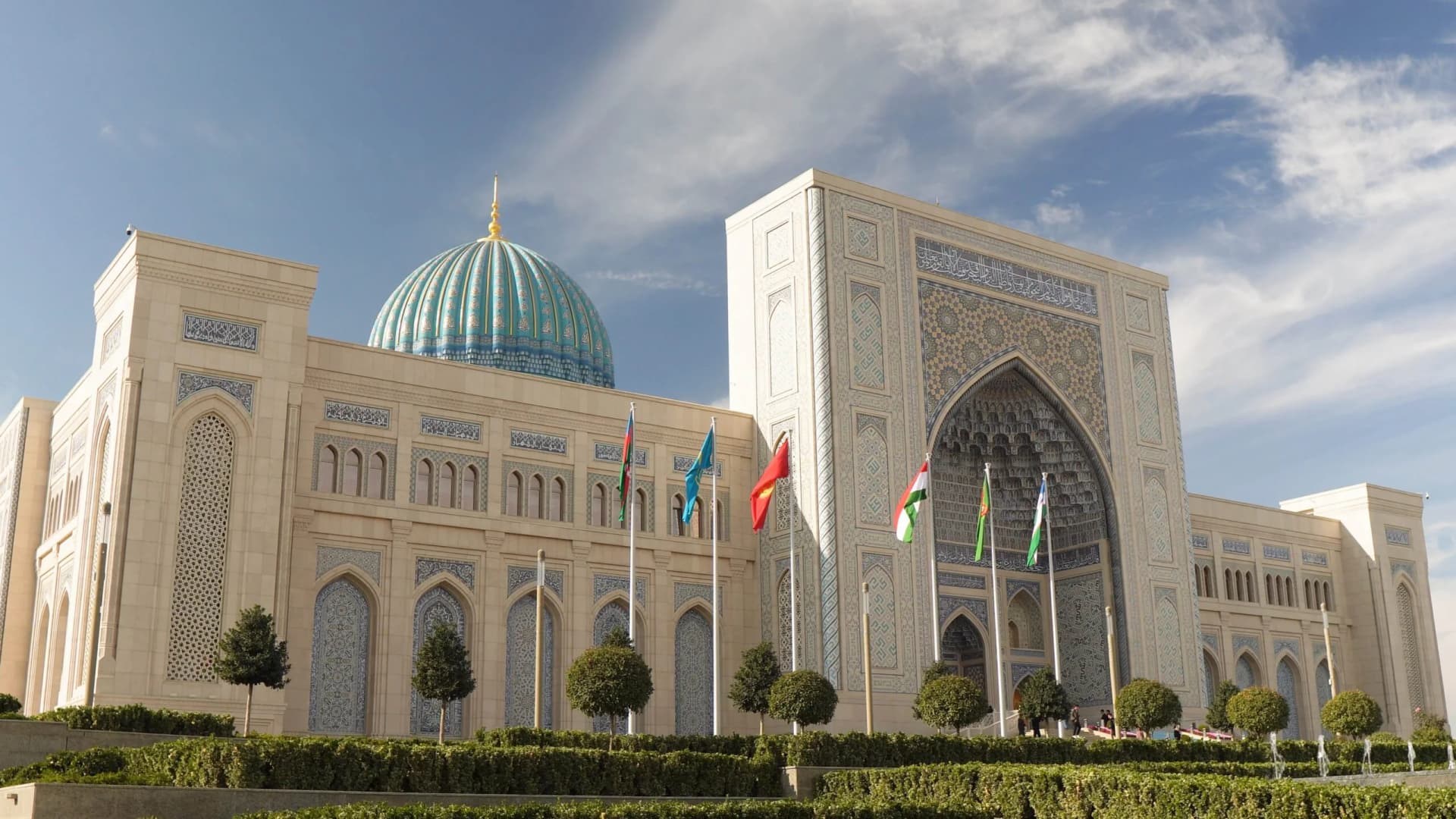
Planning for the Center was initiated by President Shavkat Mirziyoyev in 2017, as part of a national strategy to restore Uzbekistan's historical role as a stronghold of science and culture.
Key milestones
The idea of creating the Center
in 2017 – President Shavkat Mirziyoyev from the UN rostrum put forward an initiative to create the Center for Islamic Civilization in Tashkent as a scientific, cultural and educational complex.
Start of the project
Presidential Decree was adopted.
Ceremonial laying of the capsule in the foundation, start of construction in the national and Islamic architectural style.
Concept formation
Development of the scientific and museum concept "Civilization, Personality and Discovery".
Multiple meetings of the Scientific and Supervisory Boards have been held.
International cooperation
Major forums and congresses have been held with the participation of scientists from more than 30 countries. An international expert council has been formed. International organizations such as IRCICA, ICESCO, TURKSOY, Oxford Centre for Islamic Studies have joined.
Visits of the President
15 June 2018 — The foundation stone was laid; the purpose and significance of the Center were emphasized.
21 December 2018 — Construction works were reviewed; the need for in-depth study of heritage was noted.
25 June 2019 — It was emphasized that the Center should be developed as a fundamental base for scientific institutions.
20 November 2019 — Instructions were given to create the necessary conditions for local and foreign specialists to conduct research.
29 January 2021 — The building, design, and concept of the museum exhibitions were reviewed; the importance of international cooperation was noted.
8 April 2022 — The walls, arches, decorative elements, and inscriptions above the gates were reviewed; attention was paid to the content of the exposition.
29 January 2025 — Construction works and exhibits were reviewed; the importance of the Center’s scientific and educational direction and research activities was emphasized.
29 August 2025 — The final finishing and equipment works were inspected; recommendations were given to enrich the Center’s activities.
20 October 2025 — The work of widely presenting historical and spiritual heritage through exhibitions was reviewed; attention was given to scientific cooperation and personnel training.
15 November 2025 — The Presidents of Central Asia and Azerbaijan visited the Center, reviewed its main sections, and emphasized the importance of strengthening regional cooperation. On the same day, the winners of the international award “Kelajak Merosi” were honored.
Return of cultural heritage
A state commission for the return of artifacts has been established. For the first time in the history of Uzbekistan, unique artifacts were purchased and returned to their homeland. The Center's collection includes nearly 3,000 artifacts.
Role of WOSCU
The World Society for the Study, Preservation and Promotion of the Cultural Heritage of Uzbekistan (WOSCU) has carried out significant scientific and publishing work for the Center.
Modern laboratories and library
One of the largest libraries in the region (250,000 publications) has been established.
Innovation and education
Interactive screens, holograms, multimedia zones and intelligent avatars have been introduced.
International recognition
The Islamic Civilization Center in Uzbekistan, established at the initiative of the President of the Republic of Uzbekistan, Shavkat Mirziyoyev, has recently received a number of prestigious international recognitions, further strengthening its position in the global scientific and cultural arena.
In 2025, the Center was awarded the Prix Avicenne, one of Europe’s prestigious awards.
The official award ceremony took place in Paris at the building of the French National Academy of Medicine. The award was granted for the Center’s extensive scientific activities dedicated to researching and promoting the legacy of the great scholar Abu Ali ibn Sina.
According to Smithsonian Magazine, the Islamic Civilization Center has been included among the TOP-10 most anticipated museum projects in the world for 2026.
The ranking published by the Smithsonian Institution in the United States also includes well-known museums such as the Lucas Museum of Narrative Art (Los Angeles), the National Geographic Museum of Exploration (Washington), the London Museum, and Kanal – Centre Pompidou (Brussels).
According to the Prix Versailles evaluation, the Center has been included in the global list of the most beautiful museums in the world for 2026.
This ranking is formed based on criteria such as innovation, reflection of national heritage, creative approach, and environmental sustainability.
According to the organizers of the competition, the Islamic Civilization Center has not only been included in this list but has also obtained the right to compete for one of the three highest global awards to be announced at the end of 2026 — the Grand Prix Versailles or the “Interior” or “Exterior” categories. The winners are planned to be announced at the end of the year at UNESCO headquarters in Paris.
The publication BBC Travel has also listed the Islamic Civilization Center among the six most anticipated museum openings in 2026.
According to the publication, the Center will house the 7th-century Uthman Qur’an and more than two thousand rare manuscripts, and will also present history in an interactive format through the use of artificial intelligence and VR technologies.
On 26–27 September 2025, the International Experts Forum was held, and a Declaration was adopted at its conclusion.
"Through this platform, we want to consolidate the contribution of our nation to the development of science, education and culture."