



Euronews: “Associating Islam with violence contradicts its true nature”: Global Forum debates Islamic heritage
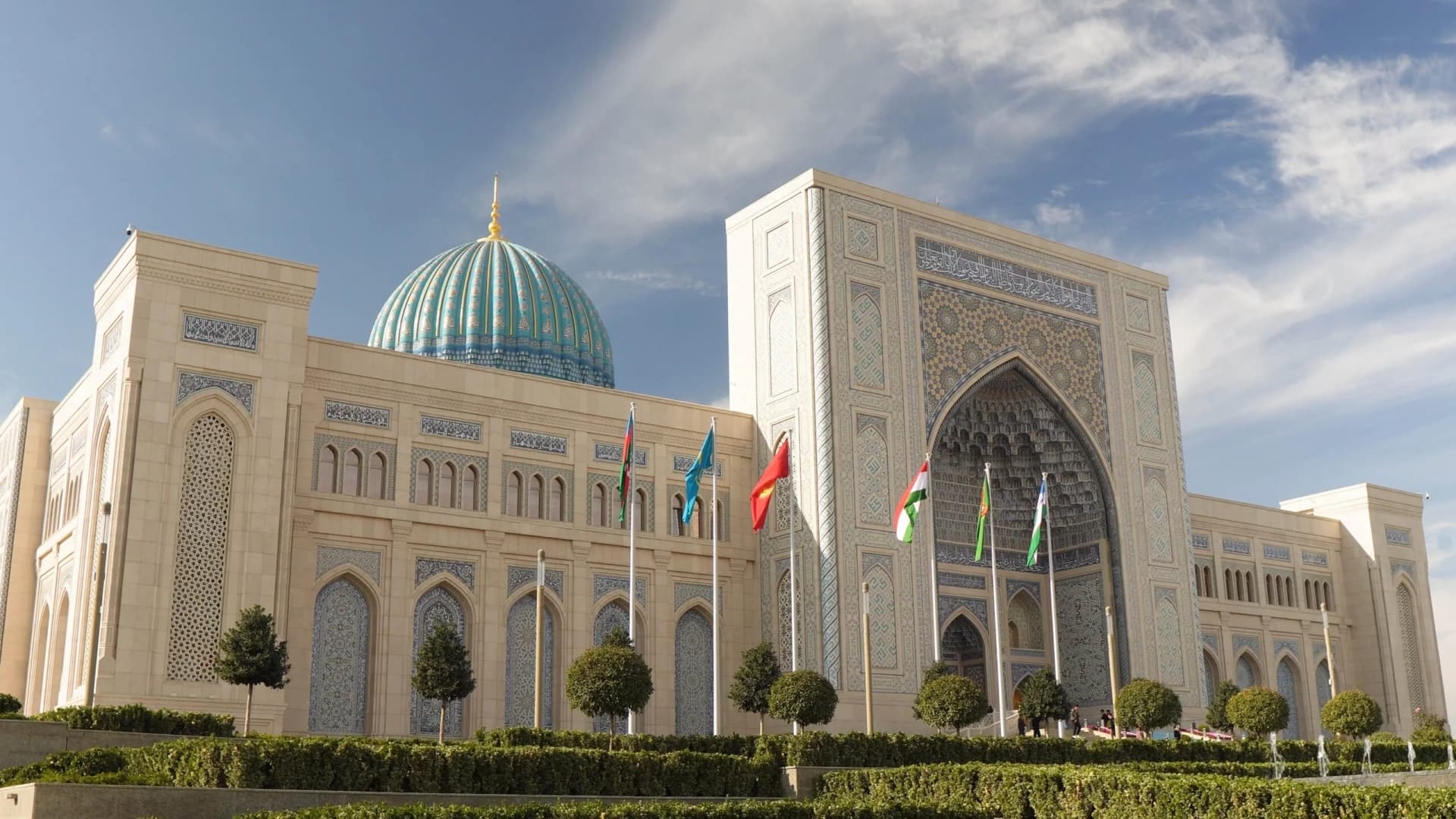
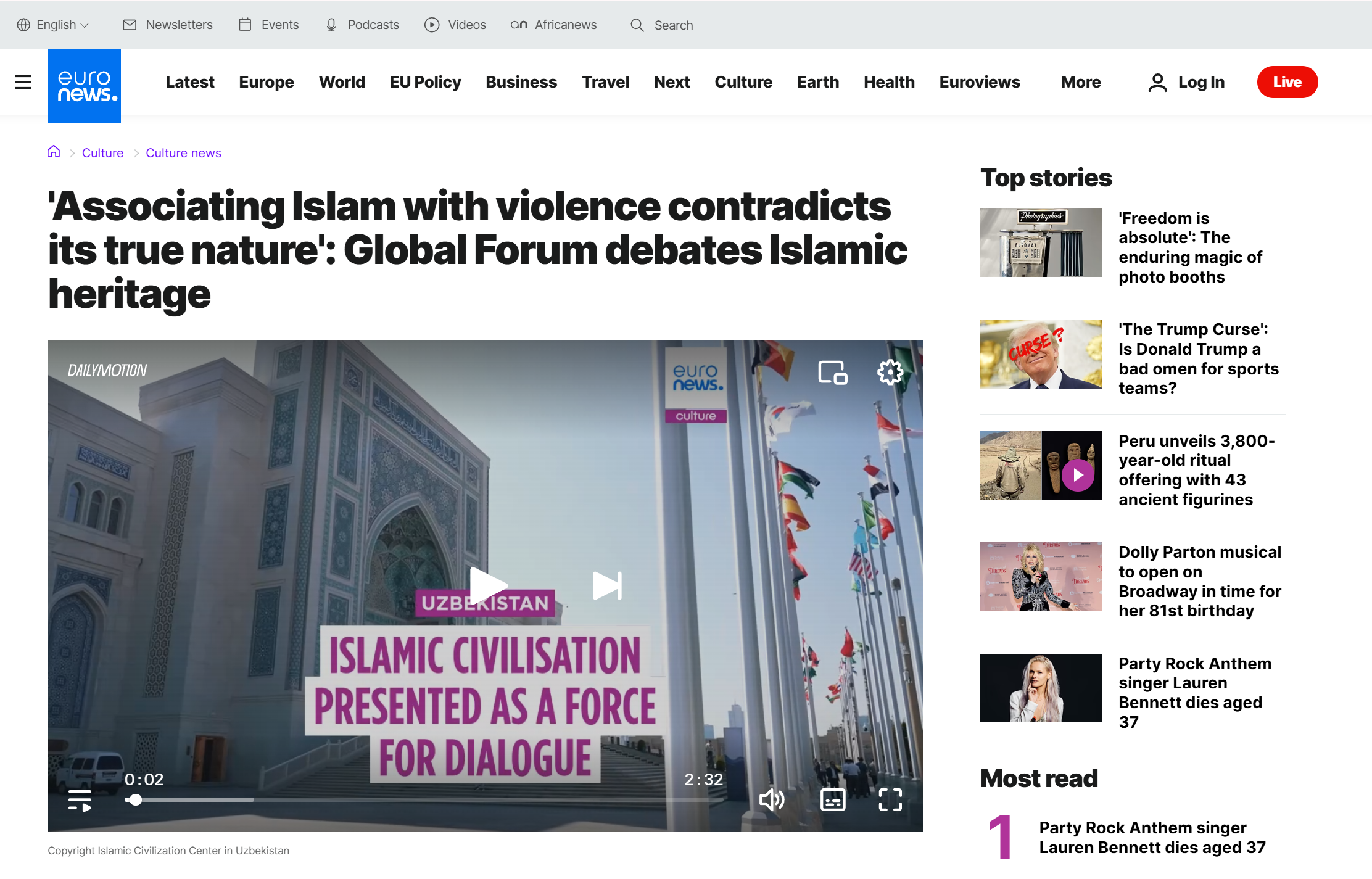 According to a feature published by the internationally renowned Euronews, the First International Islamic Civilization Forum is presented as a major global platform for reinterpreting the heritage of Islamic civilization within the context of contemporary global development. The article emphasizes that the Forum places particular focus on countering stereotypes that associate Islam with extremism and violence through a scholarly approach based on science, education, cultural exchange, and international academic cooperation. It also highlights, from an academic and analytical perspective, the strategic significance of the Forum—bringing together representatives from more than 50 countries in preserving, digitizing, and promoting the intellectual heritage of Islamic civilization while expanding collaboration with the global academic community.
More than 70 international projects were launched during the First International Islamic Civilization Forum being held in Uzbekistan. Participants called for expanding scientific cooperation, advancing education, and strengthening efforts to preserve the heritage of Islamic civilization.
Education, academic cooperation, and cultural exchange are being promoted as the principal instruments of dialogue and solidarity throughout the Forum. Scholars and officials gathered in Uzbekistan are discussing the role and significance of Islamic heritage in today's global landscape.
The five-day Forum is being held in Tashkent, Samarkand, and Termez, bringing together more than 450 scholars, religious leaders, diplomats, and researchers from over 40 countries.
Organized by the Islamic Civilization Center in Uzbekistan, the event is dedicated to the contribution of Islamic civilization to science, education, and intellectual life, as well as to fostering new forms of international academic cooperation.
In his message to the opening ceremony, President Shavkat Mirziyoyev noted that the world is currently experiencing a period of profound transformation, accompanied by conflicts, mistrust, extremism, and Islamophobia.
The President emphasized that science, education, culture, and universal moral values remain the strongest foundations for peace, dialogue, and sustainable development.
Education: A force for unity, not division
According to the organizers, one of the Forum’s principal objectives is to challenge misconceptions that associate Islam with violence or extremism by showcasing the rich scholarly heritage and scientific achievements that Islamic civilization has developed over centuries.
“The primary objective of this Forum is to once again demonstrate the immense contribution of Muslim scholars to world civilization and to show that Islam has always called for knowledge, enlightenment, and humanity,” said Rustam Jabborov, Scientific Secretary of the Islamic Civilization Center in Uzbekistan, in an interview with Euronews.
“Associating Islam with violence or extremism is fundamentally contrary to its true essence.”
A scholarly heritage that continues to shape the modern world
The discussions have placed particular emphasis on the remarkable contributions of scholars from Central Asia to the advancement of mathematics, astronomy, medicine, and philosophy, underscoring their lasting impact on global civilization.
According to Dr. Salim bin Mohammed AlMalik, Director-General of the Islamic World Educational, Scientific and Cultural Organization (ICESCO), the influence of these great scholars continues to shape the modern world.
“Without the principles established by Khwarizmi, artificial intelligence would not exist. Without Ulugbek and Biruni, astronomy would not have reached its present level. We should take pride in the great scholars of the Islamic world.”
The Forum is also exploring the application of artificial intelligence in the preservation, cataloguing, and study of manuscripts, as well as opportunities to expand academic exchanges and strengthen international scientific cooperation.
The role of science in the modern world
According to Abdul-Ati Al-Sharqawi, Chairman of the Board of the Heritage Restoration and Digital Services Foundation, which operates in London and Cairo, Uzbekistan’s scholarly legacy extends far beyond its national borders.
“This country once exported great science, literature, and creativity to the entire world,” he said.
He noted that researchers have identified nearly 100,000 manuscripts produced by scholars of Mawarannahr (Transoxiana), which are now preserved in libraries around the world. At the same time, efforts to discover additional manuscripts and historical sources continue.
Kürşad Zorlu, Deputy Chairman of Türkiye’s Justice and Development Party (AK Party), described the Forum as further evidence of Uzbekistan's steadily growing influence in both the Islamic and the Turkic world.
“Today, Uzbekistan is hosting an institution of great importance for both the Turkic and the Islamic world. The reforms implemented over the past decade are being further reinforced through the work of this remarkable institution,” he said.
“With a history spanning more than three thousand years, Uzbekistan has today become one of the major centers of Islamic civilization. In this respect, Uzbekistan holds special significance for Türkiye.”
The Forum will continue until 10 July. More than 70 joint initiatives, involving universities, museums, research institutions, and international organizations, are expected to be presented during the event.
The agenda also includes the adoption of the Tashkent Declaration, along with discussions on future cooperation in scientific research, manuscript preservation, education, and digital technologies.