
Al-Ahram Newspaper: “From Tashkent: When history poses its questions anew”
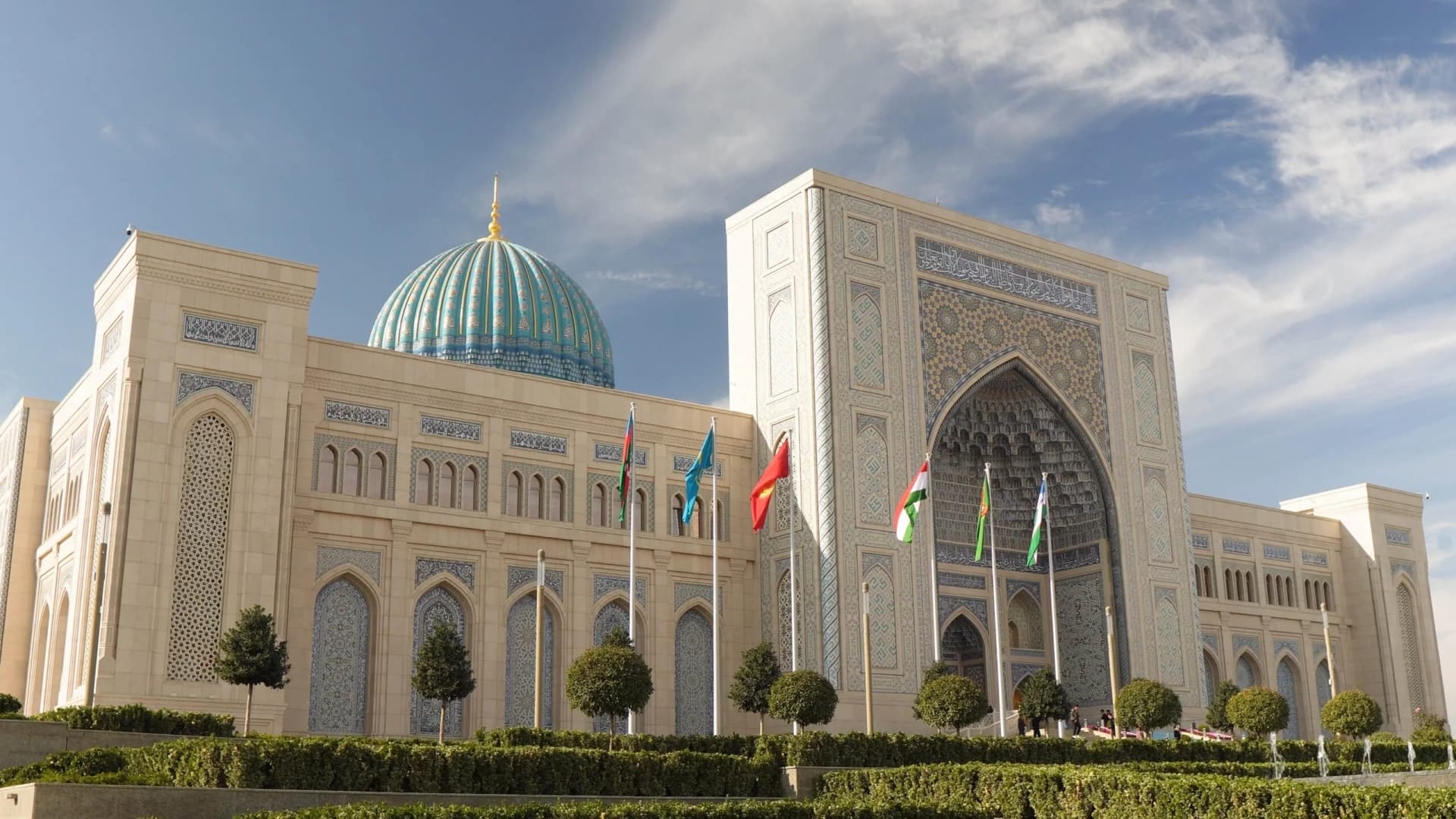
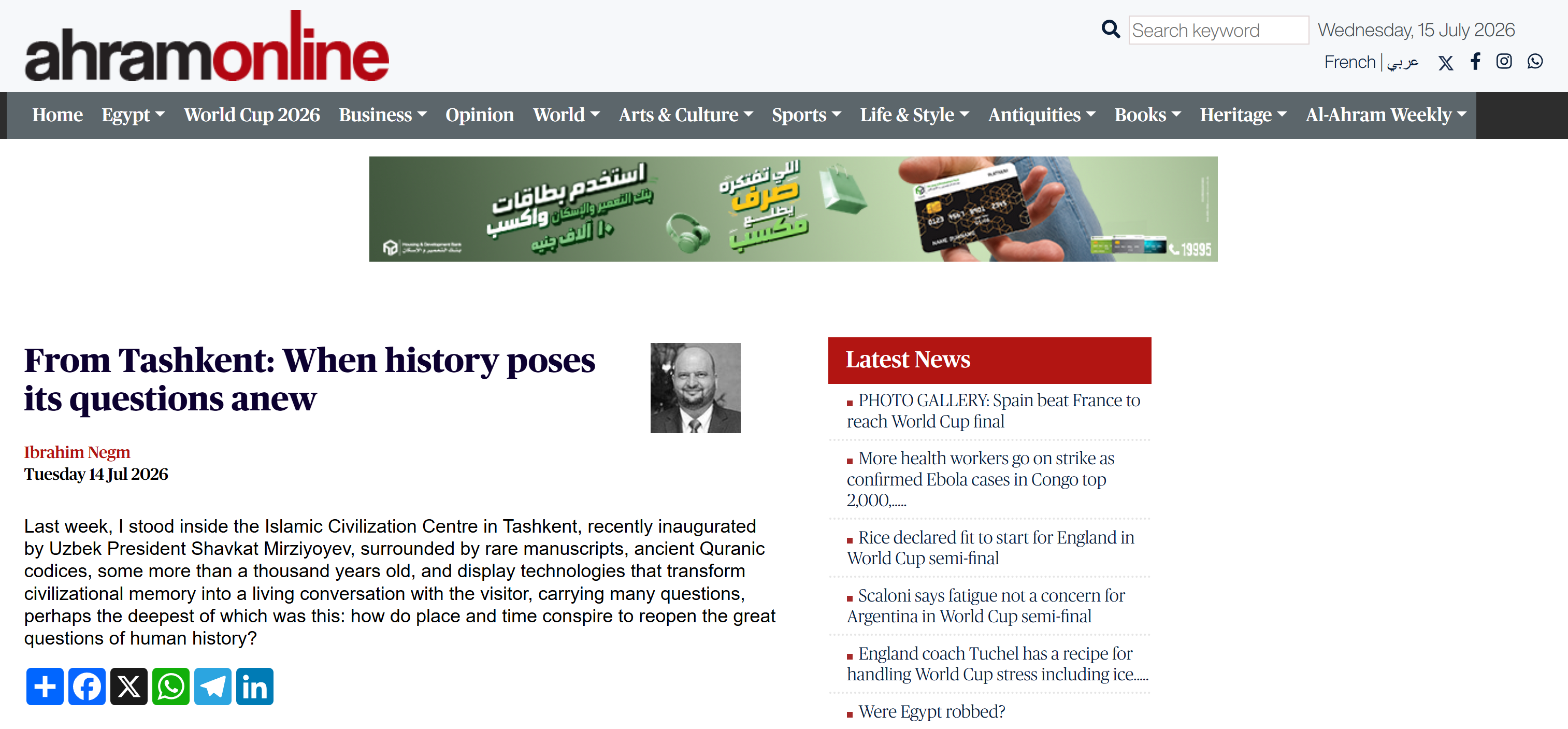 One of Egypt’s most prestigious publications, Al-Ahram, featured an article on its English-language analytical platform describing the Islamic Civilization Center in Uzbekistan as a major venue for global reflection on the past and future of Islamic civilization. Drawing on his visit to the Center, the author argues that Islamic civilization is not merely a legacy of the past, but a living civilizational project that continues to contribute to the progress of humanity. The article also highlights Uzbekistan’s efforts to present the heritage of Islamic civilization in harmony with modern science and technology, recognizing the work of the Islamic Civilization Center as a practical embodiment of a new intellectual awakening and the vision of the Third Renaissance.
Last week, I visited the Islamic Civilization Center in Uzbekistan, recently inaugurated by the President of the Republic of Uzbekistan, Shavkat Mirziyoyev. As I walked among rare manuscripts, Qur’ans dating back more than a thousand years, and advanced technologies that transform the memory of civilization into a living dialogue with every visitor, many questions arose in my mind. Above all, one question stood out: How do place and time bring humanity’s greatest questions back to the forefront of history?
Nearly three decades ago, I was a student at Harvard University when Samuel Huntington's name dominated lecture halls and academic debate alike. His thesis on the “Clash of Civilizations” was actively shaping Western political consciousness and its vision of the world to come: a world governed by separation, rivalry, and conflict between civilizational blocs, in which Islam occupied the position of the most problematic competitor in the eyes of the Western academic establishment.
I listened, read, and argued, and within me there was a quiet but firm conviction that something was fundamentally flawed at the heart of that thesis. It described a civilization that was dead, or at best frozen in time, whereas the Islamic civilization I knew was neither.
Then came 11 September, unleashing an enormous negative energy in Western consciousness directed at Islam and Muslims. Academic pages and media platforms became the stage for a recycled question, varied in form but identical in essence: What went wrong with Islam?
The religion itself was placed under investigation, as though the real culprits, accumulated historical wounds, colonial legacies, and the structural inequities of the international order, were irrelevant. What unsettled me most in that period was not the question itself, but the way it had been hollowed of depth and overloaded beyond what it could bear, transforming from a critical diagnosis into an implicit indictment.
A decade passed, and what came to be called the Arab Spring wrote a new chapter in the narrative of “the failure of political Islam.” We are still living with the consequences of that bitter experience, which added a particularly dangerous dimension through the widespread conflation of Islam as a religion and a civilization with political Islamist movements that reduced the entire tradition to a contest for power.
From these three waypoints in recent history, I return to Tashkent and find there something resembling an indirect answer to all those questions. Not a defensive answer, and not a fortified discourse that meets accusation with counter-accusation, but an answer from an entirely different logic.
This building, standing proudly in the heart of a capital that was once a pillar of Islamic intellectual civilization, declares through its scale, architecture, and contents that this civilization was never severed, and its human project has never been closed.
The real dilemma, in truth, was never in Islam itself. It lay in the widening gulf, across recent centuries, between Islam as a rich and integrated civilizational system and the lived reality of Muslims in many of their societies. A civilization that produced Ghazali, Ibn Rushd, Ibn Sina, Ibn Khaldun, and Biruni, all from the very civilizational space at whose heart Tashkent stands, cannot plausibly be said to carry within itself the seeds of its own contemporary crises.
The revival that is needed today begins with rebuilding the human being: a person who combines a rooted sense of identity with an open and inquiring mind, who draws from a great heritage to face new questions, not to hide behind inherited answers, nor to abandon them. That revival passes through genuine scholarly institutions that respect the intellect, produce knowledge, and manage disagreement with civility and evidence. It is crowned by the great Islamic values: justice, mercy, excellence, and the dignity of the human person, values that are not hung on walls but translated into policy, law, and daily conduct.
In that hall in Tashkent, where the Uthmanic Quran rests within walls that hold history and technology in the same embrace, I did not find a portrait of Islamic civilization as a civilization of the past. I found a possibility for the future instead.
I saw an image of what we can be when we move beyond the false binary of isolation and dissolution, neither sealing our doors against the world nor flinging them open so wide that we lose ourselves in the process. Instead, we engage confidently with who we are and what is unfolding around us.
From Tashkent, there is a message that deserves to be heard: that Islamic civilization does not need defenders nearly as much as it needs builders, rebuilding it step by step, institution by institution, and generation by generation.