
35 years of independence and a new intellectual turning point
 In September 2017, speaking from the rostrum of the UN General Assembly, President of Uzbekistan Shavkat Mirziyoyev stated that the use of force alone was not sufficient to counter terrorism and extremism, drawing attention to ignorance and intolerance as among their root causes. The President firmly rejected attempts to equate Islam with violence and bloodshed and called on the international community to focus on the humanitarian essence of the religion. Nine years later, as independent Uzbekistan approaches the 35th anniversary of its independence, this idea is becoming a practical direction of state policy through the dramatic expansion of access to education, the establishment of scholarly and educational institutions, and the emergence of new centers such as the Islamic Civilization Center in Uzbekistan.
A new perspective on independence
There are certain anniversaries that serve not only as occasions for celebration but also as opportunities to reassess the path that has been traveled.
Uzbekistan is approaching the 35th anniversary of its state independence. This period can be measured in terms of economic indicators, new infrastructure, cities, or state institutions. Yet one of the most profound transformations taking place in the country can be seen in people’s attitudes toward knowledge, history, and the future.
A call from the Un rostrum
One of the most significant international milestones of this policy came on September 19, 2017, in New York. In his first address to the 72nd session of the UN General Assembly, President Shavkat Mirziyoyev, speaking about the threats of terrorism and extremism, emphasized that an approach relying primarily on the use of force had proved ineffective.
The President identified ignorance and intolerance among the factors that fuel radicalism. At the same time, he rejected attempts to associate Islam with violence and stressed the need to convey its humanitarian essence to the international community.
It was from this very rostrum that Shavkat Mirziyoyev proposed that the UN General Assembly adopt a special resolution entitled “Enlightenment and religious tolerance.” Its key objectives included expanding access to education and addressing illiteracy and ignorance.
Just over a year later, on December 12, 2018, the UN General Assembly adopted the resolution “Enlightenment and religious tolerance.”
From this perspective, “Enlightenment against ignorance” has become more than a moral and educational motto for Uzbekistan. It has evolved into a policy approach that defines the interconnection between security, youth policy, religious tolerance, and education.
From an idea to institutions
Another important aspect of the 2017 UN address was that Uzbekistan did not merely call on the international community to embrace enlightenment and education. The country also outlined plans to translate this approach into practical institutions at home.
The initiatives to establish the Imam Bukhari International Scientific Research Center and the Islamic Civilization Center in Tashkent were presented as part of this policy.
When the foundation stone of the Islamic Civilization Center was laid in 2018, the President linked its core mission to studying the legacy of great ancestors, educating younger generations, advancing science and culture, and establishing the principle of “Enlightenment against ignorance.”
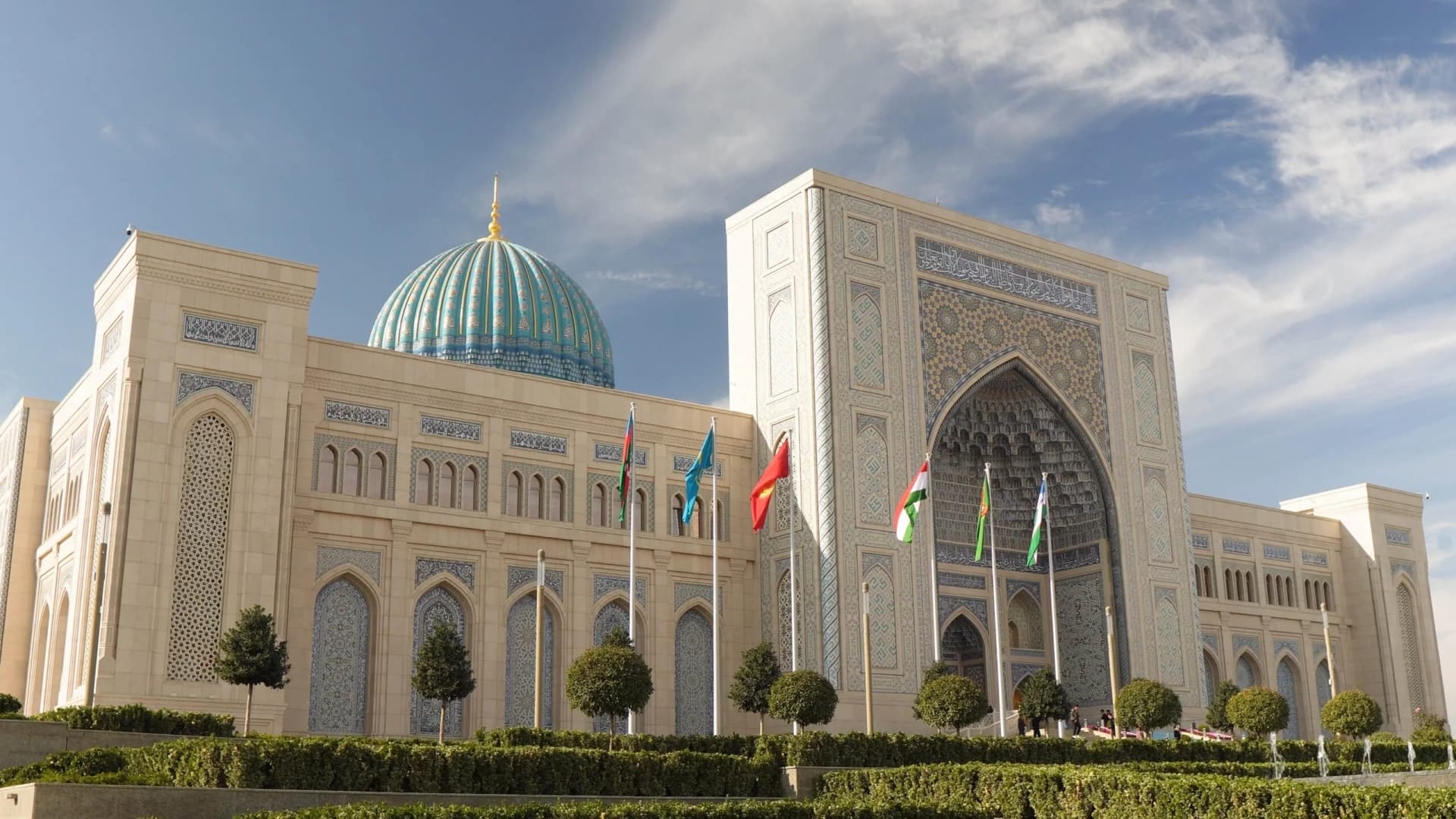
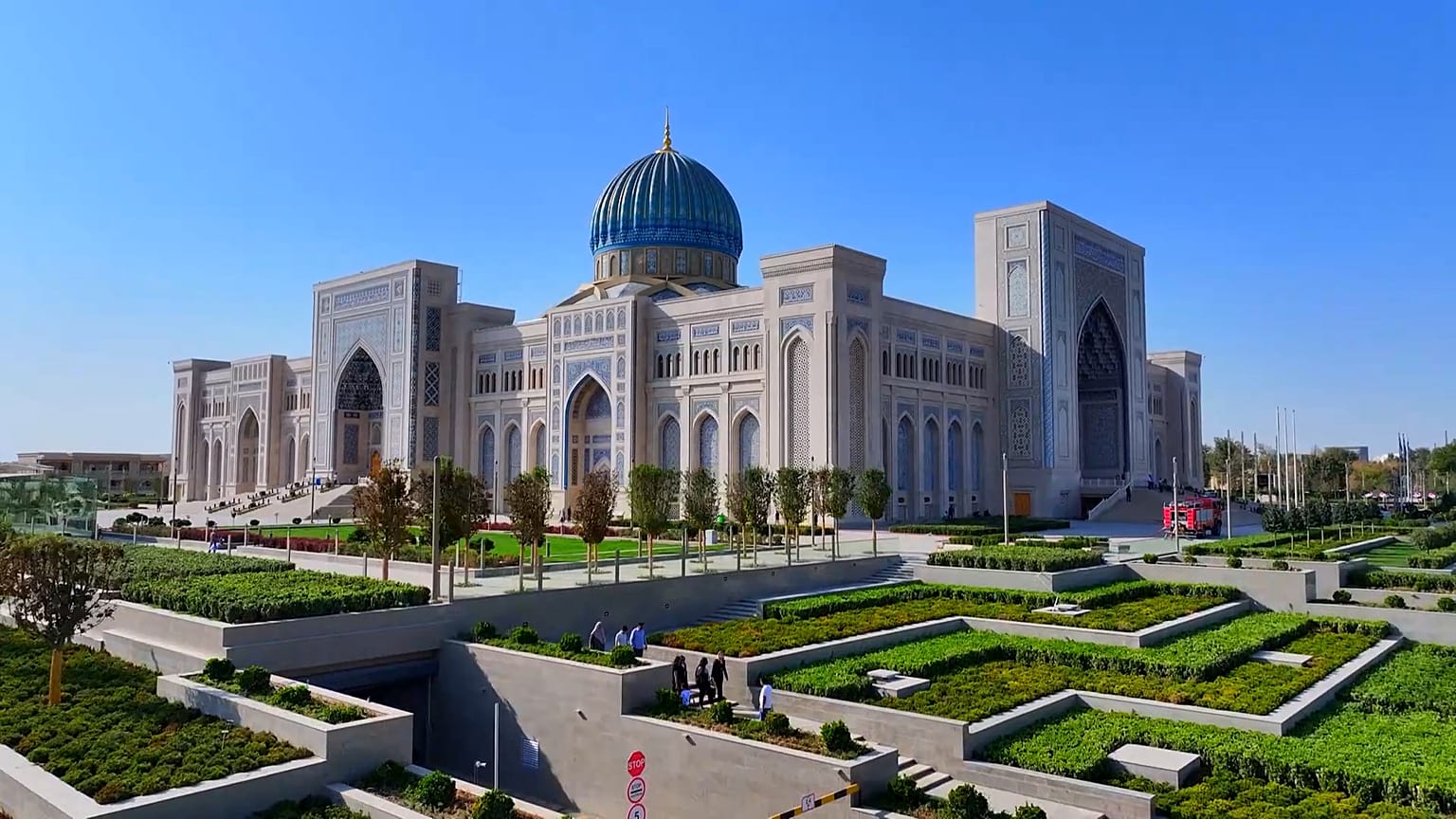
Eight years later, on March 17, 2026, the Center was officially opened.
Thus, by 2026, the idea articulated from the UN rostrum in 2017 had taken tangible form as a major scholarly and educational institution in the heart of Tashkent.
History across 50,000 square meters
The Islamic Civilization Center is located on a site of nearly 10 hectares, with a total usable area of 50,000 square meters. Its significance, however, extends far beyond the scale of the building itself. The Center features major exhibition sections devoted to the pre-Islamic period in the territory of Uzbekistan, the First and Second Renaissances, and “New Uzbekistan — the Foundation of the Third Renaissance.” The Center’s main hall houses one of the world’s oldest surviving copies of the Qur’an — the Uthman Mushaf.
The Center brings together ancient manuscripts, archaeological finds, historical maps, and other cultural treasures with modern museum technologies. This approach is not merely about displaying history. It is aimed at studying and digitizing historical heritage, bringing it into scholarly circulation, and transmitting it to new generations.
Here, the political concept and the museum concept converge at a single point: Islamic civilization is presented as a history of knowledge.
Islamic Civilization — more than the history of religion
For centuries, Central Asia was a region where major scholarly traditions developed in mathematics, astronomy, medicine, geography, philosophy, hadith studies, and other fields.
Khwarizmi’s legacy in mathematics, Abu Rayhan Biruni’s research in the natural and exact sciences, Ibn Sina’s contributions to medicine, Mirzo Ulugbek’s school of astronomy, and Imam Bukhari’s work in hadith scholarship represent different dimensions of this history.
In New Uzbekistan, there is a growing tendency to reinterpret these figures not merely as symbols of the past, but as an intellectual foundation for modern education and scholarship.
This is an important distinction.
The first stage in engaging with historical heritage is to preserve it.
The second is to study it.
The most challenging stage, however, is to create new knowledge from it.
When enlightenment becomes a security policy
One of the most noteworthy aspects of Uzbekistan’s approach is that it does not view education and religious tolerance as separate from security.
In his 2017 address to the UN, Shavkat Mirziyoyev emphasized that radicalism could not be defeated through force alone. According to this approach, providing young people with knowledge, social opportunities, and an environment that encourages independent thinking is one of the long-term safeguards against extremist ideology.
From this perspective, the Islamic Civilization Center, the Imam Bukhari Complex, universities, and research centers are not isolated institutions. They are united by a common idea — to cultivate knowledgeable individuals.
Education in the constitution — both a right and a responsibility of the state
The revised Constitution of Uzbekistan establishes everyone’s right to education. It stipulates that the state shall develop a system of continuous education and its various forms, guarantee general secondary education, and provide inclusive educational opportunities for children with special educational needs.
This legal framework also demonstrates that education is viewed as more than a social service — it is regarded as a strategic resource for the country’s development.
Not a return to the past — but using it for the future
A natural question arises here: why does a country pursuing modernization devote so much attention to history?
The answer is not to return to the past.
It is to move toward the future with greater confidence.
Historical memory and modernization are not contradictory concepts. Roots do not pull a tree backward — they enable it to grow upward.
The problem arises when the process stops at merely taking pride in one’s ancestors.
If we take pride in Khwarizmi, the next question is:
Who is creating new schools of mathematics today?
If we invoke the name of Ibn Sina:
What new contributions are Uzbekistan’s contemporary medical scientists making to global science?
If we speak of Ulugbek:
What position does the country hold today in astronomy and space research?
If we turn to Imam Bukhari:
How responsibly does today’s generation approach facts and sources?
These are the questions that transform historical memory from nostalgia into a driving force for development.
A stage of maturity in independence
Thirty-five years is not a vast span in the history of a state. Yet it is enough time for one generation to succeed another.
During this period, Uzbekistan established the institutions of a sovereign state, joined the international community, and restored many chapters of its national history.
In the most recent stage, new institutions have emerged with the aim of connecting historical memory with education and scholarship.
The Islamic Civilization Center in Uzbekistan is one of the most prominent symbols of this direction.
As of June 1, 2026, just two and a half months after its official opening, the number of local and international visitors to the Center had reached half a million. During the same period, it received more than 150 international delegations and over 2,000 foreign visitors.
In the fields of science and innovation, the Center has implemented 810 projects involving nearly 2,000 local and international scholars.
These figures indicate that the Center aspires to fulfill a broader scholarly mission that extends well beyond the role of a conventional museum.
The main test still lies ahead
However, from the perspective of international news agencies, it is not enough to present this story merely as a list of achievements.
For Uzbekistan, the main test is only beginning.
Access to higher education has expanded dramatically — now quality must be ensured.
New research centers have been established — now it is necessary to increase the number of research outcomes of international significance.
Thousands of manuscripts and artifacts are being collected — now they must be professionally studied, digitized, and brought into global scholarly circulation.
Impressive pilgrimage and museum complexes have been built — now they must be transformed into places of learning where young people can think, ask questions, and acquire knowledge.
From pride in our ancestors to responsibility before future generations
As Uzbekistan approaches the 35th anniversary of its independence, perhaps the most important question is not, “Who were we?” Nor even, “Who are we?” The fundamental question is: “Who do we want to become?”
That is why the 35th anniversary of independence is not merely an occasion to celebrate what has been achieved. It is also an important moment to pose a new question to ourselves. The time has come to ask not, “What have we achieved over these years?” but rather, “What will we create over the next thirty-five years?”
It is easy to take pride in the knowledge inherited from our great ancestors. Creating new knowledge worthy of that legacy is far more difficult.
In this sense, being a true successor to Khwarizmi, Biruni, Ibn Sina, Ulugbek, or Imam Bukhari does not mean merely repeating their names — it means striving to create new knowledge as they did.
The central issue is no longer the number of buildings and institutions.
It is the kind of generation they will nurture.
Because in the 21st century, the true strength of a nation is measured not only by its natural resources, economy, or infrastructure.
Its greatest capital is people who can think, create knowledge, and respond to ignorance with enlightenment.
In this sense, the 35th anniversary of independence is not a final destination.
It marks the beginning of a new question: after the great legacy left to us by our ancestors, what legacy will we leave to future generations? May we prove worthy of answering this question.
Abulfayz Sayidasqarov
P.S. The article may be republished with a link to the Center’s official website