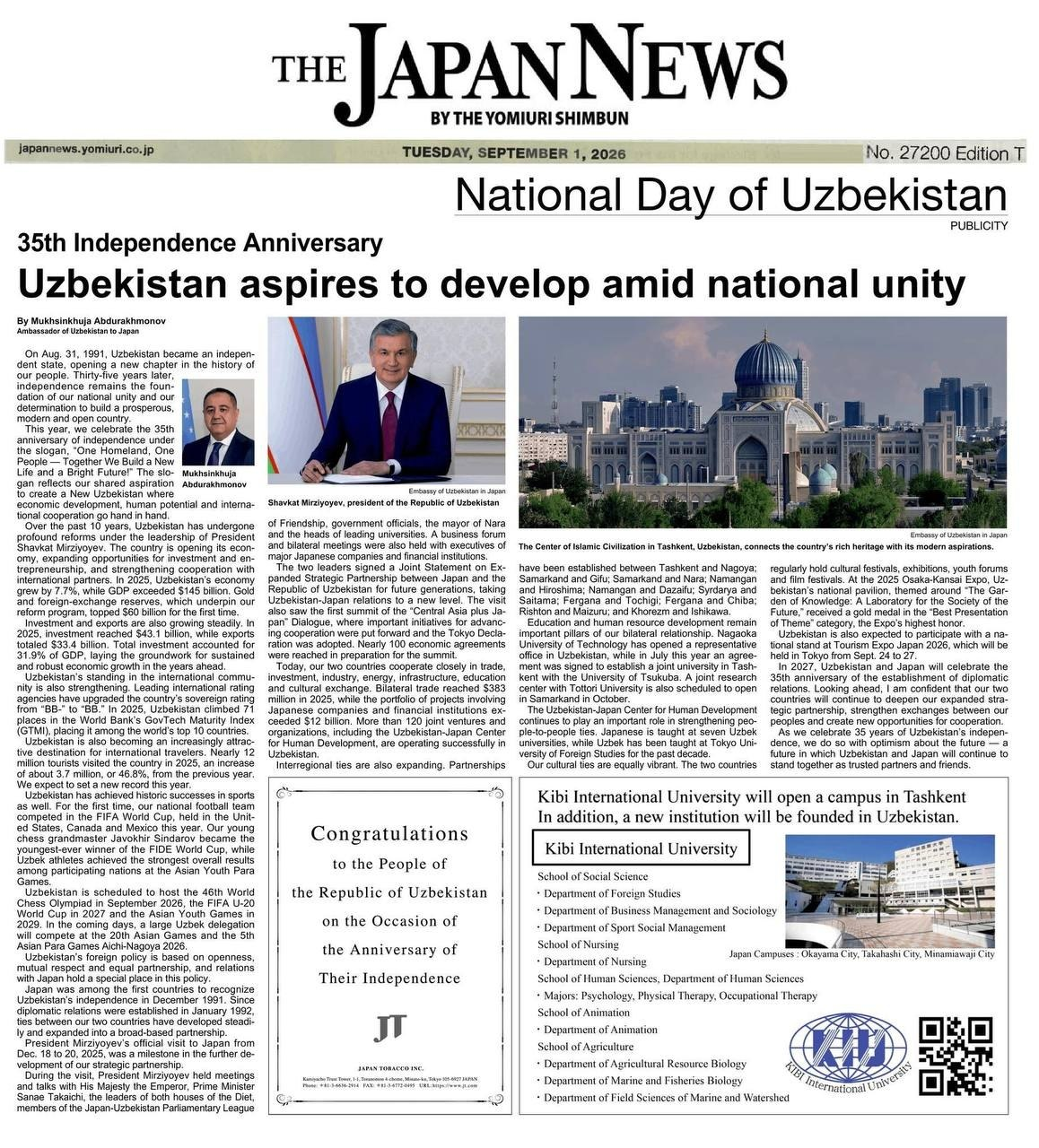
 Japan’s prestigious The Japan News published an article titled “Uzbekistan aspires to develop amid national unity,” dedicated to the 35th anniversary of Uzbekistan’s independence. The article was authored by Mukhsinkhuja Abdurakhmonov, Ambassador Extraordinary and Plenipotentiary of Uzbekistan to Japan.
The article highlights Uzbekistan’s development over the years of independence, reforms aimed at building a New Uzbekistan, the country’s growing standing on the international stage, as well as its strategic cooperation with Japan in the fields of trade, investment, education, and culture.
On August 31, 1991, Uzbekistan became an independent state, opening a new chapter in the history of our people. Thirty-five years later, independence continues to serve as the foundation of our national unity and our firm aspiration to build a prosperous, modern, and open state.
This year, we are celebrating the 35th anniversary of our country’s independence under the motto, “One Homeland, One People — Together We Build a New Life and a Bright Future!” This motto reflects our shared aspiration to build a New Uzbekistan in which economic development, human potential, and international cooperation advance in harmony.
Over the past 10 years, under the leadership of President Shavkat Mirziyoyev, Uzbekistan has undergone a profound process of reform. The country’s economy has become increasingly open, opportunities for investment and entrepreneurship have expanded, and relations with international partners have strengthened. In 2025, Uzbekistan’s economy grew by 7.7 percent, while gross domestic product exceeded $145 billion. The country’s gold and foreign exchange reserves, an important pillar of our reform agenda, surpassed $60 billion for the first time.
Investment and export volumes have also continued to grow steadily. In 2025, investments reached $43.1 billion, while exports amounted to $33.4 billion. Total investment accounted for 31.9 percent of gross domestic product, creating a strong foundation for sustained and high economic growth in the years ahead.
Uzbekistan’s standing in the international community has also continued to strengthen. Leading international rating agencies upgraded the country’s sovereign credit rating from “BB-” to “BB.” In 2025, Uzbekistan climbed 71 places in the World Bank’s GovTech Maturity Index (GTMI), entering the top 10 countries in the world.
Uzbekistan is also becoming an increasingly attractive destination for international tourists. In 2025, nearly 12 million tourists visited our country. This was approximately 3.7 million, or 46.8 percent, more than in the previous year. We expect to set a new record this year.
Uzbekistan has also achieved historic successes in sports. For the first time, our national football team will participate in the FIFA World Cup, to be held this year in the United States, Canada, and Mexico. Young chess grandmaster Javokhir Sindarov became the youngest winner in the history of the FIDE World Cup. In addition, Uzbek athletes recorded the best overall result among participating countries at the Asian Youth Para Games.
Uzbekistan is scheduled to host the 46th Chess Olympiad in September 2026, the FIFA U-20 World Cup in 2027, and the Asian Youth Games in 2029. In the coming days, a large Uzbek delegation will take part in the 20th Asian Games and the 5th Asian Para Games, to be held in Aichi-Nagoya in 2026.
Uzbekistan’s foreign policy is based on the principles of openness, mutual respect, and equal partnership, with relations with Japan occupying a special place in this policy.
Japan was among the first countries to recognize Uzbekistan’s independence in December 1991. Since the establishment of diplomatic relations in January 1992, ties between the two countries have developed steadily, reaching the level of a comprehensive partnership.
President Mirziyoyev’s official visit to Japan on December 18–20, 2025, marked an important milestone in the further development of our strategic partnership.
During the visit, President Mirziyoyev held meetings and talks with His Majesty the Emperor, Prime Minister Sanae Takaichi, the leaders of both chambers of Parliament, members of the Japan–Uzbekistan Parliamentary Friendship League, government representatives, the Mayor of Nara, and the heads of leading universities. A business forum and bilateral meetings were also held with the participation of executives from major Japanese companies and financial institutions.
The leaders of the two countries signed a Joint Statement on an Expanded Strategic Partnership between Japan and Uzbekistan for Future Generations. This brought Uzbekistan–Japan relations to a new stage. The first summit of the “Central Asia plus Japan” Dialogue was also held as part of the visit. Important initiatives aimed at expanding cooperation were put forward, and the Tokyo Declaration was adopted. In preparation for the summit, nearly 100 economic agreements were reached.
Today, the two countries cooperate closely in trade, investment, industry, energy, infrastructure, education, and cultural exchange. In 2025, bilateral trade turnover amounted to $383 million, while the portfolio of projects involving Japanese companies and financial institutions exceeded $12 billion. More than 120 joint ventures and organizations are successfully operating in Uzbekistan, including the Uzbekistan–Japan Center for Human Development.
Interregional ties are also expanding. Partnership relations have been established between Tashkent and Nagoya, Samarkand and Gifu, Samarkand and Nara, Namangan and Hiroshima, Namangan and Dazaifu, Syrdarya and Saitama, Fergana and Tochigi, Fergana and Chiba, Rishtan and Maizuru, and Khorezm and Ishikawa.
Education and human resource development remain among the key pillars of our bilateral relations. Nagaoka University of Technology has opened its representative office in Uzbekistan. In July of this year, an agreement was signed with the University of Tsukuba to establish a joint university in Tashkent. A joint research center in cooperation with Tottori University is also planned to open in Samarkand in October.
The Uzbekistan–Japan Center for Human Development plays an important role in strengthening ties between our peoples. Today, the Japanese language is taught at seven universities in Uzbekistan. Meanwhile, Uzbek has been taught at Tokyo University of Foreign Studies for the past ten years.
Our cultural ties are also developing rapidly. The two countries regularly hold cultural festivals, exhibitions, youth forums, and film festivals. At Expo 2025 Osaka, Kansai, the Uzbekistan National Pavilion, themed “Garden of Knowledge: Laboratory for a Future Society,” won the gold medal in the “Best Presentation of the Theme” category. This is the highest award of the Expo.
Uzbekistan is also expected to participate with a national stand at Tourism Expo Japan 2026, to be held in Tokyo on September 24–27, 2026.
In 2027, Uzbekistan and Japan will celebrate the 35th anniversary of the establishment of diplomatic relations. Looking ahead, I am confident that our two countries will further deepen their expanded strategic partnership, strengthen people-to-people exchanges, and create new opportunities for cooperation.
As we celebrate the 35th anniversary of Uzbekistan’s independence, we look to the future with great confidence and optimism. In the years ahead, Uzbekistan and Japan will continue to move forward together as trusted partners and friends, strengthening the friendship between our peoples and creating new opportunities for cooperation.