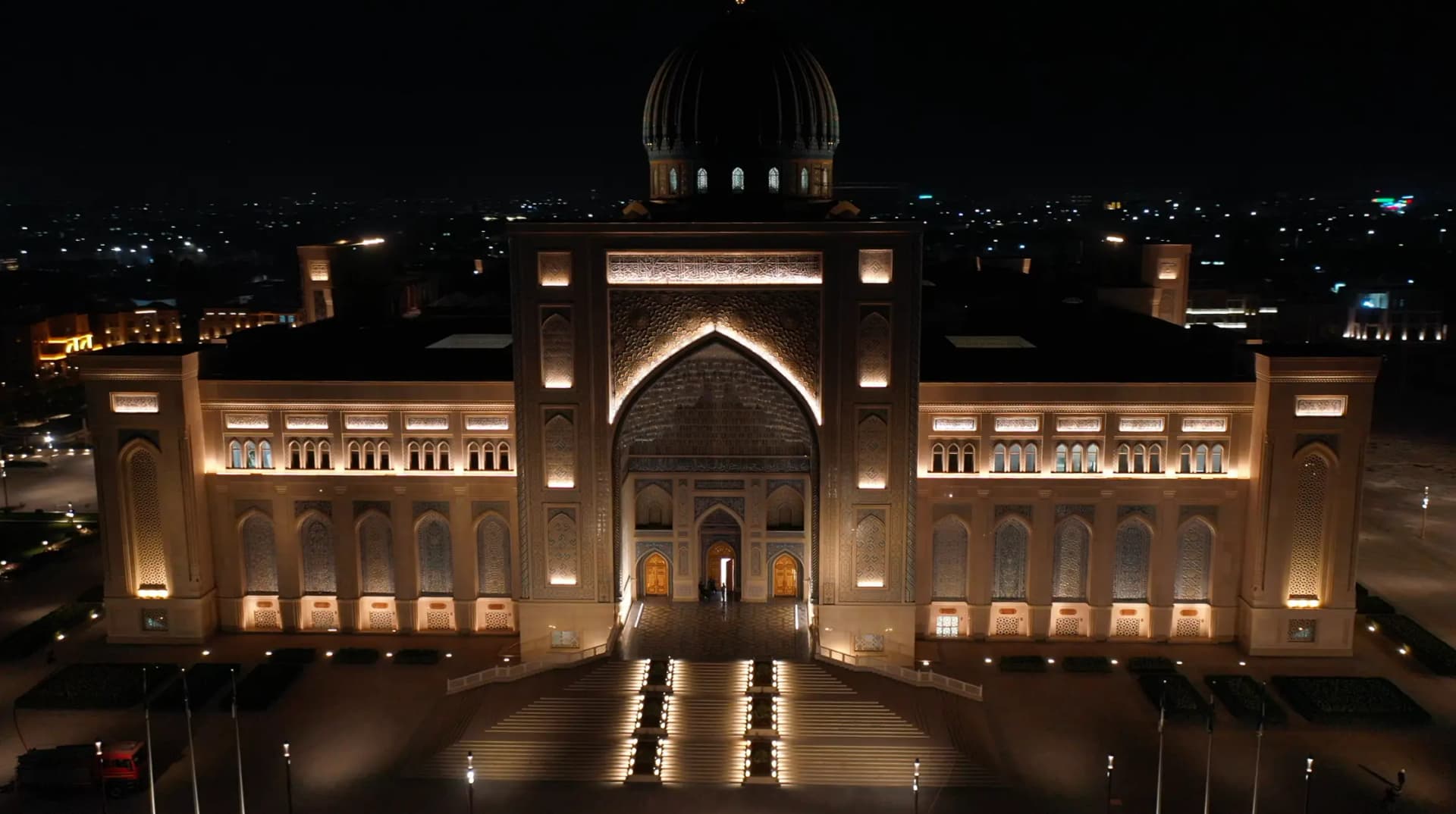
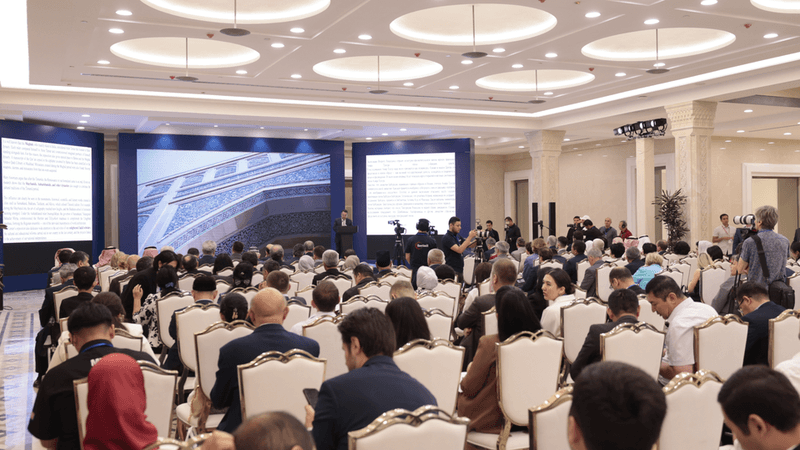
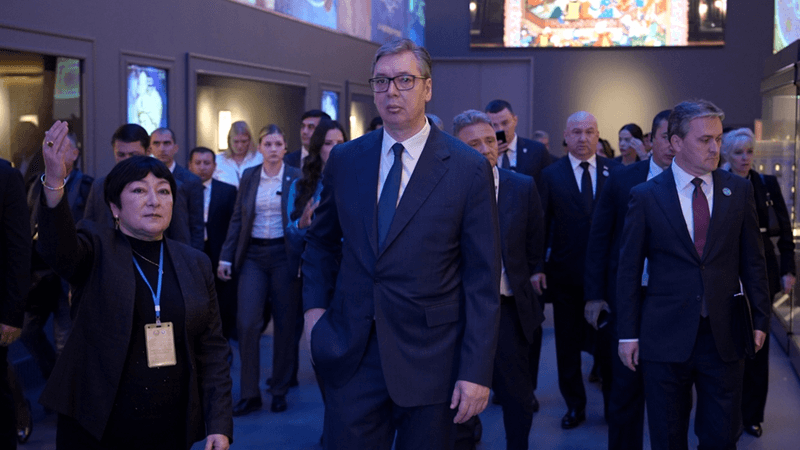
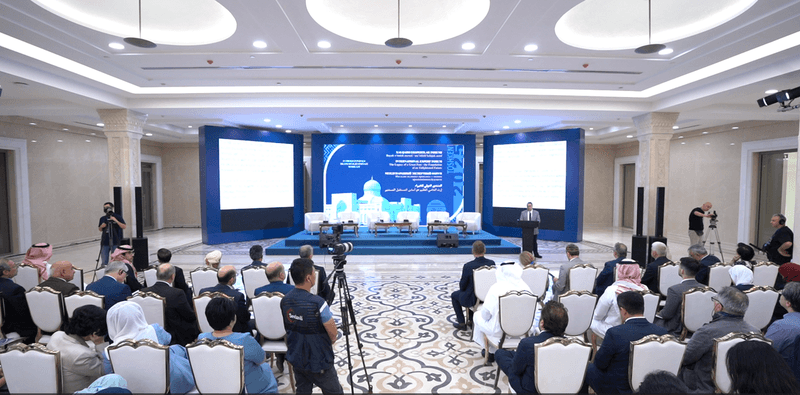
 Today marks the 1053rd anniversary of the birth of Abu Rayhan Muhammad ibn Ahmad Beruni. Born in the land of Khwarazm, this great scholar made an immense contribution to the advancement of world science through his wide-ranging research, profound intellect, and tireless pursuit of understanding the universe. For centuries, his name has been directly associated with numerous fields, including astronomy, mathematics, geography, geodesy, mineralogy, medicine, history, ethnography, and philosophy.
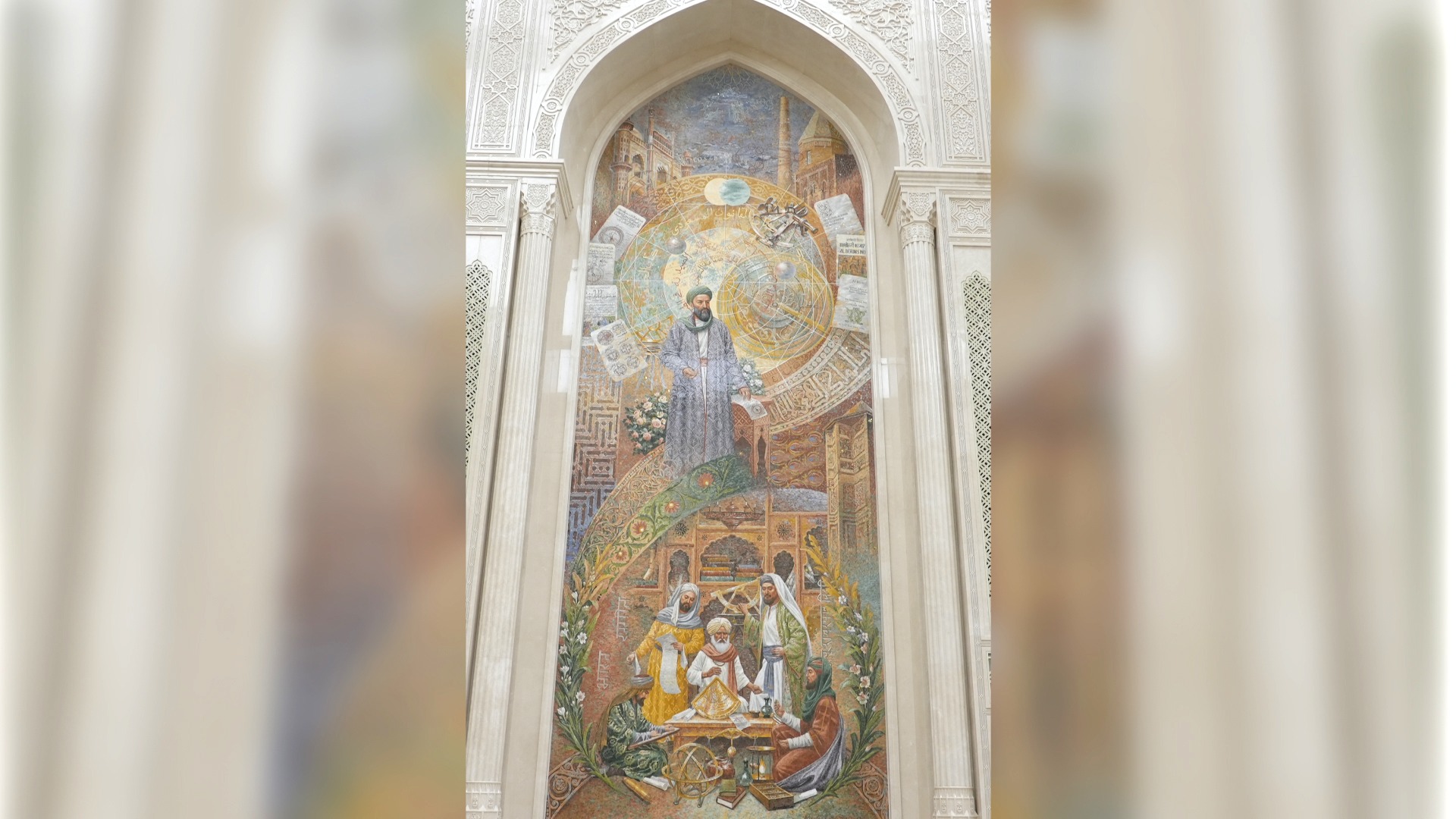
The monumental “Abu Rayhan Beruni” arches, located in the foyer of the Gallery of Great Figures at the Islamic Civilization Center in Uzbekistan, reflect in the language of color the multifaceted life and vast scholarly legacy of this remarkable thinker.
A viewer contemplating the work sees not merely the image of a single scholar, but the world of his intellect. The composition harmoniously portrays Beruni’s life journey, his scholarly travels, astronomical observations, geographical studies, research in nature and medicine, as well as his famous works and discoveries.
For this reason, this monumental painting may rightly be regarded as an artistic chronicle embodying the life and scientific legacy of the great scholar.
 The great scholar who emerged from the land of Khwarazm
Abu Rayhan Beruni was born on September 4, 973, near the city of Kath, the ancient capital of Khwarazm. Belonging to the Iraqi family of the Afrighid Khwarazmshah dynasty, Beruni was raised in the household of the renowned scholar Abu Nasr ibn Iraq.
His interest in science developed at a very early age. By the age of 16, he had already begun engaging in astronomical observations, and from his youth he set out to investigate complex scientific questions such as the movement of celestial bodies, time and space, and the dimensions of the Earth.
At the age of 22, Beruni left Kath and lived in Urgench, Ray, Gurgan, and Ghazna, as well as in India. Wherever he went, he communicated with local scholars, studied the knowledge available there, and continued his own scientific research.
These cities and events associated with his life journey have also found their artistic expression in the painting. The central idea that unites these different places is the endless journey of a person in search of knowledge.
A lifetime could not contain his world of knowledge
Beruni is known to have written nearly 150 works, 31 of which have survived to our time. These works alone demonstrate how remarkably wide-ranging his scholarly interests were.
His works such as “Chronology,” “Geodesy,” “Tafhim,” “India,” “The Mas‘udi Canon,” “Mineralogy,” and “Pharmacognosy” bring together important scientific ideas and conclusions from various fields of knowledge.
Alongside astronomy and mathematics, Beruni also left a profound mark in geography, geodesy, physics, mineralogy, pharmacology, history, literature, religious studies, and philosophy.
In the monumental painting, the various dimensions of this scholarly legacy are brought to life through distinct visual scenes. The books in the scholar’s hands, scientific instruments, globe, maps, and natural landscapes artistically unite his intellectual pursuits into a single, coherent composition.
The scholar who sought to unravel the mysteries of the universe
Astronomy holds a special place in Beruni’s scientific legacy. He did not limit himself to observing the movements of celestial bodies, but studied them through precise mathematical calculations.
His famous work, “The Mas‘udi Canon,” embodies encyclopedic knowledge in the exact sciences. It extensively covers cosmology, spherical astronomy, trigonometry, and mathematical geography. The work also contains tabulated data on 1,029 fixed stars.
Beruni developed formulas for mathematically calculating planetary motion and compiled tables of sine, cosine, tangent, and cotangent functions. He also described precise mathematical methods for calculating solar and lunar eclipses.
The celestial scenes, stars, and details related to astronomical observations depicted in the painting introduce viewers to Beruni’s scholarly quest to understand the universe.
Beruni: measuring the earth and exploring its secrets
The great scholar’s research in geography and geodesy was also remarkably advanced for its time.
In his work “Geodesy,” Beruni described methods for determining the optimal route from Ghazna to Mecca, identifying the geographical coordinates of cities, and calculating distances across the Earth’s surface.
Beruni also expressed scientific views on the geological history of the Earth and the geological evolution of the Amu Darya region and the Arabian Desert. His conclusion that the Indian and Atlantic Oceans were connected south of Africa further demonstrates the remarkable breadth of his geographical thinking.
While at Nandana Fort, the scholar used mathematical methods to determine the radius of the Earth. He also created a globe measuring 750 centimeters in diameter, which made it possible to determine distances between settlements and identify their coordinates on the basis of geographical features.
The depiction of a globe and geographical maps in the monumental painting is therefore highly symbolic. They show that Beruni studied the Earth not merely as a place where people live, but as an object of scientific inquiry.
The polymath who uncovered the secrets of nature
Beruni’s interests were not limited to the heavens and the Earth. He also conducted in-depth studies of minerals, rocks, medicinal plants, and the animal world.
In his work “Mineralogy,” he provided valuable information on the natural formation of minerals, precious stones and metals, as well as mineral resources found in Central Asia and the Near and Middle East.
The scholar also demonstrated that the widely held belief of his time that common metals could be transformed into precious metals lacked a scientific basis.
In “Pharmacognosy,” he described 1,116 medicinal substances derived from minerals, plants, and animals. He recorded nearly 4,500 names for them in various languages and dialects. In compiling the work, he synthesized the scholarly legacy of 250 authors who had lived in different regions over a period of 1,500 years.
These facts alone reveal Beruni not merely as a researcher of his era, but as a great intellectual who collected, synthesized, and systematically organized knowledge from diverse sources.
A bridge between languages and civilizations
Another important feature that distinguishes Beruni’s scholarly legacy is his engagement with the knowledge of different peoples and civilizations.
The scholar knew Ancient Greek, Latin, Syriac, Sanskrit, Persian, Arabic, Khwarazmian, Sogdian, and Turkic languages. He drew on sources written in various languages and subjected them to comparative analysis.
In “Chronology,” he compiled information on the calendars, religious beliefs, customs, festivals, legends, and myths of different peoples. For centuries, this work served as an important reference for converting ancient dates into the calendars of later periods, including the Islamic calendar.
In the composition of the painting, the harmonious combination of images representing different peoples and cultures reflects another important dimension of Beruni’s scholarly legacy — the exchange of knowledge between civilizations.
The scholar who studied India and sought to understand its culture
Beruni’s work in India occupies a special place in his scholarly legacy. He studied the country’s history, geography, philosophy, art, customs, and religious beliefs.
Based on the information he gathered, Beruni wrote “India,” in which he presented an objective account of the life, culture, and religious views of the Indian people. He approached different beliefs with respect and promoted the ideals of intercultural dialogue and mutual understanding.
He translated important works of Greek scientific heritage, including the “Almagest,” into Sanskrit. He also translated scientific works written in Sanskrit into Arabic.
In this way, Beruni contributed to the exchange of knowledge between two distinct scholarly and cultural environments. Even today, this aspect of his work remains a remarkable historical example of scientific dialogue between civilizations.
Beruni’s world reflected in color
“The significance of the monumental painting ‘Abu Rayhan Beruni’ lies in the fact that it presents the scholar’s life and scientific legacy not as a collection of separate facts, but as a coherent artistic narrative. Looking at this work in the foyer of the ‘Gallery of Great Figures,’ viewers can experience in a single composition Beruni’s life journey beginning in Kath, his travels to different lands, his observations of the stars, his measurements of the Earth, his studies of minerals and medicinal plants, and his exploration of the cultures of various peoples. This is not merely a depiction of one person’s life, but a portrayal of the world of a great intellect. The strength of Beruni’s scientific legacy lies precisely in this: he did not simply compile the knowledge available in his time, but enriched it through observation, analysis, calculation, and logical conclusions. Through his works, different branches of science became interconnected,” said Professor Zohidulla Munavvarov, Chief Researcher at the Islamic Civilization Center in Uzbekistan.
Today, this legacy is being brought to life once again through the language of painting at the Islamic Civilization Center in Uzbekistan.
The monumental “Abu Rayhan Beruni” painted arch is not only a work dedicated to the memory of the great scholar, but also an expression of profound respect for knowledge. It not only introduces viewers to history, but also inspires them, like Beruni, to explore, question, observe, and discover.
Indeed, Beruni’s genius, which has reached us across the centuries, reminds us of one enduring truth: a legacy built through knowledge transcends the boundaries of time and space.