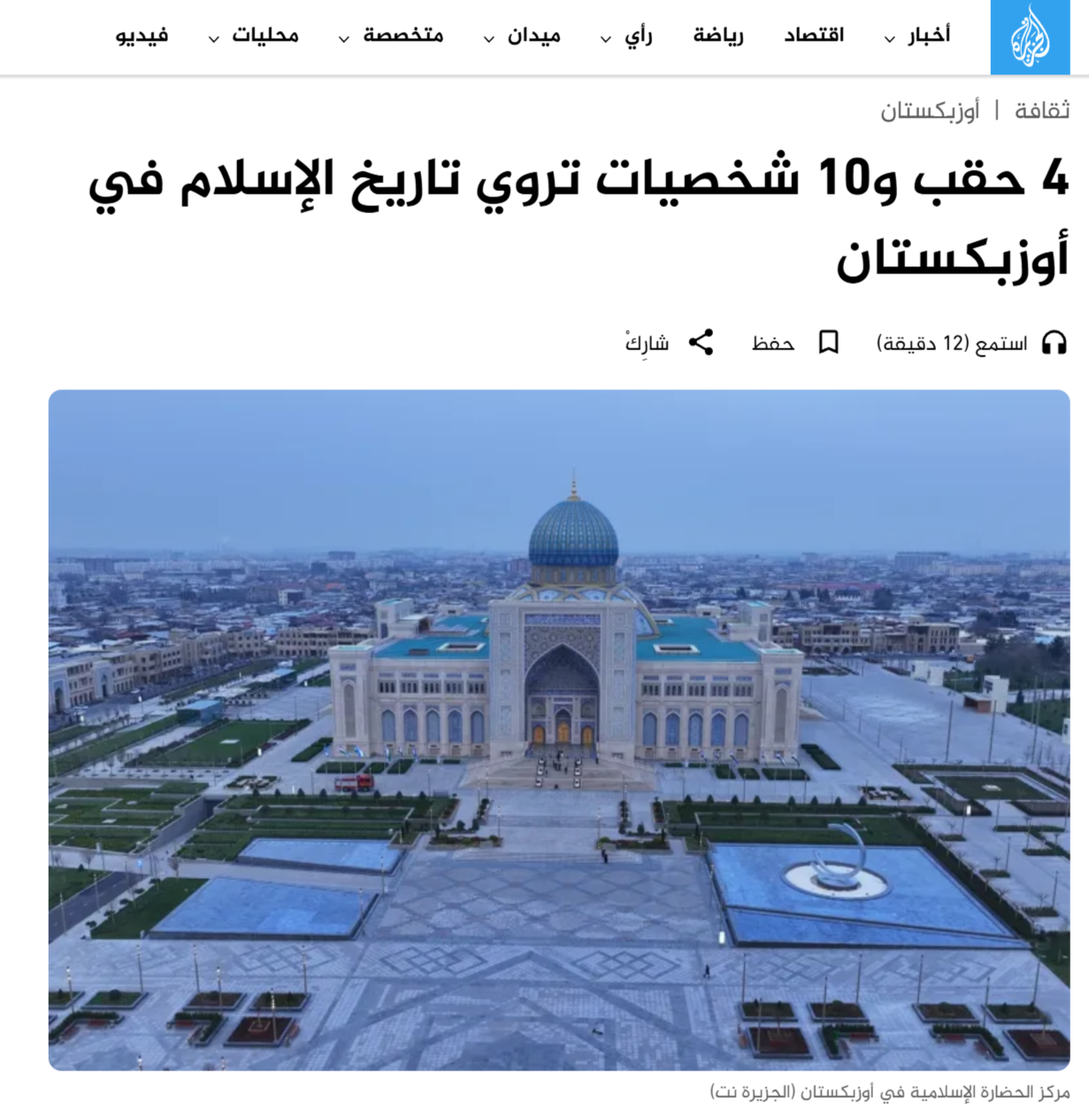
 The museum of the Islamic Civilization Center in Uzbekistan is attracting the attention of foreign media as a unique institution that brings together the country’s millennia-old history in one place. Through the museum’s exhibitions, Al Jazeera explores four major periods in the history of Islamic civilization in Uzbekistan and ten great figures who helped lay its foundations, while also highlighting ancient manuscripts of the Holy Qur’an, historical artifacts, and the legacy of eminent scholars such as Muhammad Khwarizmi, Imam Bukhari, Abu Ali ibn Sina, Mirzo Ulugbek, and Zahiriddin Muhammad Babur.
Tashkent — In the spacious halls of a magnificent building whose dome seems to merge with the sky and echo its blue color, thousands of rare objects, archaeological finds, and documents recount centuries of Islamic civilization in Uzbekistan. They tell the story of periods of flourishing that began in the seventh century CE, when the culture of Central Asia blended with the culture introduced by the Arabs, forming a distinctive civilization united by Islam.
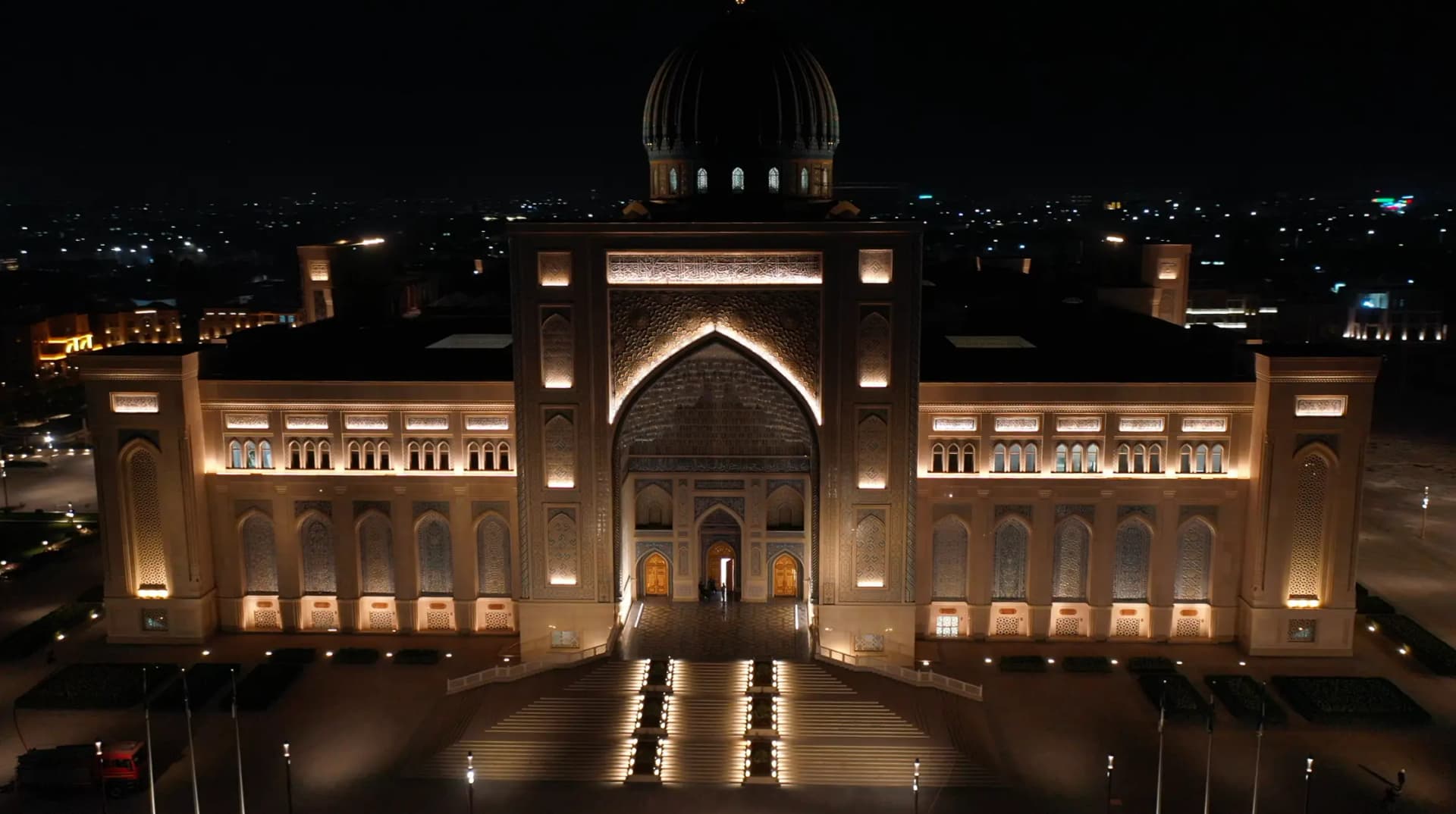
From the outside, the Islamic Civilization Center in Uzbekistan is located in the city of Tashkent, with its walls adorned with decorative patterns featuring Arabic calligraphy. The building is surrounded by a spacious square and a beautiful garden. As the sun sets and night falls over the city, residents of Tashkent visit this place for leisure and relaxation.
Just a few dozen meters from the Center rise the minarets of the Hazrati Imam Complex, stretching toward the clouds. Our accompanying guide explained that this ensemble of historic buildings is a sacred site dedicated to the memory of Abu Bakr Kaffal Shashi, a tenth-century scholar and righteous figure. Tashkent itself was once known as “Shash,” a name associated with this eminent scholar.
“The past leaves its mark” — A journey through the museum of Islamic art, featuring Khwarizmi’s manuscripts and examples of calligraphic art from Tashkent and Bukhara
The museum, which is part of the Islamic Civilization Center and houses approximately 8,000 artifacts and works of art, presents each exhibit as a window into a different chapter of the history of the region once known as “Mawarannahr.”
Here, objects made of stone, clay, wood, paper, metal, ceramics, and textiles are displayed side by side. Each tells the story of a different period in the history of the people of Uzbekistan. These stories begin with the era when their ancestors lived in caves and recorded scenes from their lives through symbols carved into rocks.
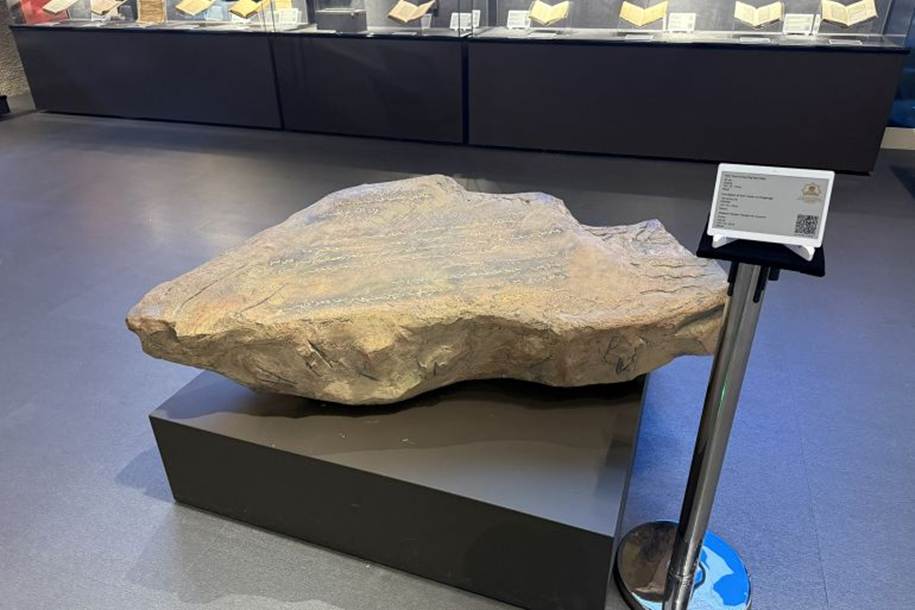 A 14th-century stone displayed at the Museum of Islamic Civilization in Uzbekistan. It is said that Amir Temur personally inscribed it
Ancient exhibits and modern technologies
Within the walls of this “historical chronicle,” modern technologies blend seamlessly with ancient exhibits. Alongside bronze and copper coins, the museum displays ceramic vessels and pottery, jewelry and precious stones, ancient swords and traditional weapons, musical instruments and fragments of sculptures, mosaics, miniatures, as well as models depicting historical figures and traditional crafts.
Modern technologies play an important role in helping visitors fully understand the significance of these exhibits that have survived through the centuries. In particular, three-dimensional displays and interactive screens “speak” on behalf of the silent artifacts, revealing their historical value through texts and videos.
According to a museum guide who spoke to Al Jazeera Net, nearly 5,000 people visit this magnificent site every day. Around 90 percent of them are local residents, while the remainder are tourists and guests from abroad.
We toured the museum with guide Sobitjon Oripov. Covering an area of 7,000 square meters, the museum has five main exhibition halls.
One of them is called the Holy Qur’an Hall, where rare Qur’anic manuscripts copied by prominent figures who played an important role in the country’s history are on display.
Another hall houses artifacts and remains dating back to civilizations of the pre-Islamic period.
The third hall presents the First Renaissance of Uzbekistan and Central Asia, covering the period from the 9th to the 13th centuries.
The fourth hall highlights the Second Renaissance, also known as the Timurid Renaissance, covering the historical period from the 14th to the 16th centuries through documents and exhibits.
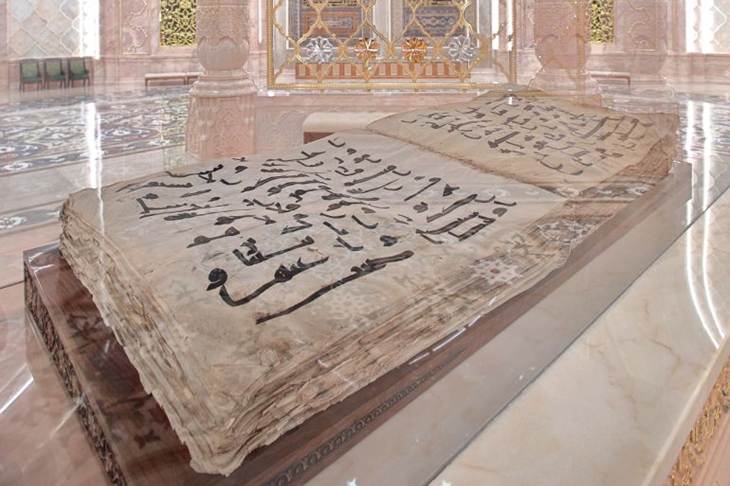 The Uthman Mushaf manuscript at the Museum of the Islamic Civilization Center in Uzbekistan
A special hall for the Uthman Mushaf
At the center of the Holy Qur’an Hall stands a special raised platform enclosed by a protective barrier. According to museum officials, it houses what is believed to be the oldest surviving copy of the Qur’an — the “Uthman Mushaf,” associated with Caliph Uthman ibn Affan, may Allah be pleased with him.
The manuscript consists of 338 folios and is written in Kufic script. Dating to the 7th century CE, it was written on deerskin. In 1997, it was included in UNESCO’s Memory of the World Register.
According to historical accounts, Amir Temur brought the Mushaf from Baghdad to Samarkand in the 14th century.
In 1868–1869, the Mushaf was taken to the Imperial Public Library in St. Petersburg, then part of the Russian Empire, which at the time controlled much of Central Asia.
In 1923, following persistent demands from Muslim scholars and prominent community representatives, the rare Uthman Mushaf manuscript was returned to Tashkent by special train. It was initially entrusted to the Muyi Muborak Madrasah within the Hazrati Imam Complex.
Later, in November 2025, the manuscript was transferred to the Holy Qur’an Hall of the museum at the Islamic Civilization Center.
Relics from historical periods
The hall dedicated to Uzbekistan’s pre-Islamic history displays heritage dating from the 10th millennium BCE to the middle of the 7th century CE. It was during this period that the first representatives of Islam entered the lands inhabited by the descendants of the Sogdians, Bactrians, and Khwarazmians.
The hall features a monumental 260-meter-long wall displaying inscriptions and images that trace nearly three thousand years of development among the peoples who lived in the territory of present-day Uzbekistan. They tell the story of progress from the emergence of agriculture to the rise of urban development and the flourishing of trade along the Great Silk Road.
The hall also displays stone arrowheads dating back several centuries, bearing witness to the earliest encounters between people living in mountainous regions and wild animals. Other exhibits include a bronze deer figurine dating to the 1st millennium BCE, hunting scenes and other symbolic images carved into rocks more than 10,000 years ago. According to Oripov, some of these images also reflect beliefs and perceptions from ancient times.
Through interactive maps and videos displayed on screens, the appearance of ancient cities and settlements in the territory of present-day Uzbekistan has been reconstructed. Sounds and musical instruments that were widespread during that period have also been recreated. The exhibition also provides information on the development of agriculture and metallurgy at the time.
The first renaissance of Mawarannahr
The third hall displays exhibits relating to the first renaissance of Mawarannahr. It brings together historical evidence reflecting the early interaction, integration, and blending of local culture with Arab and Islamic culture.
The exhibition highlights a process of cultural integration between civilizations that lasted for more than four centuries. It features historical artifacts from the Umayyad, Abbasid, Samanid, Qarakhanid, Ghaznavid, Seljuk, Khwarazmshah, and Mongol periods.
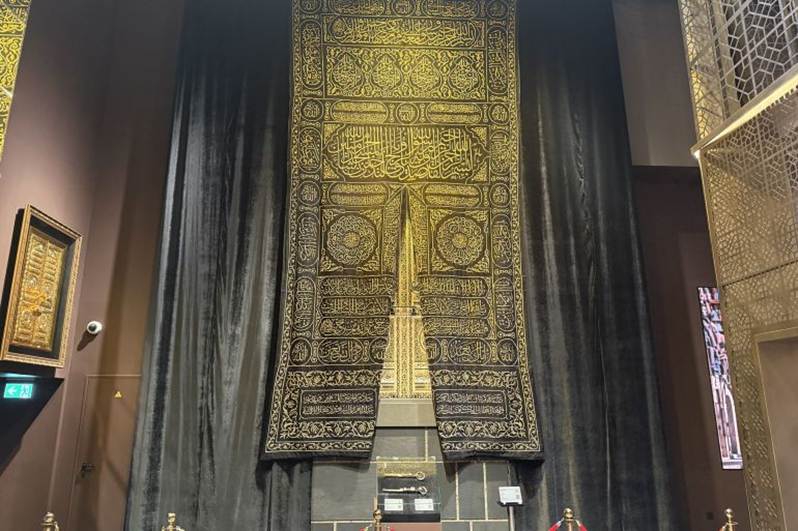 A model of the door of the Holy Kaaba at the Museum of the Islamic Civilization Center in Uzbekistan
Another large arch that immediately draws attention illustrates the Uzbek people’s deep regard for the Hajj, its traditions, and pilgrimage journeys. A large part of the arch is devoted to models of the Holy Kaaba, its kiswah, and Maqam Ibrahim.
Displayed here is a kiswah made for the Kaaba in 1859, alongside a model of the Kaaba’s door and a replica of its key. The key bears an inscription of verse 27 from Surah Al-Hajj:
“Proclaim the pilgrimage among the people. They will come to you on foot and on every lean camel, coming from every distant road.”
The Timurid period
A separate hall is also dedicated to the Timurid period, spanning the 14th to the 16th centuries. It presents the era of Amir Temur and his state, as well as the period of his successors.
During this era, the country experienced significant growth and development, while cities especially Samarkand and Herat became major centers of science and learning.
The hall features exhibits evoking Amir Temur’s palaces, madrasas, and mosques, as well as artifacts associated with his legacy.
Also on display are exhibits reflecting the outstanding scholarly achievements of the great scientist and astronomer Mirzo Ulugbek and his students, including Ali Qushchi and Ghiyath al-Din Jamshid.
The exhibition also gives a prominent place to the miniatures of the renowned artist and painter Kamoliddin Behzad.
The library of the Islamic Civilization Center
Located on the second floor of the Islamic Civilization Center is a library that is not part of the museum and offers extensive academic and information resources.
The library has 266 seats. Its shelves hold 300,000 printed books, as well as an equal number of electronic books.
Through access to local and international databases, users can also benefit from more than 10 million electronic resources.
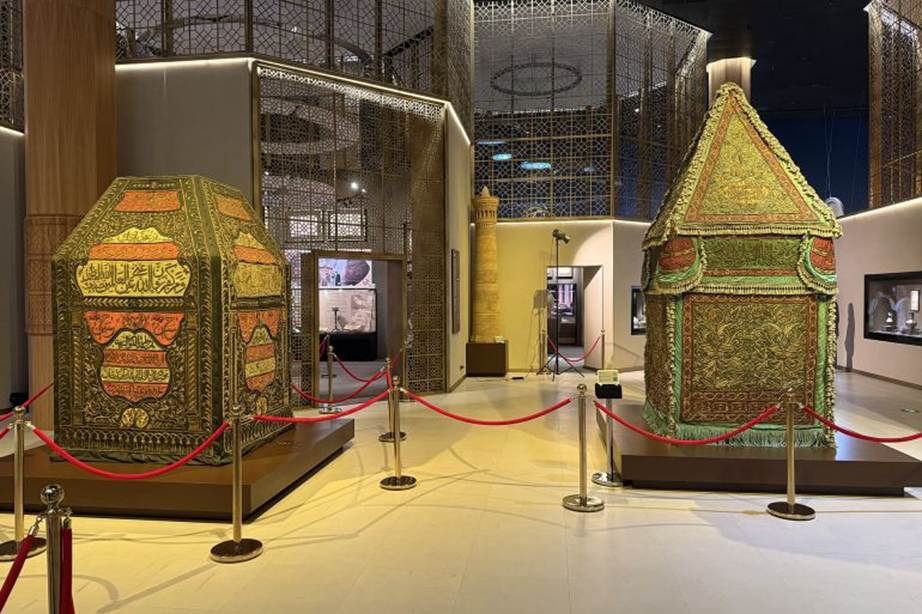 The Hajj Journey Arch at the Museum of the Islamic Civilization Center in Uzbekistan
Gallery of Great Figures
Uzbekistan also takes pride in its great historical figures. Among them are 14 eminent personalities whom the Museum of the Islamic Civilization Center presents as outstanding symbols of the region’s scientific advancement and intellectual flourishing. Visitors can learn about these figures in a special hall known as the “Gallery of Great Figures.”
In the spacious and richly decorated hall, monumental portraits of these great personalities are displayed on marble panels. Each panel weighs two tons, measures 8 meters in length and 3 meters in width. They were created using 110 varieties of colored marble imported from Italy, along with white marble brought from Türkiye.
Museum guide Sobitjon Oripov explained that seven of these portraits are dedicated to the most prominent representatives of the First Renaissance in Central Asia and Uzbekistan.
Among them is Muhammad ibn Musa Khwarizmi, who was born in the Khwarazm region in northwestern Uzbekistan and is renowned for his contributions to the use of zero and for discoveries that revolutionized the field of algebra.
Beside him is a portrait of Ahmad Farghani. A scholar, engineer, and astronomer, Farghani worked at the “House of Wisdom” in Baghdad. His works on astronomy and geography were translated into Latin and inspired renowned figures such as the explorer Christopher Columbus and the Italian astronomer Nicolaus Copernicus.
According to the guide, Farghani is also credited with inventing the Nilometer in Egypt, a device used to measure the water level of the Nile River. The instrument was used for this purpose for 1,100 years.
Among the great figures, a portrait of Temur Taraghay Barlos, better known as Amir Temur (Tamerlane), also occupies a prominent place.
Uzbeks regard Amir Temur as a national hero, the founder of their Second Renaissance, and a great military commander who conquered the Khwarazm Empire. He also established a vast empire that extended into the territories of neighboring states.
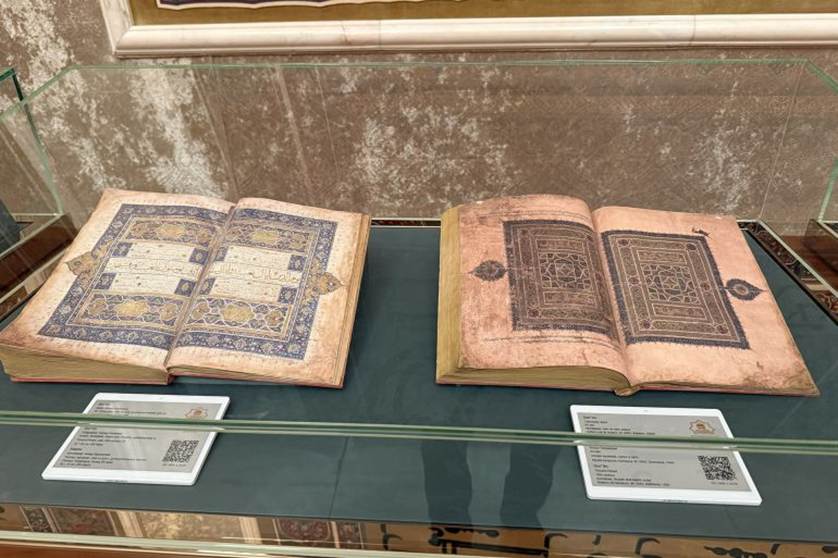 Ancient manuscripts of the Holy Qur’an at the Museum of the Islamic Civilization Center in Uzbekistan
Gallery of Great Figures — continued
It is impossible to discuss this period of Uzbekistan’s history without mentioning the great scholars of Hadith. Among the most renowned are Imam Muhammad ibn Ismail Bukhari and Imam Tirmidhi. The museum also commemorates their names and their immense contributions to the collection and study of the noble Hadiths.
Alongside them stands the scholar, physician, and philosopher Abu Ali Husayn ibn Sina. He was one of the most important polymaths of the medieval period and had already demonstrated exceptional talent in numerous fields of science and knowledge before reaching the age of twenty.
Abu Rayhan Biruni is also among the scholars immortalized in the museum’s “Gallery of Great Figures.” He left a significant scholarly legacy in mathematics and is regarded as the first scientist to develop a spherical model of the Earth’s atmosphere.
“Among the exhibits in our museum, you can also see a more modern interpretation of a model based on al-Biruni’s concept of the atmosphere,” says our guide, Sobitjon Oripov.
Next comes Abu Nasr Farabi, who was born in the city of Farab. Locally, he is regarded as the “Second Teacher” after the Greek philosopher Aristotle. Farabi combined philosophy with the Islamic religious sciences and Sufism.
Alongside him is Kamoliddin Behzad, who is regarded as the “founder” of the miniature painting tradition in Central Asia. European artists and historians compared him to the renowned Italian painter and architect Raphael Sanzio da Urbino, calling him the “Raphael of the East.”
Among the great figures commemorated in the museum is also Mirzo Ulugbek, the renowned astronomer associated with Samarkand. He built an observatory in Samarkand and also founded the madrasa there that bears his name.
The museum exhibition also presents information about Zahiriddin Muhammad Babur. A descendant of Amir Temur, he was born in the city of Andijan in the Fergana Valley. He later moved to India, where he founded the Mughal Empire, known more widely in Central Asia as the Baburid Empire.