 The Timurid era holds particular significance not only as a period of remarkable achievements in science, architecture, and literature, but also as a time when pottery and the decorative arts reached a high level of development. Ceramic objects from this period offer valuable insights into the everyday life, aesthetic tastes, craftsmanship, and cultural connections of people of that time.
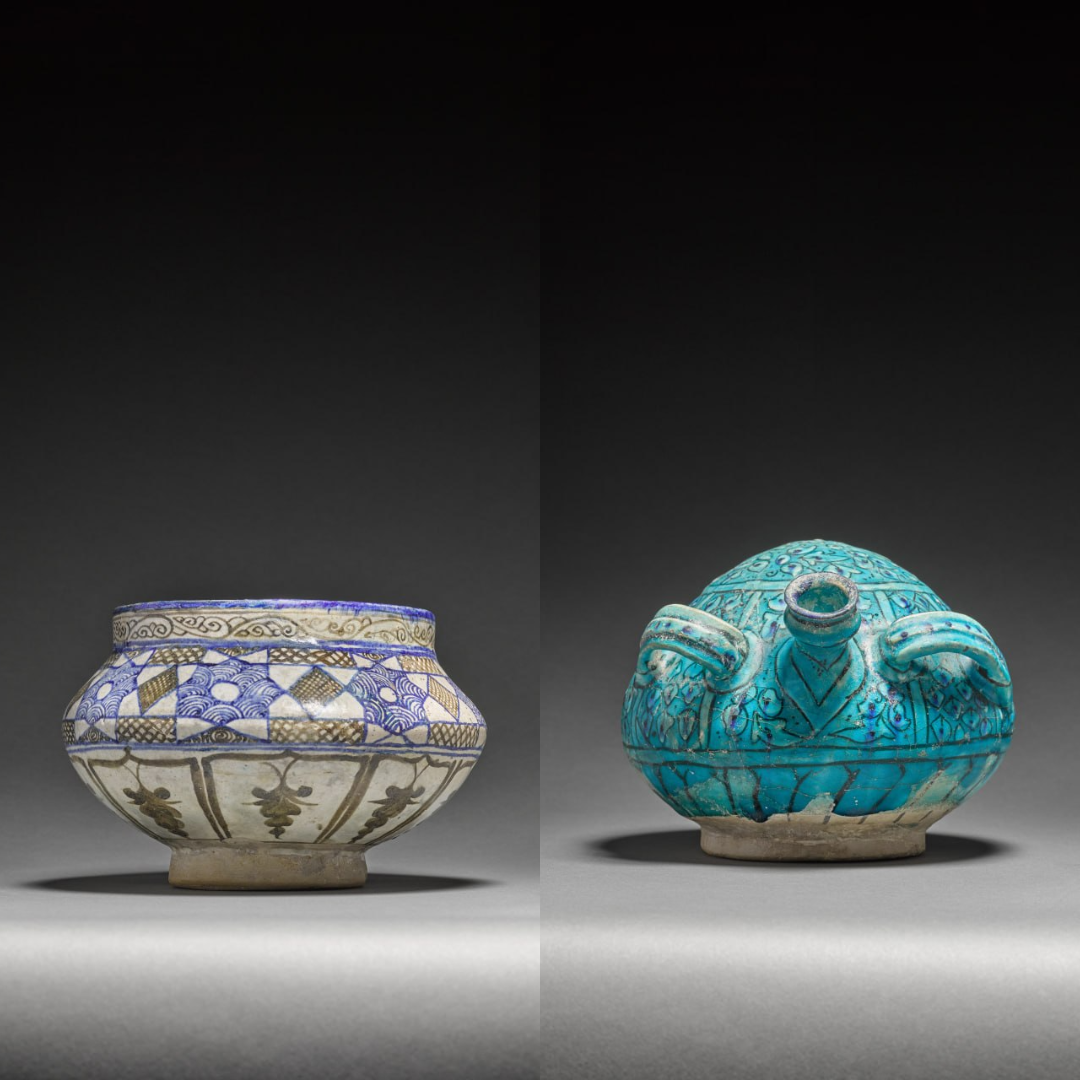
Two ceramic objects featured in the exhibition of the Islamic Civilization Center — a bowl and a travel jug dating to the Timurid era — are vivid examples of this rich heritage.
One of them dates to the late 15th century and was produced in the region of Mawarannahr. Made of ceramic, the vessel measures 23.5 × 15.6 centimeters.
The second object is a ceramic jug dating to the Timurid era, from the 15th to the early 16th century. Found in Central Asia, the vessel measures 17 × 21 centimeters.
The ceramic bowl is spherical in shape, with a short straight foot and a slightly raised rim. Its surface was first coated with white slip, then delicately decorated with blue and brown iron-oxide pigments and covered with a transparent glaze. The exterior of the bowl is divided into three distinct horizontal decorative bands. The upper section features brown scroll motifs, while the middle section contains a complex geometric composition consisting of eight-pointed stars, quadrangular forms, and wavy and lattice-like patterns. The lower section is decorated with brown floral motifs.
At the center of the bowl’s interior is a six-petalled floral medallion, harmoniously surrounded by small decorative motifs. The composition clearly reflects the predominance of geometric ornamentation and a strong emphasis on order and symmetry. These features demonstrate the particular attention paid to the harmony of form and decoration in the applied arts of the Timurid era.
The bowl is also historically significant because it reflects the widespread exchange of artistic and craft traditions during a period of active cultural interaction between Khorasan, Mawarannahr, and China. Cultural influences and the exchange of experience among different regions along the Great Silk Road were also reflected in the art of ceramics. In addition, this bowl serves as an important material source for studying the everyday life and elite culture of the late 15th century.
Another notable object in the exhibition is a travel jug. Distinguished by its spherical body, narrow neck, and two handles, the vessel is entirely covered with a transparent turquoise glaze. Its surface is decorated with floral motifs in blue and black.
The shape of the jug also provides clues about its practical function. Such vessels may have been used by caravan merchants or travelers embarking on long journeys, including the Hajj pilgrimage, to carry water and other liquids. The two handles would have allowed the vessel to be secured with a rope or strap, making it convenient to fasten the jug, for example, to the side of a camel during travel. Its narrow neck would also have provided additional convenience for storing liquids.
At the same time, the jug may also have been used at weddings, banquets, and other ceremonies. In this respect, it may have served not only a practical purpose but also a ceremonial one.
Through these objects, we can see not only the skill of the potters, but also the way of life, travel culture, aesthetic tastes, and worldview of people of that period. Every ceramic object that has survived to the present day is more than an ordinary household item. It is a material source of history that speaks about the technology, art, and human life of its time.
Exhibits of this kind are of immense scholarly and museum significance for understanding the development of geometric ornamentation in Islamic art, the high level of Central Asian ceramics, and the cultural environment of the Timurid era.