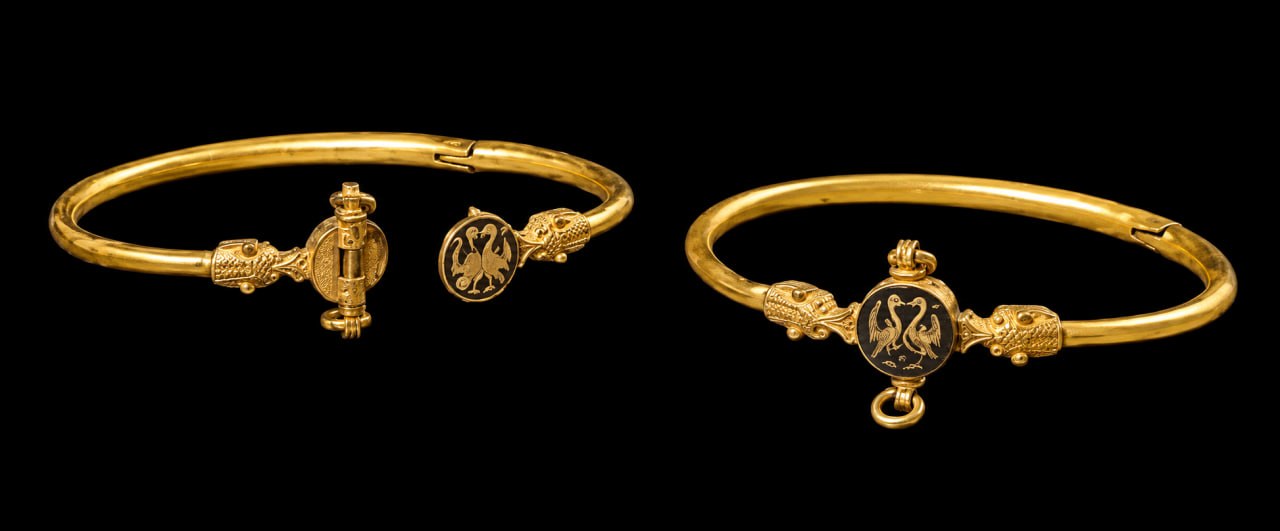
 The pair of bracelets featuring peacock and lion motifs, currently on display in the exhibition of the Islamic Civilization Center in Uzbekistan, dates to the 11th–12th centuries and is noteworthy as one of the finest examples of medieval Central Asian jewelry art.
The pair originates from Central Asia and was created in the 11th–12th centuries. Each bracelet measures 6.1 × 5.1 × 2.4 centimeters, while the combined weight of the pair is 72 grams.
These delicately crafted ornaments were made from sheets of gold formed into a tubular shape. Approximately one-third of each bracelet incorporates an almost imperceptible hinge mechanism that allowed it to be opened and closed.
Both ends of the ornament terminate in the form of lion heads. The lions are depicted as if biting the clasp with their mouths. On the round medallion on the outer side of the clasp, long-necked and long-tailed peacocks facing one another are depicted. Particularly striking are the lions’ eyes, executed in the granulation technique, and their triangular ears. The peacocks are rendered in a relatively realistic manner, while the lions are portrayed in a more stylized artistic form.
One of the most interesting aspects of the bracelets is the way they combine traditions from different periods and cultures. The composition of confronting birds is associated with royal Sasanian iconography and later became even more widespread in the medieval period through Sogdian art.
In this sense, these ornaments are not only vivid examples of jewelry craftsmanship, but also valuable historical objects that reflect the cultural influences, artistic traditions, and continuity of styles in Central Asia.