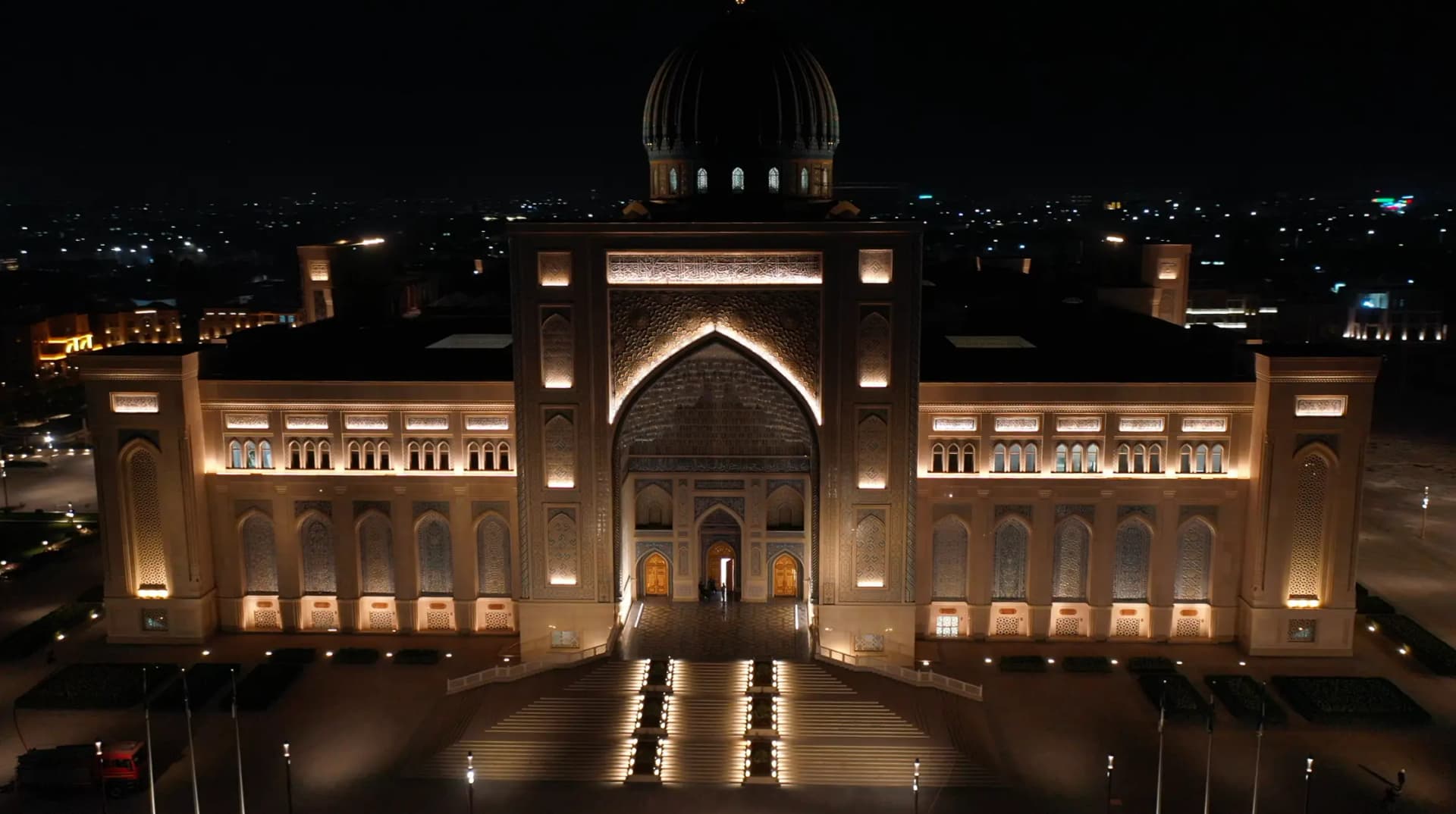
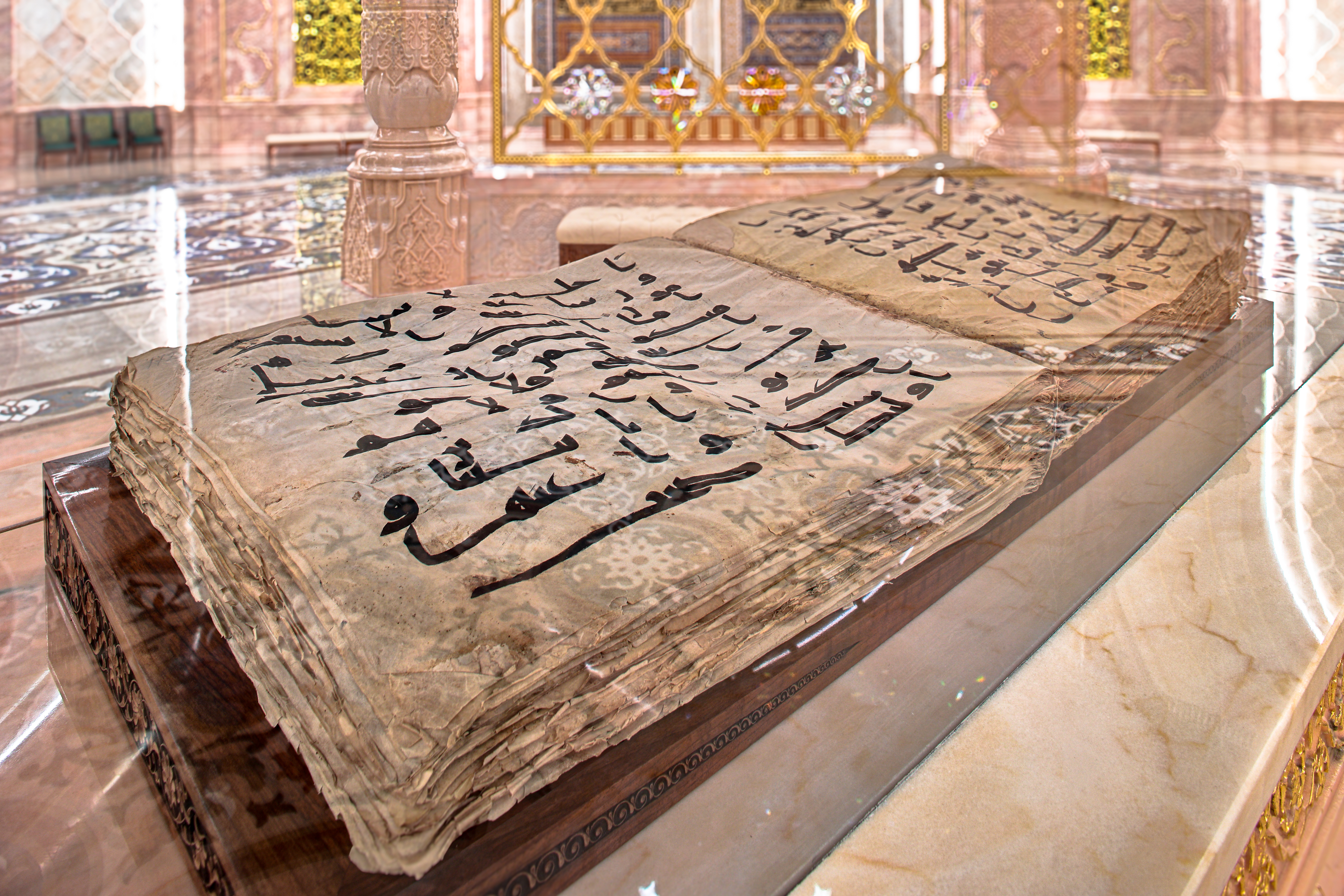
 At the center of the Holy Qur’an Hall of the Islamic Civilization Center in Uzbekistan, established at the initiative of our esteemed President, an ancient seventh-century Qur’an manuscript — the Uthman Mushaf — is on display. However, before reaching its present location, this rare manuscript passed through a complex historical journey spanning nearly fourteen centuries of Qur’anic manuscript tradition and involving Samarkand, St. Petersburg, Ufa, and Tashkent. To understand this history, it is first necessary to look at how the Holy Qur’an was initially compiled into the form of a Mushaf.
7th century: compilation of the Qur’an into the form of a Mushaf
The compilation of the Holy Qur’an into the form of a Mushaf took place in two important stages. During the lifetime of the Prophet Muhammad (peace and blessings be upon him), the verses of the Qur’an were memorized by his Companions and recorded by the scribes of revelation on various writing materials. However, they had not yet been compiled into a single Mushaf.
After the Prophet’s passing, the Battle of Yamama, which took place during the caliphate of Abu Bakr Siddiq and resulted in the martyrdom of many Qur’an reciters, heightened the need to compile the Qur’anic text in one place. According to a hadith narrated by Imam Bukhari from Zayd ibn Thabit, Umar ibn Khattab proposed to Abu Bakr that the Qur’an be compiled. This task was entrusted to Zayd ibn Thabit. Zayd compiled the Qur’anic verses by comparing written materials with the recitations preserved in the memories of the Companions. As a result, the Qur’an was compiled into suhuf — a collection of written sheets. These sheets were first kept by Abu Bakr, then by Umar ibn al-Khattab, and later by Hafsa bint Umar.
The period of Uthman ibn Affan: official copies of the Mushaf
During the caliphate of Uthman ibn Affan, the Islamic state expanded, and differences in Qur’anic recitation began to emerge among Muslims in various regions. According to a hadith narrated by Imam Bukhari from Anas ibn Malik, Hudhayfa ibn Yaman, during the campaigns in Arminya and Azerbaijan, observed differences in Qur’anic recitation between the soldiers of Sham and Iraq and warned Uthman ibn Affan about the matter.
Following this, the caliph ordered that the sheets kept by Hafsa bint Umar be brought to him and entrusted a committee consisting of Zayd ibn Thabit, Abdullah ibn Zubayr, Sa‘id ibn ‘As, and Abdurrahman ibn Harith ibn Hisham with preparing official copies of the Mushaf. The completed copies were then sent to major centers of the Muslim world. Thus, while the Qur’an was compiled into a single collection during the caliphate of Abu Bakr, during the caliphate of Uthman ibn Affan official copies of the Mushaf were prepared on the basis of that text and distributed throughout the Muslim lands.
The history of the Mushaf’s arrival in Central Asia
The question of exactly when and by what route the Mushaf reached Central Asia remains a subject of scholarly research. According to widely circulated accounts, the “Uthman Mushaf” was brought from Iraq to Samarkand in the 14th century by our great ancestor Amir Temur. Thereafter, this rare manuscript was preserved with great reverence for many years at the Nodir Devonbegi Madrasa in Samarkand.
1868: from Samarkand to St. Petersburg
The period of the Uthman Mushaf’s history that can be traced more clearly through documentary evidence begins in the 19th century. In 1868 (1869 according to some sources), the Mushaf was taken from Samarkand to St. Petersburg. It was first transferred to the Russian Ministry of Public Education and later to the Saltykov-Shchedrin Library.
1905: facsimile copies of the Mushaf
In St. Petersburg, the Mushaf was not only preserved but also studied from scholarly and publishing perspectives. In 1905, 50 facsimile copies of the manuscript were produced. This publication became an important source for researchers who did not have the opportunity to examine the ancient manuscript in person, enabling them to study its text and calligraphic features.
After 1917: calls for the return of the Mushaf
Following the political changes, the Muslim community raised the issue of returning the ancient Mushaf to its own custody. As a result, the manuscript was removed from St. Petersburg and initially taken to Ufa. From there, its journey turned once again toward Turkestan.
1924: return to Tashkent
In 1924, the Uthman Mushaf was returned to Tashkent, where it began to be preserved at the State Museum of the History of Uzbekistan. Thus, the Mushaf’s nearly half-century historical journey through Samarkand — St. Petersburg — Ufa — Tashkent came to an end.
1989: transfer to the religious administration
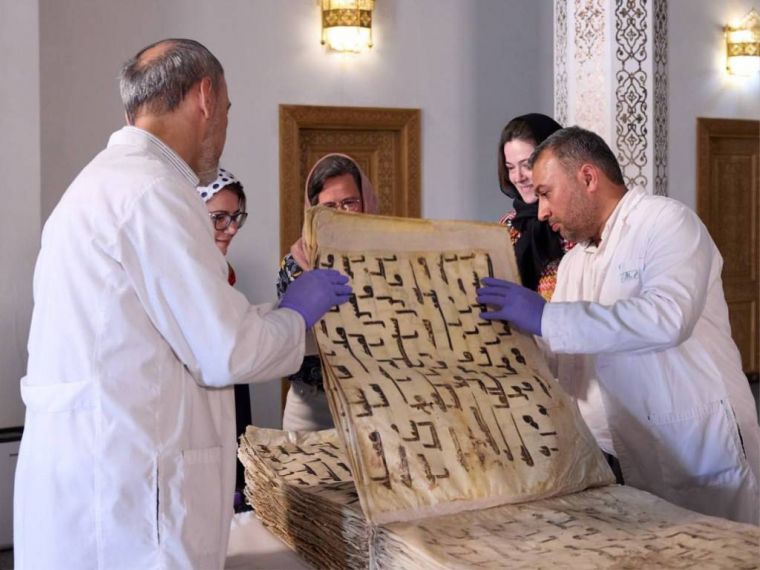
The Mushaf remained in the museum collection for several decades. In 1989, by a decision of the Government of Uzbekistan, the manuscript was transferred to the Muslim Board of Uzbekistan. On March 14, 1989, at the Fourth Congress of Muslims held in Tashkent, it was announced that the Mushaf had been returned to the custody of the Muslim community. In the following years, it was preserved at the Muyi Muborak Madrasa within the Hazrati Imam Complex.
 1996–2000: UNESCO recognition
The 1990s marked an important period in the international history of the Uthman Mushaf. In 1996, Uzbekistan nominated the manuscript for inclusion in UNESCO’s “Memory of the World” International Register. In 1997, the Uthman Mushaf was inscribed on the register. On August 28, 2000, a special certificate confirming this recognition was presented. Thus, the manuscript received international recognition as an important part of the world’s documentary heritage.
2007: a special preservation system
To preserve the ancient manuscript in accordance with modern conservation standards, Resolution No. 115 of the Cabinet of Ministers of the Republic of Uzbekistan was adopted on June 8, 2007. A specially designed protective system manufactured in Germany was installed, creating controlled temperature and humidity conditions for the preservation of the Mushaf. This marked an important step toward ensuring the manuscript’s long-term conservation.
November 13, 2025: a new home
Another important date in the history of the Uthman Mushaf is November 13, 2025. On that day, the manuscript was transferred from the Muyi Muborak Madrasa in the Hazrati Imam Complex to the Islamic Civilization Center in Uzbekistan and placed in a specially protected display case in the Holy Qur’an Hall. Since then, this rare monument associated with nearly fourteen centuries of history has been on display in the Center’s Qur’an Hall.
A Mushaf consisting of 338 folios
Today, this Mushaf consists of 338 folios, each measuring 53 × 68 centimeters. The Qur’anic text was written on deerskin in the Hijazi script. The manuscript was written without diacritical marks or vowel signs, with 12 lines of text on each page. Of the 114 surahs of the Holy Qur’an, 89 are not preserved in this Mushaf. Portions of the remaining 23 surahs have survived. Only two surahs — An‘am and Ta-Ha — have been preserved in their entirety.
 Today: the Mushaf beneath a 65-meter-high dome
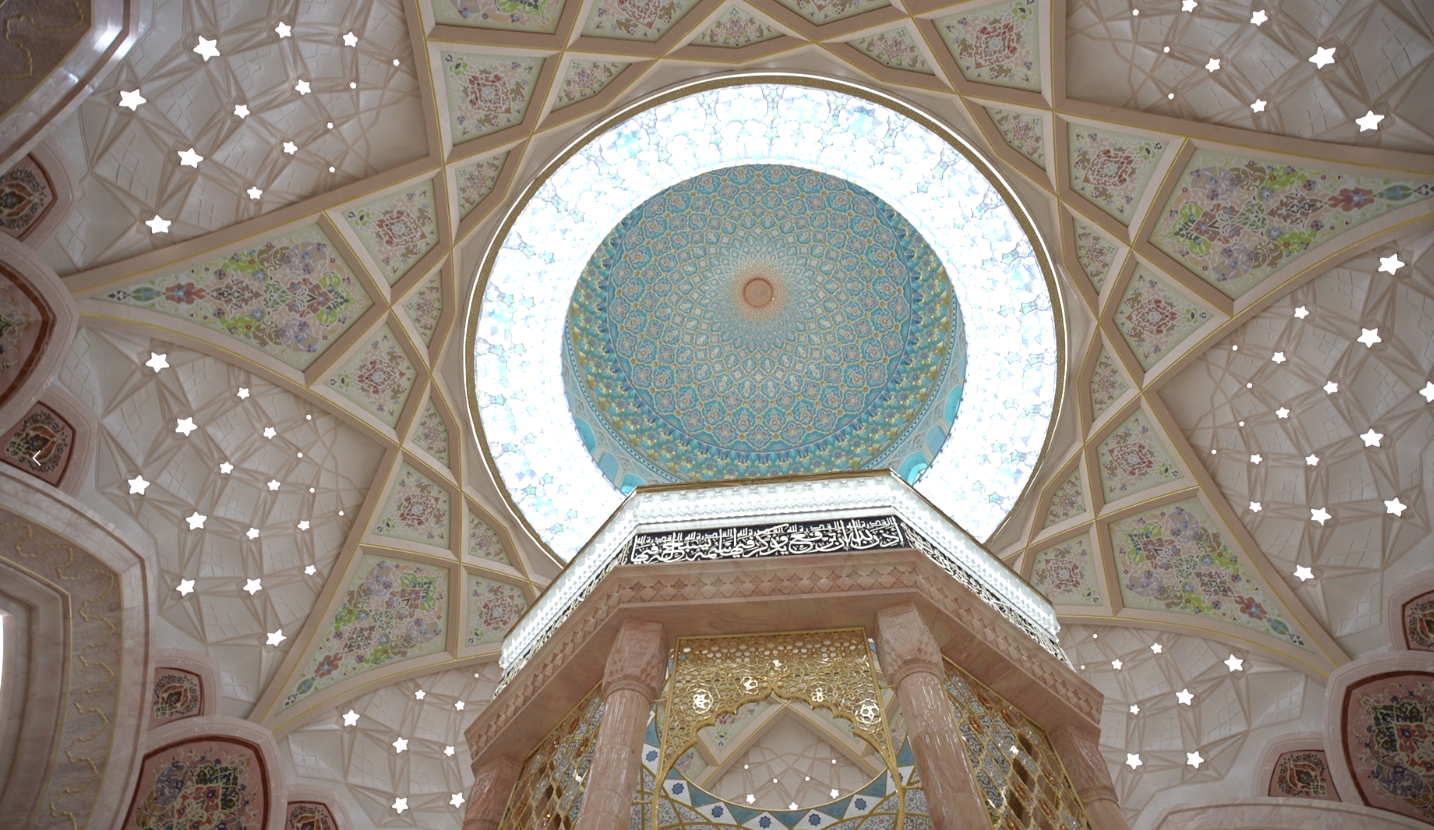
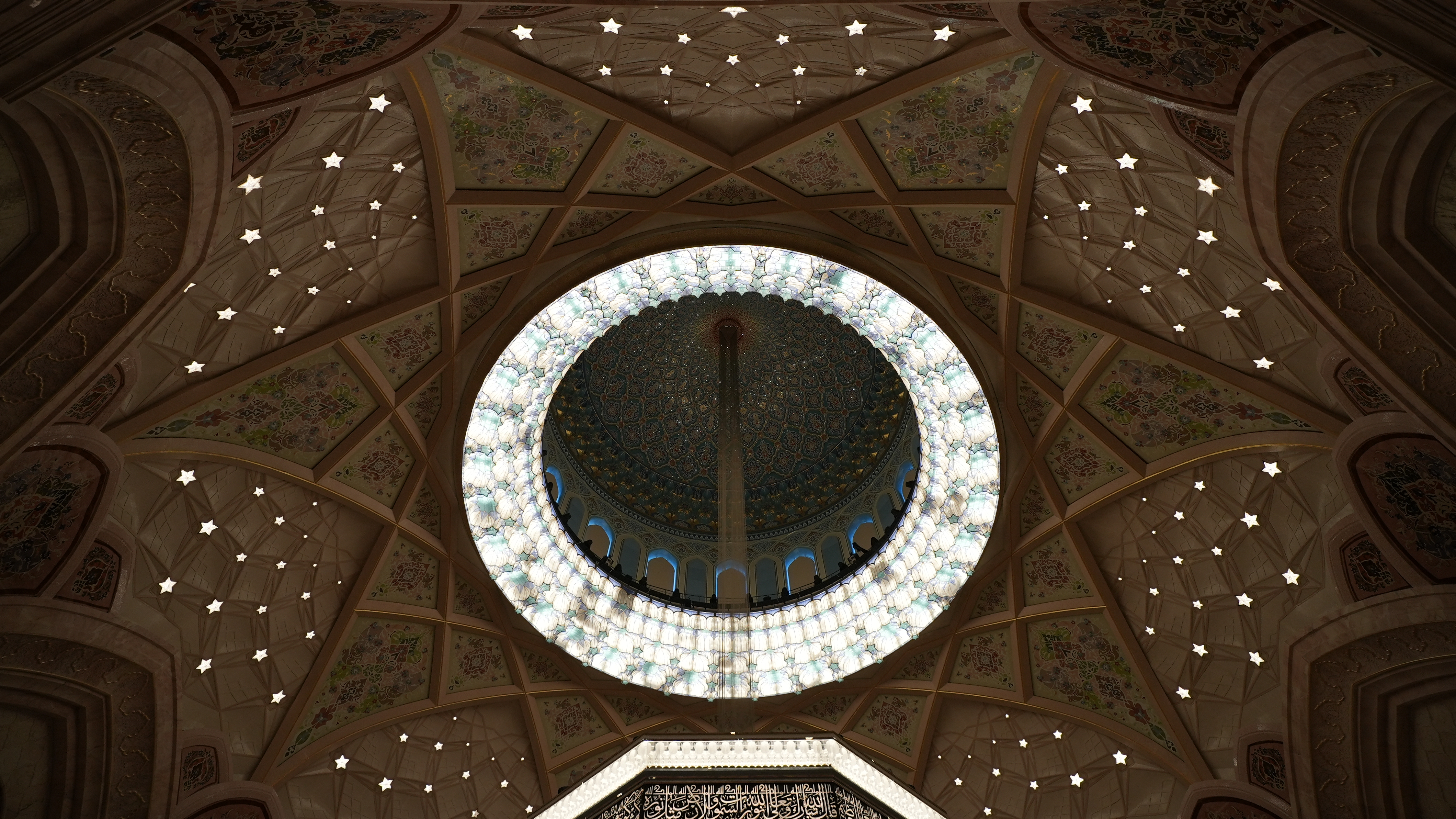
Visitors entering the Holy Qur’an Hall of the Islamic Civilization Center in Uzbekistan are first struck by its impressive scale. The octagonal hall has a diameter of 45 meters and a total area of 1,638 square meters. Looking upward, visitors see a monumental dome rising to a height of 65 meters. Its decorative design incorporates more than 1.6 million Swarovski crystals.
The hall also features a special Holy Qur’an mapping show created with modern multimedia technologies. Through a combination of light, imagery, and sound, the show presents the revelation of the Holy Qur’an in a powerful and artistic form. At the very center of this magnificent and symbolic space stands the seventh-century Uthman Mushaf.
 114 Qur’an manuscripts surrounding a single Mushaf
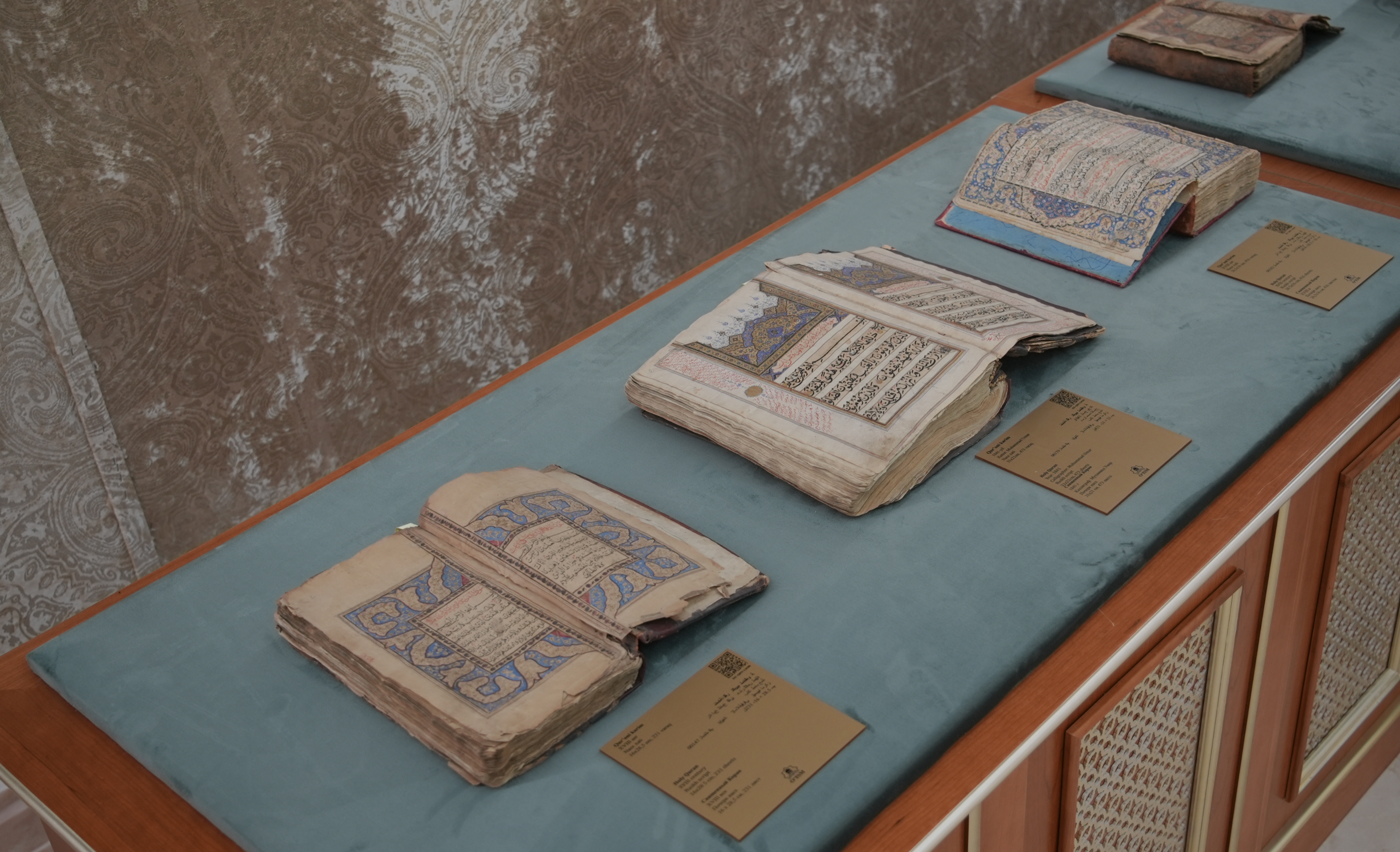
The exhibition in the Qur’an Hall is not limited to the Uthman Mushaf alone. A total of 114 Qur’an manuscripts are displayed around the central exhibit. This number is also symbolically significant, as the Holy Qur’an consists of 114 surahs.
The exhibition features Qur’an manuscripts dating from the Samanid, Karakhanid, Seljuk, Ghaznavid, Timurid, and Shaybanid periods. Thus, visitors to the hall encounter not only a single ancient manuscript, but also, within one space, the centuries-old traditions of Qur’anic manuscript production, calligraphy, and book culture that developed across Central Asia.
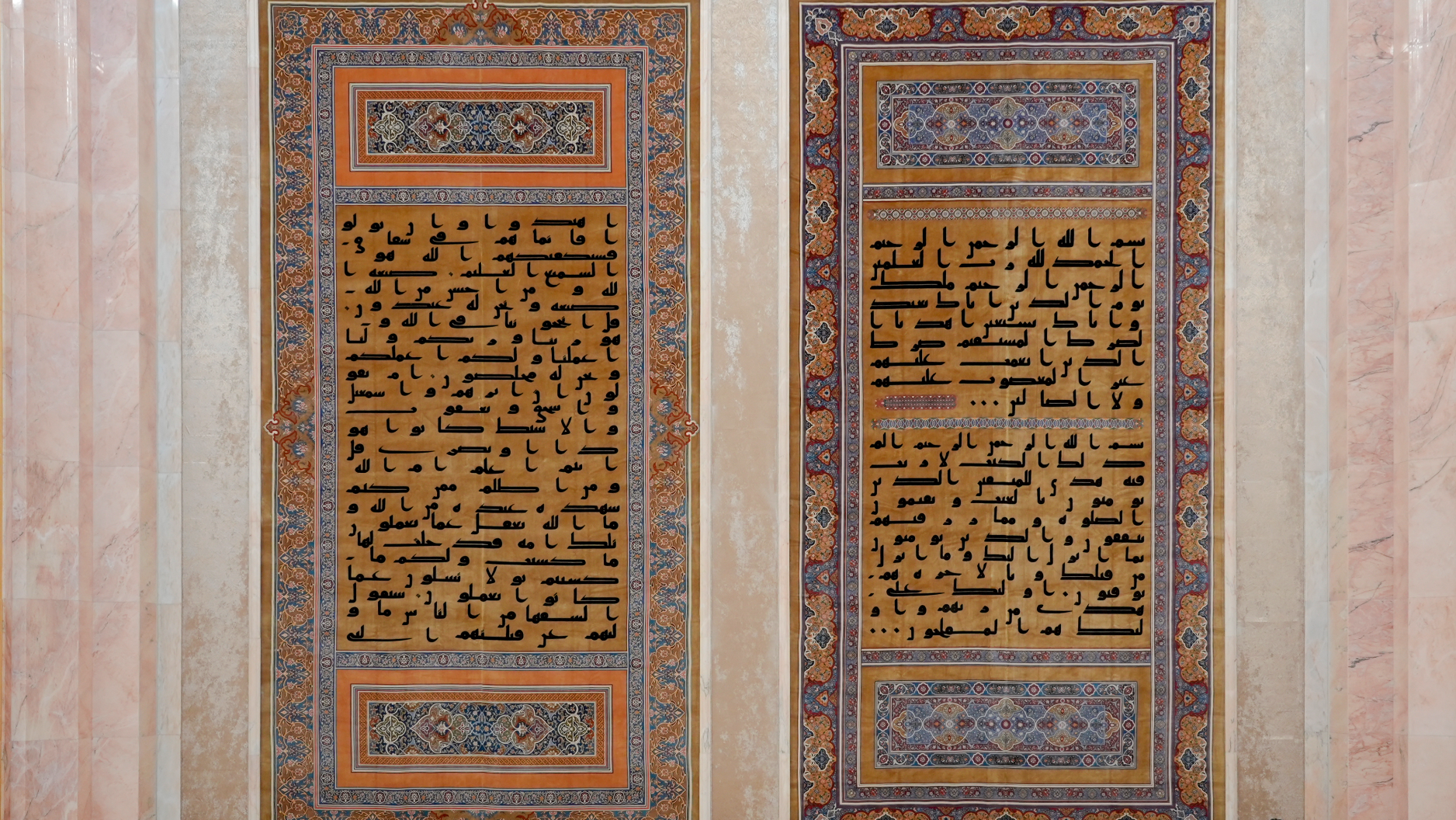
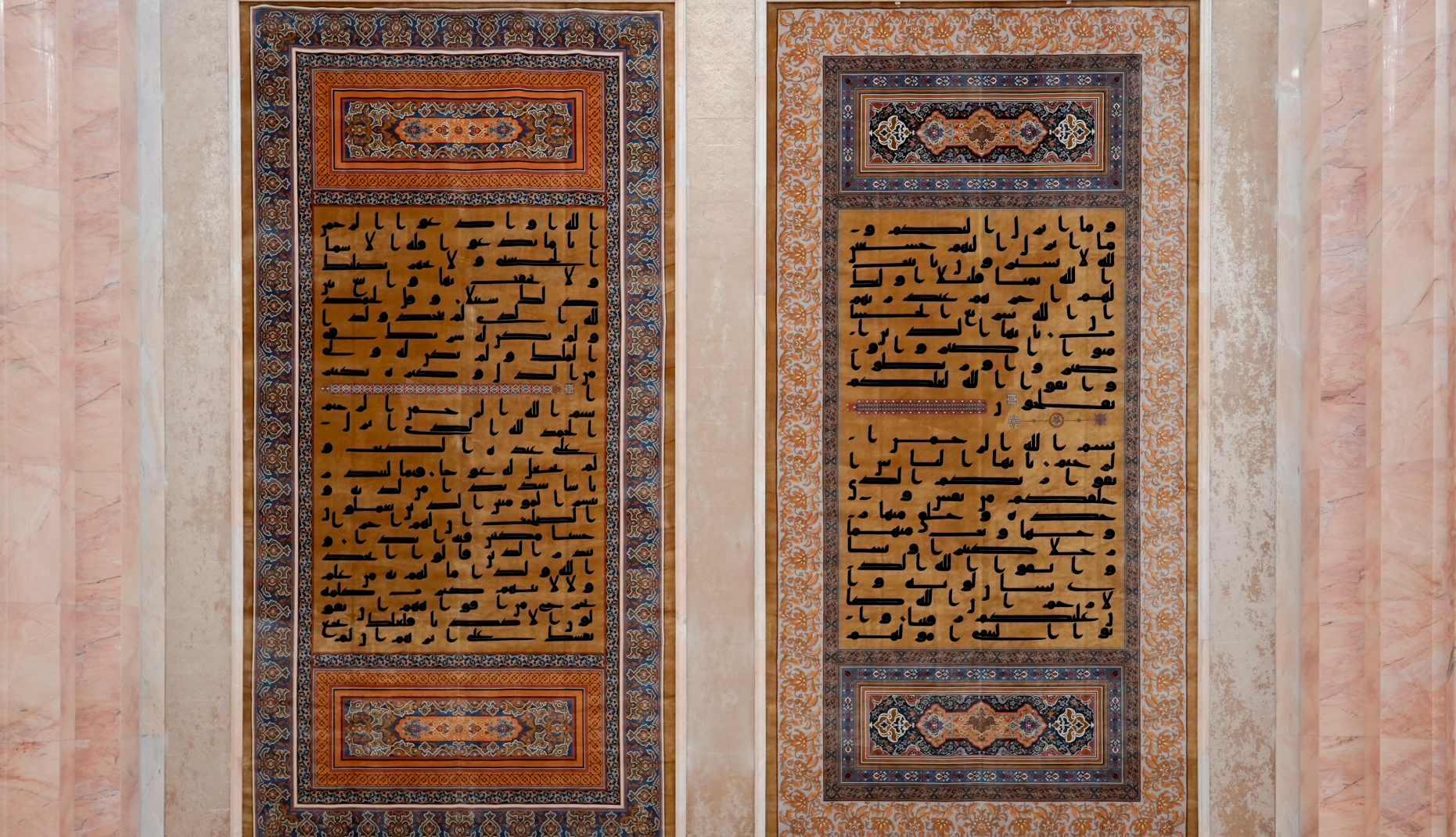 Eight silk carpets and eight shams
Another important artistic feature of the Qur’an Hall is its large silk carpets inscribed with verses from the Qur’an. A total of eight large silk carpets are displayed across the hall’s four arched sections. They bear selected verses from different surahs of the Holy Qur’an. In this way, architecture, calligraphy, manuscript heritage, and modern museum technologies are brought together in a single harmonious space. In addition, eight circular shams motifs are positioned above the carpets, each inscribed with a special supplication.
Sarvar Sharopov
P.S. The article may be republished provided that a link to the Center’s official website is included