Diplomatic Community: “Uzbekistan: Where the heritage of Islamic civilization meets the future”
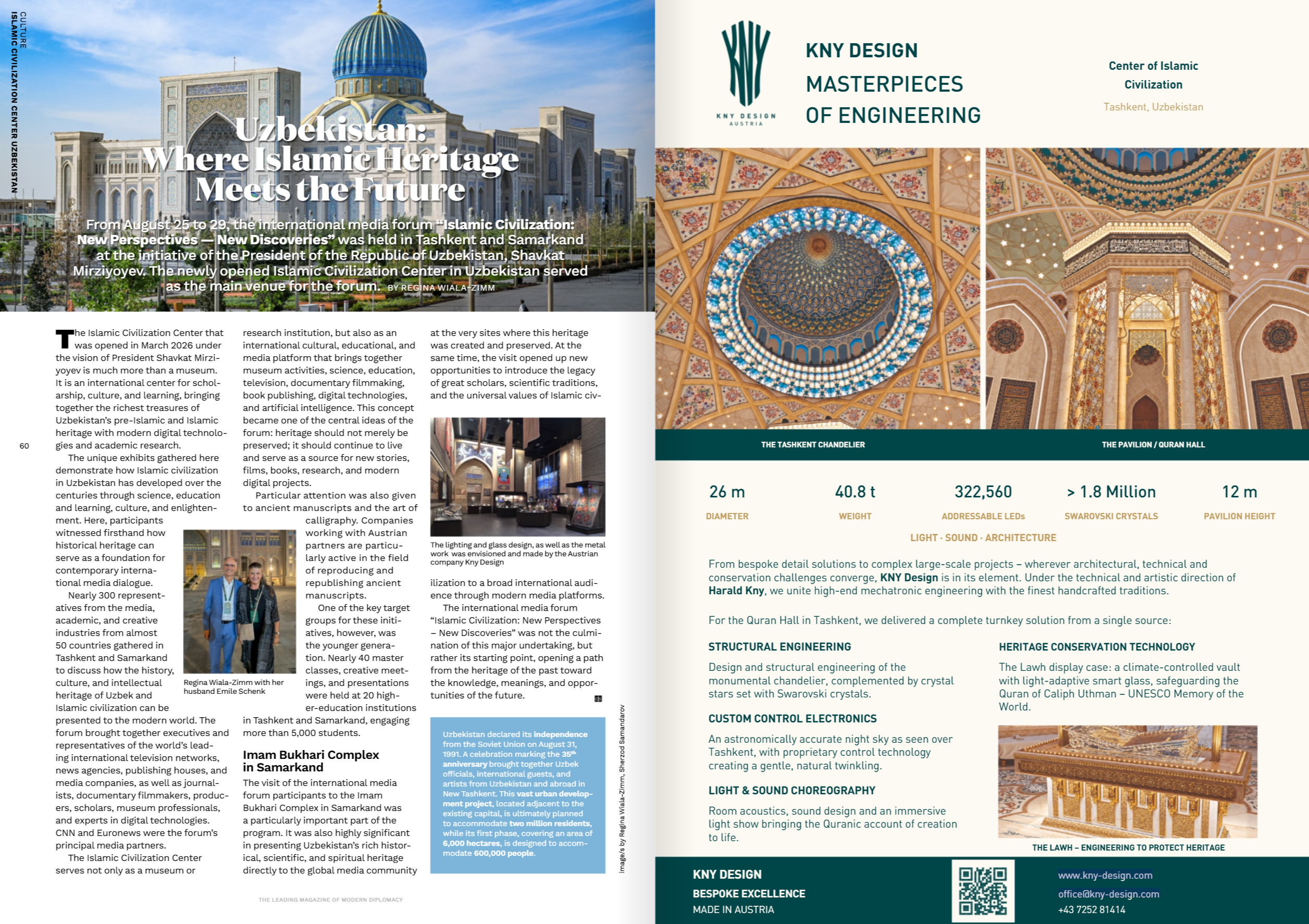
The Islamic Civilization Center in Uzbekistan, where historical heritage and modern technologies come together and new opportunities for global scientific and cultural dialogue are opening, is at the center of international attention. In her article, Regina Viala-Simm, an author for Diplomatic Society magazine, writes about the international media forum "Islamic Civilization: A New Perspective, New Discoveries," held in Tashkent and Samarkand, and highlights the importance of the Center not only in preserving unique historical monuments but also in conveying them to future generations through modern media, digital technologies, and scientific research.
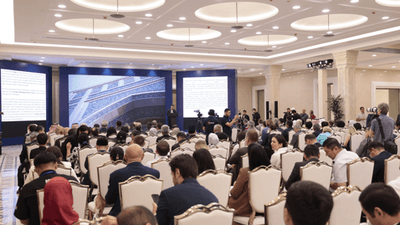
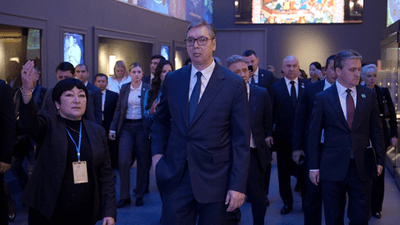
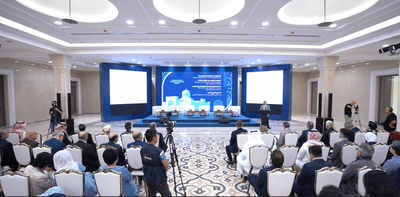
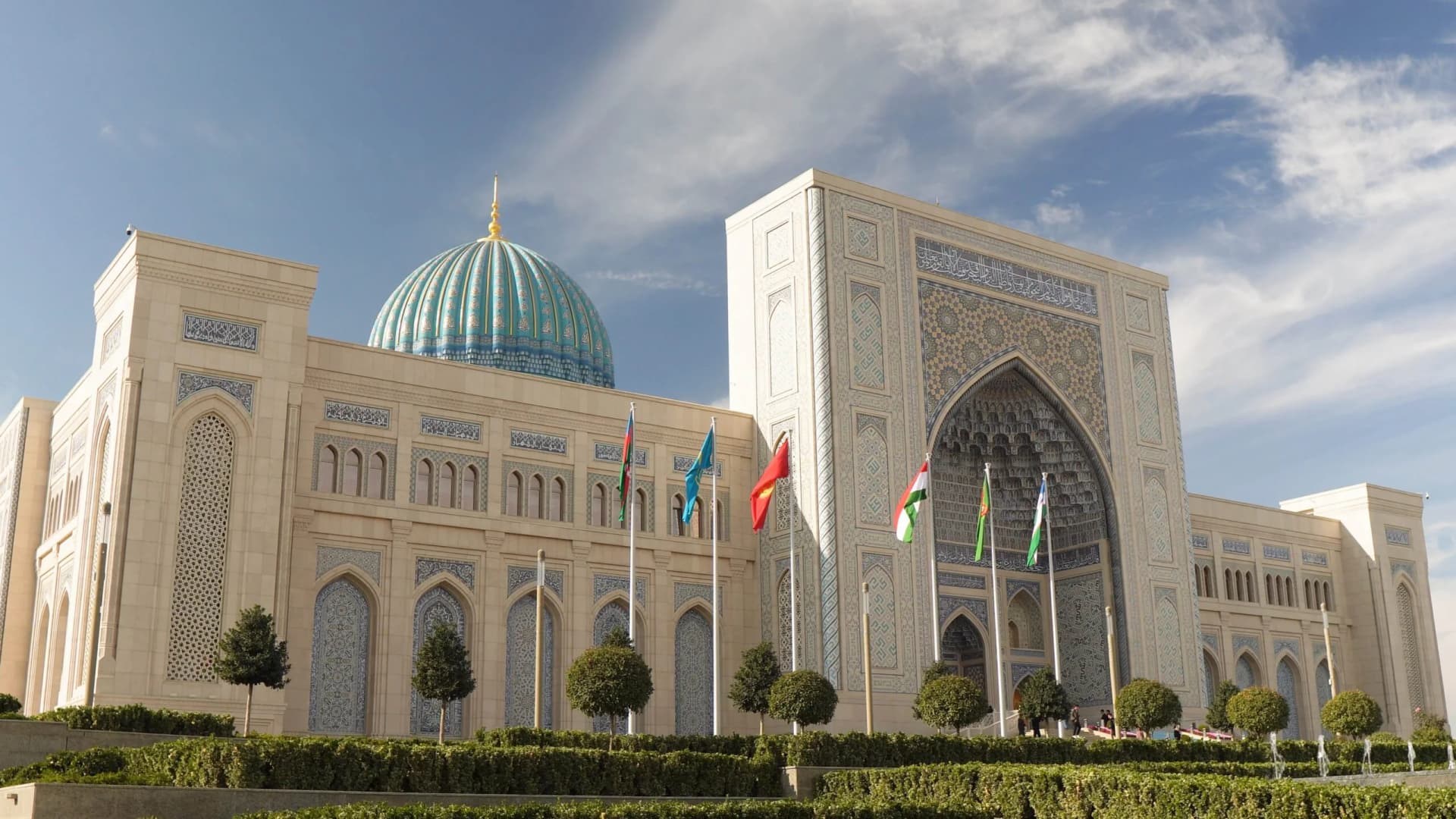
From August 25 to 29, on the initiative of the President of the Republic of Uzbekistan, Shavkat Mirziyoyev, the international media forum "Islamic Civilization: A New Perspective, New Discoveries" was held in the cities of Tashkent and Samarkand. The recently opened Islamic Civilization Center in Uzbekistan was chosen as the main venue of the forum.
Established on the idea of President Shavkat Mirziyoyev and opened in March 2026, the Islamic Civilization Center means far more than an ordinary museum. It is an international scientific, cultural, and educational center that combines Uzbekistan's rich pre-Islamic and Islamic civilizational heritage with modern digital technologies and academic research.
The unique exhibits gathered here demonstrate how Islamic civilization in Uzbekistan developed over the centuries through science, education, enlightenment, and culture. The forum participants witnessed firsthand that historical heritage can serve as a solid foundation for modern international media dialogue.
In Tashkent and Samarkand, nearly 300 participants from about 50 countries, representing the media, academia, and the creative sphere, came together. They discussed how to present the history, culture, and intellectual heritage of Uzbek and Islamic civilization to the modern world.
The forum was attended by heads and representatives of the world's leading international television channels, news agencies, publishing houses, and media companies, as well as journalists, documentary filmmakers, producers, scholars, museum specialists, and digital technology experts. CNN and Euronews were the forum's main media partners.
The Islamic Civilization Center operates not only as a museum or research institution but also as an international cultural, educational, and media space that unites museum activity, science, education, television, documentary film, book publishing, digital technologies, and artificial intelligence.
This very idea became one of the main themes of the forum: it is not enough merely to preserve heritage; it is necessary to keep it alive and turn it into a source for new stories, films, books, scientific research, and modern digital projects.
Particular attention was also paid to ancient manuscripts and the art of calligraphy. Companies working with Austrian partners on restoring ancient manuscripts, creating copies of them, and republishing them are especially active.
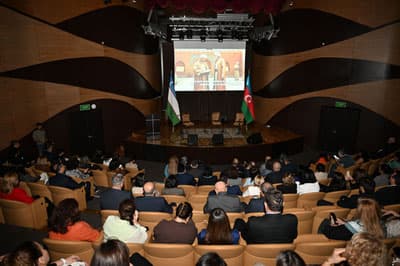
However, one of the main target audiences of these initiatives was the younger generation. In 20 higher education institutions in Tashkent and Samarkand, nearly 40 master classes, creative meetings, and presentations were held, with more than 5,000 students taking part.
The Imam al-Bukhari complex in Samarkand
The visit of the international media forum participants to the Imam al-Bukhari complex in Samarkand was one of the especially important parts of the program.
This visit was also of great significance in terms of directly showing the international media community Uzbekistan’s rich historical, scientific, and spiritual heritage in the very places where this heritage was created and preserved.
At the same time, the visit opened new opportunities for conveying the legacy of the great scholars, scientific traditions, and the universal values of Islamic civilization to a broad international audience through modern media platforms.
The international media forum “Islamic Civilization: A New Perspective, New Discoveries” was not the end of this large-scale work but its beginning. It opened a path from the heritage of the past toward the knowledge, meanings, and opportunities of the future.
Uzbekistan declared its independence from the Soviet Union on August 31, 1991. The celebrations dedicated to the 35th anniversary of the country’s independence brought together Uzbek officials, international guests, and artists from Uzbekistan and abroad in New Tashkent.
This vast urban development project, being built in an area adjoining the existing capital, is designed in the future for a population of two million. Its first phase, covering 6,000 hectares, is intended to create living conditions for 600,000 people.
Technical specifications
Parameter Value
Diameter 26 meters
Weight 40.8 tons
Addressable LED lights 322,560 units
Swarovski crystals More than 1.8 million
Pavilion height 12 meters
Light · sound · architecture
From special solutions for delicate details to complex, large-scale projects, any task that combines architecture, technical challenges, and the protection of cultural heritage is the core specialization of KNY Design.
Under the technical and artistic direction of Harald Kny, the company combines high-level mechatronic engineering with the most refined methods of traditional craftsmanship.
For the Qur'an Hall in Tashkent, we developed and delivered a complete, ready-to-use solution from a single source.
Design and engineering solutions
Developing the design and construction of the majestic chandelier, as well as creating a composition of stars decorated with Swarovski crystals.
Custom control electronics
Reproducing the night starscape over Tashkent with astronomical accuracy. For this purpose, a special control technology was developed, creating a soft, natural twinkling effect of the stars.
Light and sound direction
Creating the room's acoustics, sound design, and an engaging light show that brings to life the story of creation as described in the Quran.
Cultural heritage protection technologies
Tablet display case: reliable protection of the Mushaf of Caliph Uthman, inscribed in UNESCO's Memory of the World International Register, by means of a special protective chamber equipped with climate control and light-adaptive smart glass.
This article was automatically translated using artificial intelligence.