
Agenda Nexus: “Uzbekistan’s cultural renaissance”
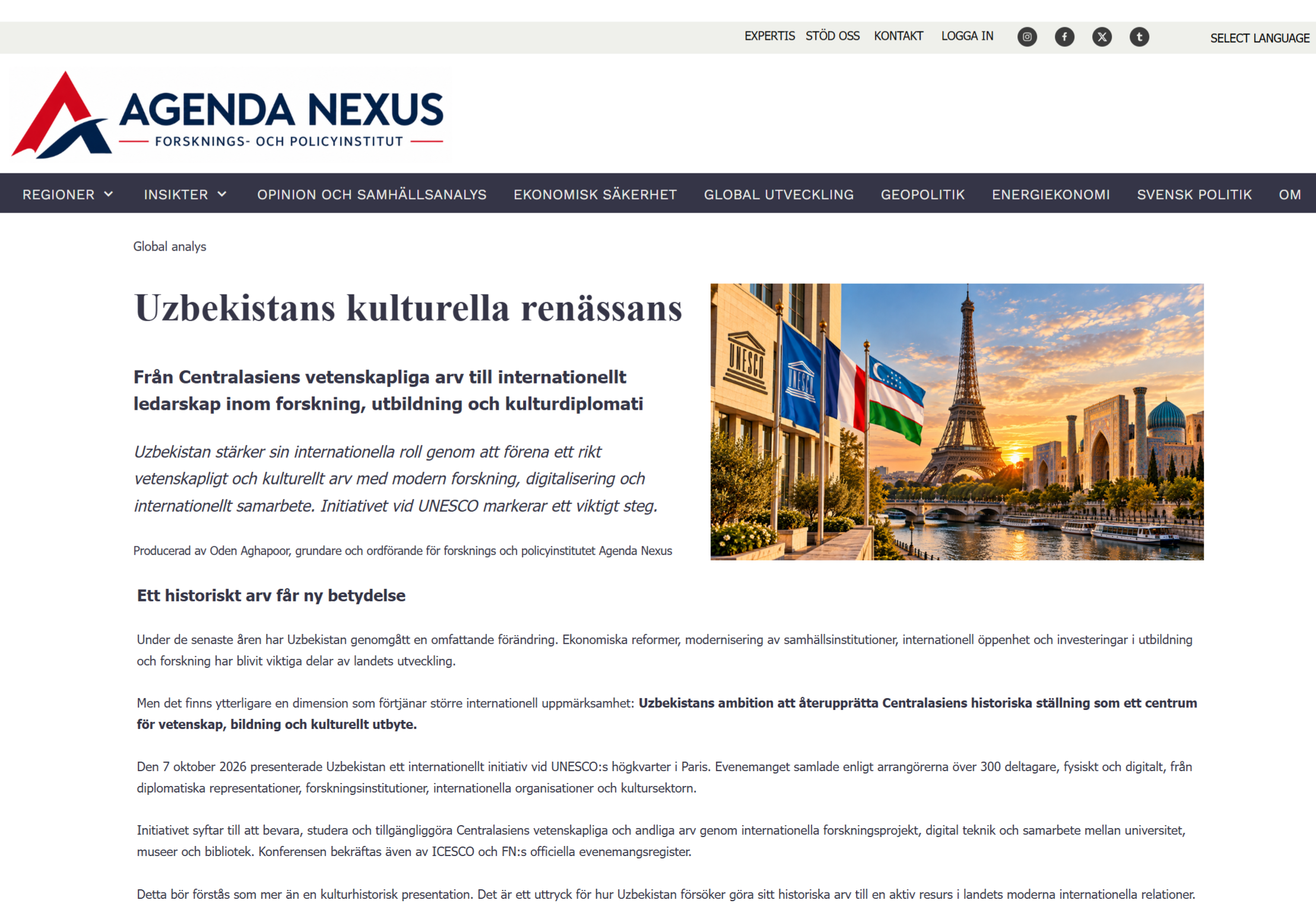
Uzbekistan is strengthening its standing on the world stage by combining its rich historical and scientific heritage with modern research, digital technologies, and international cooperation. In an article by Oden Agapur, founder of the Agenda Nexus institute, President Shavkat Mirziyoyev’s vision of the Third Renaissance, the international significance of the Islamic Civilization Center in Uzbekistan, and the initiatives advanced within UNESCO are analyzed from the perspective of the country’s new opportunities in science and cultural diplomacy.
From Central Asia’s scientific heritage toward international leadership in science, education, and cultural diplomacy
Uzbekistan is actively shaping its global role by combining its rich scientific and cultural heritage with modern research, digitization, and international cooperation. The initiative advanced within UNESCO is an important step along this path.
Historical heritage is taking on new meaning
In recent years, Uzbekistan has undergone extensive transformation. Economic reforms, the modernization of social institutions, growing openness to international cooperation, and substantial investment in education and scientific research have become key components of the country’s development.
However, another aspect also deserves significant attention from the international community: Uzbekistan’s aspiration to restore its historical position as a Center of science, education, and cultural exchange in Central Asia.
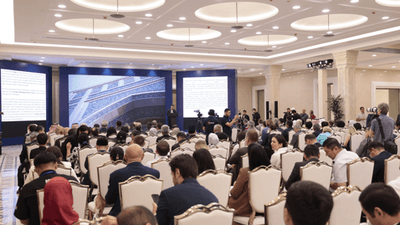
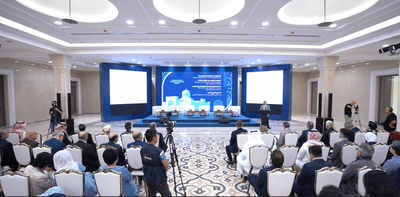
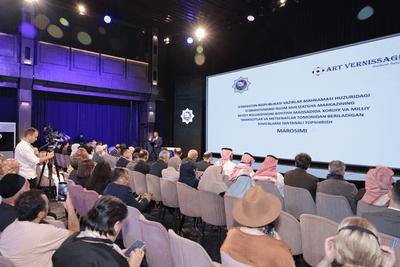
On October 7, 2026, Uzbekistan presented an international initiative at UNESCO headquarters in Paris. According to the organizers, more than 300 participants, including representatives of diplomatic missions, research institutions, international organizations, and the cultural sector, attended in person and online.
The initiative is dedicated to the preservation, scientific study, and global accessibility of Central Asia’s intellectual and spiritual heritage. To achieve this, it seeks to promote international research projects, digital technologies, and cooperation among universities, museums, and libraries. Information about the conference has also been recorded in the official event registers of the Islamic World Educational, Scientific and Cultural Organization (ICESCO) and the United Nations.
This event should not be viewed merely as a cultural and historical showcase. Rather, it demonstrates Uzbekistan’s efforts to turn its historical legacy into an active resource in modern international relations.
Central Asia is a meeting place of knowledge
For several centuries, the region historically known as Mawarannahr stood as a paramount center of scientific discovery and philosophical advancement.
Cities such as Samarkand, Bukhara, and Khiva served as vibrant meeting places for merchants, scholars, theologians, and thinkers. Through the Great Silk Road, not only goods but also mathematical concepts, astronomical observations, medical expertise, and philosophical traditions spread across regions.
Scholars such as Khwarizmi, Biruni, and Ibn Sina made enormous contributions to the advancement of scientific knowledge. Their pioneering works in mathematics, astronomy, medicine, and the natural sciences had a profound influence far beyond Central Asia and laid the groundwork for the work of later generations of scholars.
This legacy does not belong to Uzbekistan alone; it forms an indispensable part of humanity’s collective scientific heritage.
At the same time, present-day Uzbekistan possesses distinctive geographical and historical opportunities to showcase these traditions to the global community. The country’s cities, historical institutions, and preserved cultural spaces serve as a vital bridge connecting its past and the modern international scholarly community.
Eight sites in Uzbekistan are included on UNESCO’s World Heritage List. These include Samarkand, the historic center of Bukhara, and Itchan Kala in Khiva. This highlights the country’s important role in preserving the cultural history of Central Asia.
Mirziyoyev’s vision for a new renaissance
President Shavkat Mirziyoyev has consistently emphasised the close relationship between historical heritage, education, science, and national development.
This vision, described in Uzbekistan as the concept of the Third Renaissance, involves combining the scientific breakthroughs of previous eras with the needs of today’s research, innovation, and international knowledge exchange.
This strategic direction deserves special attention.
In many countries, cultural heritage is viewed mainly as a matter of preserving historical monuments and developing tourism. Uzbekistan, however, is trying to develop a model in which cultural heritage also serves as a foundation for future scientific activity, academic cooperation, and international dialogue.
The initiative at UNESCO can be seen as a continuation of this process. By bringing the legacy of Central Asia’s historical scholars to the international stage, Uzbekistan aims to contribute to a deeper understanding of how global scientific knowledge has developed through cross-civilizational exchange.
This ambition also has diplomatic significance. When historical scientific traditions become a foundation for new international partnerships, cultural heritage can serve as a bridge between institutions and societies.
An international center in Tashkent
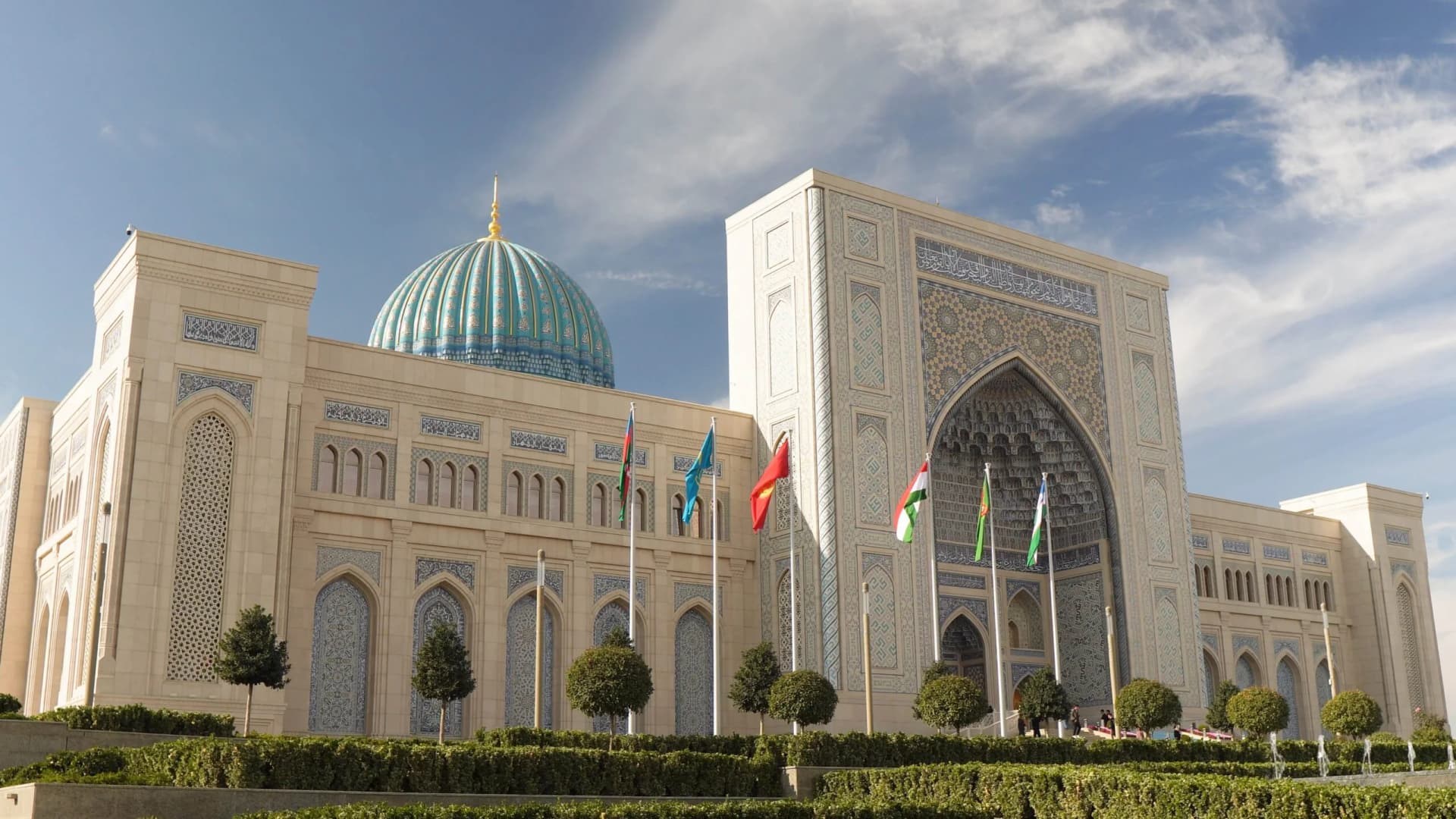
One of the key institutions in this process is the Islamic Civilization Center in Uzbekistan, located in Tashkent.
Established on the initiative of President Shavkat Mirziyoyev, the Center unites museum activities, scholarly collections, research, digitization, and educational programmes.
According to the Center’s mission, its infrastructure encompasses a world-class scientific library, expansive exhibition halls, and platforms for high-level international conferences. Its ambitious architectural design has also received international recognition. Notably, in 2026, the Center was included in the Prix Versailles list of remarkable museum buildings.
However, the Center’s significance is not limited to its building and collections.
Its long-term potential lies in its ability to turn Tashkent into an international meeting place for research into the scientific history of Central Asia and the Islamic world.
Here, historical manuscripts and artefacts can be connected with modern scientific research, digital archives, and academic exchange programmes.
This means that Uzbekistan not only presents its past to the international community but also builds institutional infrastructure for creating new knowledge and scholarly discoveries for the future.
Firdavs Abdukhalikov and international cooperation
One of the main figures contributing to this work is Dr. Firdavs Abdukhalikov, Director of the Islamic Civilization Center in Uzbekistan and Chairman of the World Society for the Study, Preservation, and Popularization of the Cultural Legacy of Uzbekistan (WOSCU).
His academic and organizational efforts have fostered extensive cooperation with international scholars, libraries, museums, and institutions.
During the presentation in Paris, Abdukhalikov emphasised the need to strengthen joint efforts to make Central Asia’s historical legacy of knowledge more accessible to today’s researchers and future generations.
This is an important perspective.
Individual countries may preserve extensive historical collections, but the materials needed for scholarly research are often scattered across several continents. Manuscripts and historical documents are held in international collections across Europe, Asia, and other regions.
Consequently, a deeper understanding of the scientific history of Central Asia requires cooperation that goes beyond national borders.
Abdukhalikov’s international work can be assessed as part of Uzbekistan’s broader effort to establish long-term scientific partnerships.
The scale of this global engagement was distinctly reflected at the Paris forum through the active participation of high-level delegations from leading international organizations, including ICESCO and IRCICA.
Digitization as a strategic investment
One of the most noteworthy aspects of Uzbekistan’s initiative concerns digital technologies and artificial intelligence.
The plans include creating an international digital platform for historical sources, using artificial intelligence to study manuscripts, establishing a scientific consortium, and supporting young researchers.
Here, historical legacy intersects directly with technological innovation.
Digitization helps make rare documents accessible to researchers who may not be able to visit archives and libraries in person. Text analysis and image processing technologies can also support the identification, cataloguing, and cross-comparison of historical manuscripts.
At the same time, such research requires rigorous scientific quality control, reliable metadata, respect for the provenance of collections, and long-term international cooperation.
If the initiative is carried out on the basis of these principles, Uzbekistan can contribute to making international research infrastructure more open and accessible.
This would give the country’s efforts to develop cultural and historical heritage a significance far broader than museum activity.
Cultural diplomacy as an advantage on the international stage
Uzbekistan’s proactive engagement within UNESCO also demonstrates how cultural diplomacy can reinforce and expand traditional foreign policy.
Diplomatic relations are conventionally shaped by commerce, security, foreign investment, and political agreements. However, international influence is also shaped by scientific research, education, culture, and institutional ties.
When a country opens its historical collections, supports international research, and creates platforms where representatives of different academic traditions can meet, new opportunities for cooperation emerge.
This is what makes Uzbekistan’s strategy distinctive.
The country has a rich historical heritage, a strategic position in Central Asia, and a commitment to deepening international relations. By bringing these strengths together, Uzbekistan could establish a distinctive role in the field of international knowledge diplomacy.
These efforts could also contribute to a richer international understanding of Islamic Civilization, with particular emphasis on science, education, intercultural exchange, and intellectual development.
From international forums to sustainable institutions
In its analytical assessments, Agenda Nexus has highlighted Uzbekistan’s modernization processes, its openness to international cooperation, and its vital function as an interregional connective bridge.
Oden Agapur’s participation in international events in Uzbekistan, along with his meetings and visits to universities and research institutions, has helped the organization gain a better understanding of the country’s development processes.
One important conclusion that has emerged repeatedly is the value of aligning international ambitions with institutions engaged in practical work and personal academic networks.
The presentation in Paris should be assessed from this perspective as well.
An international event can attract attention, but the long-term results of an initiative are determined precisely by scientific programmes, academic partnerships, and joint projects.
Therefore, Uzbekistan possesses significant potential. However, realizing this potential will require continuity, sustained scientific transparency, and adherence to international quality standards.
Strategic Conclusions
Uzbekistan’s initiative within UNESCO reflects an approach oriented toward viewing cultural heritage not merely as historical wealth, but as a foundation for international cooperation and new future knowledge generation.
From Agenda Nexus’s perspective, three key conclusions stand out.
First, Uzbekistan has an opportunity to further consolidate its position as an international center for the study of Central Asia’s scientific and cultural history.
Second, integrating digitization, scientific research, and international cooperation can turn historical collections into a more active part of the global scientific infrastructure.
Third, this initiative demonstrates how cultural diplomacy can play an important role in Uzbekistan’s international relations and strengthen mutual understanding between countries, institutions, and generations.
Thus, the strategic significance lies not only in Uzbekistan rediscovering its historical heritage and presenting it to the international community.
The main significance lies in the aspiration to use this heritage to create new knowledge, new partnerships, and unlock future opportunities.
This is also where the deeper meaning of the concept of the Uzbek renaissance emerges: it is not a return to the past, but an attempt to put historical knowledge in the service of the development of a modern, internationally connected, and science-oriented society.