UzA: “Uzbekistan's great spiritual and scientific heritage showcased in Paris”
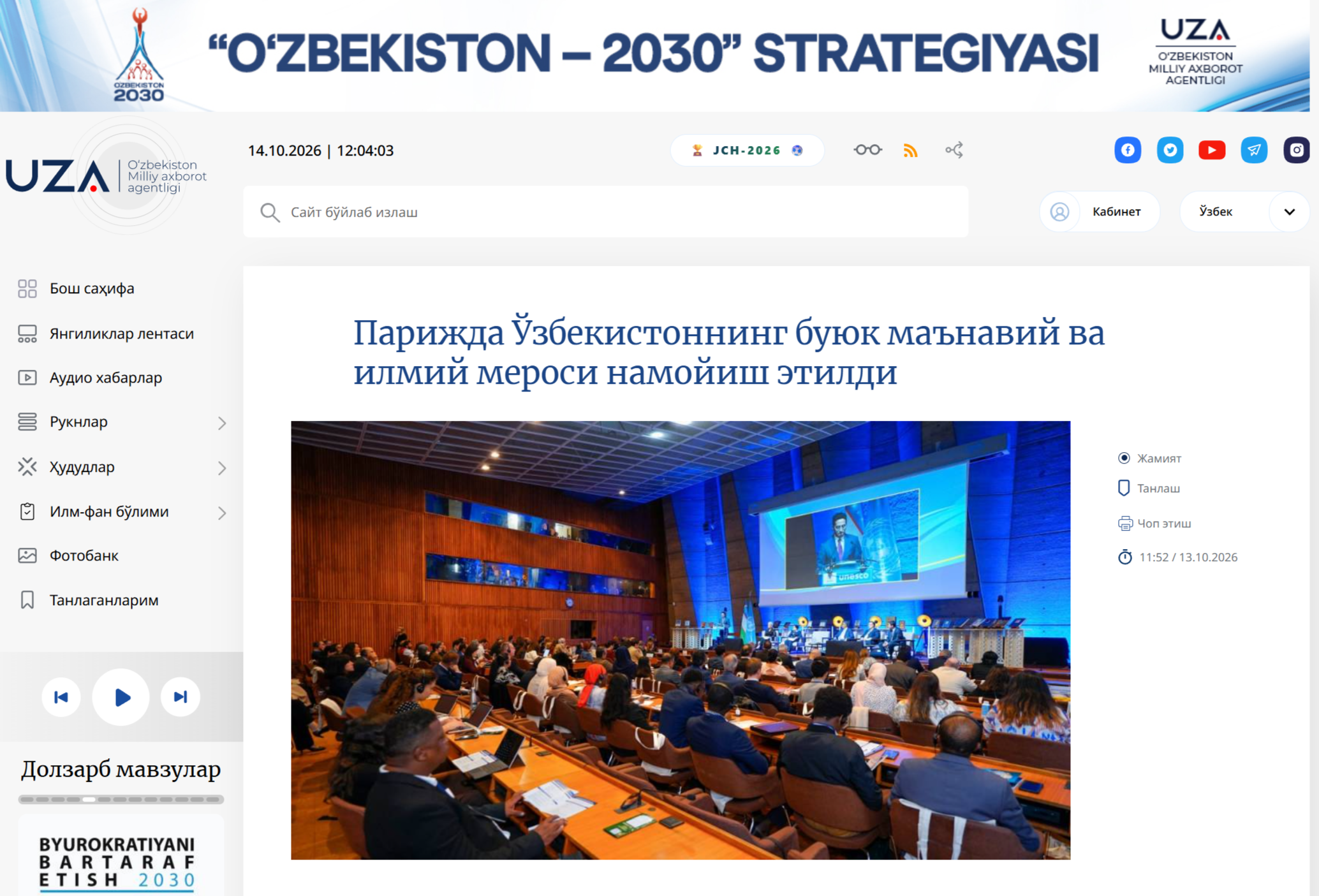
Uzbekistan’s rich spiritual and scientific heritage was widely showcased to the international community in Paris. An article by Rustam Jabborov, Scientific Secretary of the Islamic Civilization Center in Uzbekistan, published by the National Information Agency of Uzbekistan (UzA), covers promoting the scientific legacy of our great scholars through the UNESCO platform, the historical role of Amir Temur and the Timurid Renaissance in world civilization, and the advancement of historical ties between East and West. The author also underscores the vital role of the Islamic Civilization Center in Uzbekistan, established on the initiative of President Shavkat Mirziyoyev, in popularizing our national heritage internationally and developing international scientific and cultural cooperation.
Widely promoting Uzbekistan’s rich history, the invaluable contributions of its scholars, and its enduring role in world civilization has become a central priority of the cultural and educational reforms underway in New Uzbekistan.
The Islamic Civilization Center in Uzbekistan, established on the initiative of our President Shavkat Mirziyoyev, is a major scientific and educational institution serving the realization of these objectives. Sustained efforts are being carried out to introduce the Center’s activities to the international community and to connect its scientific and cultural potential with the leading international organizations and prestigious research institutions.
The international events organized in Paris, the capital of France, on October 7–8, 2026, were also a natural progression of these strategic efforts. Over the two days, discussions held at UNESCO Headquarters, the Embassy of the Republic of Uzbekistan in France, and the country’s leading scientific and cultural institutions covered our country’s civilizational heritage, historical dialogue between East and West, and prospects for science and cultural cooperation.
At the UNESCO forum...
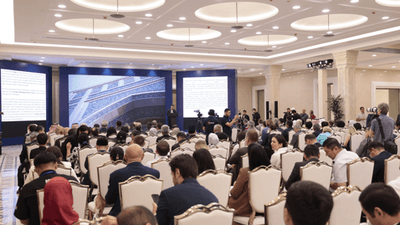
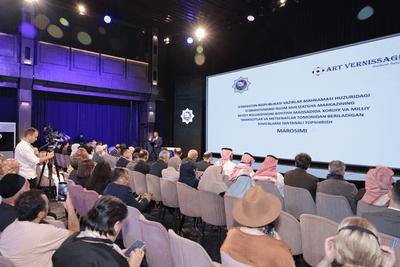
On October 7, an international conference titled “Islamic Civilization: Mawarannahr’s Great Spiritual and Scientific Heritage and Horizons of Enlightenment” was held at UNESCO Headquarters in Paris, and a special presentation dedicated to the Islamic Civilization Center in Uzbekistan was also organized.
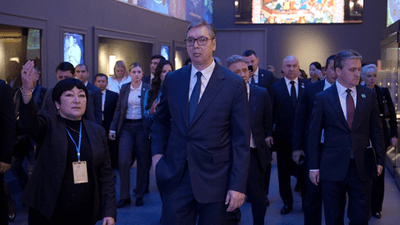
It is worth noting that Paris, where UNESCO Headquarters is located, is one of the ancient centers of world science, art, and culture. This city, with a history of more than two thousand years, is home to prestigious institutions such as the Louvre Museum, the Sorbonne University, and the National Library of France. The conference was attended by a delegation led by Firdavs Abdukhalikov, Director of the Islamic Civilization Center in Uzbekistan and Chairman of the World Society for the Study, Preservation and Popularization of the Cultural Legacy of Uzbekistan.
The main theme of the conference concerned the renowned scientific schools established on the territory of Uzbekistan, the contribution of the Muslim East to world science, and innovative methods of studying and promoting this heritage. The presentations and visual materials dedicated to the activities of the Islamic Civilization Center in Uzbekistan aroused great interest among foreign participants. Indeed, this complex performs functions far broader than the traditional concept of a museum. It presents, within a unified scientific concept, civilizations from the pre-Islamic period onward, the First and Second Renaissance, the contributions of great thinkers, the manuscript heritage, the evolution of statehood, science, and art.
Cultural heritage as the foundation of dialogue
At the conference held at UNESCO Headquarters, the heads of prominent international organizations highlighted Uzbekistan’s comprehensive reforms in safeguarding cultural heritage and advancing scientific research.
In particular, ICESCO Director General Salim Al-Malik emphasized that Islamic civilization is intrinsically rooted in the values of peace, brotherhood, culture, and science. According to him, cultural heritage is a vital bridge that strengthens mutual understanding among peoples, generations, and civilizations, while collaborative initiatives in science and education fundamentally bring diverse societies closer together. Salim Al-Malik highly praised the work being done in this regard at the initiative of the President of Uzbekistan, Shavkat Mirziyoyev.
In his speech titled “Spiritual heritage, the awakening of thought, and modern progress,” Professor Mahmud Erol Kılıç, Director General of IRCICA, drew attention to the need for a comprehensive scholarly approach in studying the history of civilizations. He observed that human progress cannot be confined to the narrative of a single nation or geographic region. The interaction among different civilizations, and the exchange of scientific ideas and spiritual values, have been decisive in the formation of world culture.
Scholarly insights presented at the conference by Professor Mario Taddei of the Milan Institute of Design in Italy also drew the attention of the participants. The scholar spoke about the influence of the scientific legacy of great scholars such as Khwarazmi, Ibn Sina, and Beruni on the thought of the European Renaissance, in particular on the work of Leonardo da Vinci. Such scholarly approaches once again show how important a place the intellectual environment formed in Mawarannahr held in the development of global science.
It is well known that Khwarazmi’s research in mathematics, Beruni’s encyclopedic scientific legacy, and Ibn Sina’s works on medicine and philosophy served the development of Eastern and Western science for centuries. For this reason, widely promoting the legacy of our great ancestors in international scientific arenas is also relevant from the standpoint of restoring historical truth, stimulating young people’s interest in science, and strengthening educational ties among different peoples.
The legacy of Amir Temur at the Center of French scholars’ attention
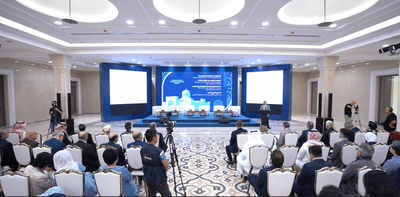
On the second day of the events in Paris, October 8, an international scientific conference dedicated to the 690th anniversary of the birth of Amir Temur was held at the Embassy of the Republic of Uzbekistan in France.
It is well known that in the late 14th and early 15th centuries, the state of Amir Temur established diplomatic relations with European countries. Notably, the correspondence between Sahibkiran Amir Temur and King Charles VI of France is regarded as an important historical source on the international relations of that era. These letters testify that more than six centuries ago, political and diplomatic dialogue already existed between Mawarannahr and Western Europe. Today, these relations are being enriched with new content in the fields of science, history, culture, and spiritual heritage. During the conference, Firdavs Abdukhalikov delivered a report titled “Amir Temur and the Timurid Renaissance: a great historical heritage connecting East and West.”
Indeed, the Timurid era was a stage of great cultural advancement in the history of Central Asia. During this golden age, Samarkand and Herat became major scientific and cultural centers. The Observatory of Ulugh Beg, the works of Alisher Navoi, the miniature school of Kamoliddin Behzod, and the achievements in architecture and the art of the book are vivid expressions of this renaissance.
Today, great attention is being paid at the Islamic Civilization Center in Uzbekistan to studying this heritage in depth and illuminating its place in the development of world civilization on a scientific basis. The fact that France has its own distinctive scholarly traditions of researching Timurid history was also clearly demonstrated during the conference.
In particular, Frederic Bressand, Founder and President of the Association for the Study of History and Art of the Timurids, took part with a report devoted to Amir Temur’s activity as a patron of art and culture. The scholar has been engaged in researching and popularizing Timurid history and art since the 1980s. The journal “Timurids,” associated with his work, has helped increase interest in the heritage of this period within the French scientific community.
Catherine Poujol, a professor at the National Institute for Oriental Languages and Civilizations (INALCO) in Paris, delivered a report on the journey of the Spanish ambassador Ruy Gonzalez de Clavijo to Samarkand and his famous travelogue.
The observations Clavijo recorded during his visit to Amir Temur’s court in the early 15th century remain an indispensable primary source today for studying the history of the Timurid era, court ceremonies, the urban appearance of Samarkand, and the social life of that period.
Frans Grenet, Professor at the Collège de France and a renowned archaeologist, set out his views based on historical sources concerning Amir Temur’s relations with China and his plans for military campaigns. Art historian and researcher Sharora Solihiy focused on the cultural environment of the Timurid era, the poetry of Alisher Navoi, and his patronage of creative figures. Sali Shahsivari, Managing Director of the Al-Furqan Islamic Heritage Foundation, spoke about the role of the Timurid era in the development of science and enlightenment. Thus, the conference approached the legacy of Amir Temur and the Timurids from the perspectives of history, Oriental studies, art history, diplomacy, and source studies.
As part of the international conference dedicated to the 690th anniversary of the birth of Amir Temur, an exhibition titled “The Great Legacy of the Timurids: The Art, Science, and Culture of Central Asia” was also organized. The exposition displayed materials on Timurid-era architecture, artistic culture, the art of the book, and the traditions of science and enlightenment. In particular, the scholarly and popular-science publications prepared by the Islamic Civilization Center in Uzbekistan and the Imam Bukhari, Imam Termizi, and Imam Maturidi International Research Centers aroused interest among foreign guests.
The treasure at the National Library of France
One of the particularly significant meetings during the visit to Paris was the dialogue held at the National Library of France. The Library’s collection of Oriental manuscripts has been regularly enriched since the 17th century. In particular, during the reign of King Louis XIV, great attention was paid to collecting works in Arabic, Persian, Turkic, and other Eastern languages.
Notably, this repository also holds priceless manuscripts related to the history, classical literature, and intellectual heritage of Uzbekistan. Among them are rare manuscript copies of seminal works by renowned thinkers and poets, including Alisher Navoi, Zakhiriddin Muhammad Babur, and Haydar Khwarazmi. During the meeting, it was reported that the library holds more than 150 manuscripts written in Old Uzbek.
In the discussions with Laurent Hericher, Head of the Oriental Manuscripts Department in BnF, prospects for studying these collections, describing them scientifically, and conducting joint research were discussed. At the meeting, books published by the Islamic Civilization Center in Uzbekistan and the Imam Maturidi International Scientific Research Center were presented to French specialists.
Dialogues at the Louvre Museum and the Paris Institute of Islamic Studies
As part of its visit to France, the Uzbek delegation also visited one of the world’s most famous museums, the Louvre. The Louvre is a major cultural institution that brings together artistic and historical heritage belonging to different eras and civilizations of humanity. Its exhibitions display works of art from Ancient Egypt, Greece, Rome, the countries of the East, and other civilizations.
Another significant meeting in Paris was held at the Islamic Institute attached to the Grand Mosque of Paris - Grande Mosquée de Paris. Opened in 1926, this complex occupies an important place in the life of French Muslims. Its architecture reflects a distinctive harmony of Eastern artistic traditions and the Parisian urban environment. The institution’s rector, Chems-eddine Hafiz, spoke highly of the work being carried out in our country under the leadership of President Shavkat Mirziyoyev to preserve historical and cultural heritage, reinforce religious tolerance, and develop enlightenment.
Indeed, today, on the initiative of our President, the idea of laying the foundation of the Third Renaissance in Uzbekistan is being consistently put into practice. In this process, restoring historical memory, supporting science, and developing cooperation with the world’s leading scientific centers play an important role.
“Alongside establishing the Islamic Civilization Center in Uzbekistan, the idea of broadly promoting our country’s profound spiritual heritage and the incomparable contribution of our great scholars to world civilization on the platforms of prestigious international organizations such as UNESCO and the UN, and in the world’s leading countries, was also put forward directly by our President Shavkat Mirziyoyev,” said Firdavs Abdukhalikov, Director of the Center.
“Indeed, today we see the practical results of this initiative in the example of international scientific and cultural dialogue. More than six centuries ago, diplomatic letters were exchanged between Amir Temur and King Charles VI of France; today, Tashkent and Paris are connected by collaborative research, scientific conferences, museums, manuscripts, and cultural and educational projects. This new meaning given to historical bonds serves to strengthen relations between Uzbekistan and France and to expand cooperation between Eastern and Western scholarly schools.”
Thus, our primary objective is to conduct rigorous, scholarly research on the intellectual treasures left by our ancestors, integrate them into the global scientific dialogue, and ensure they actively inform contemporary cultural and intellectual progress.