Euronews: “From Samarkand to Paris: Preserving Central Asia’s scientific heritage”
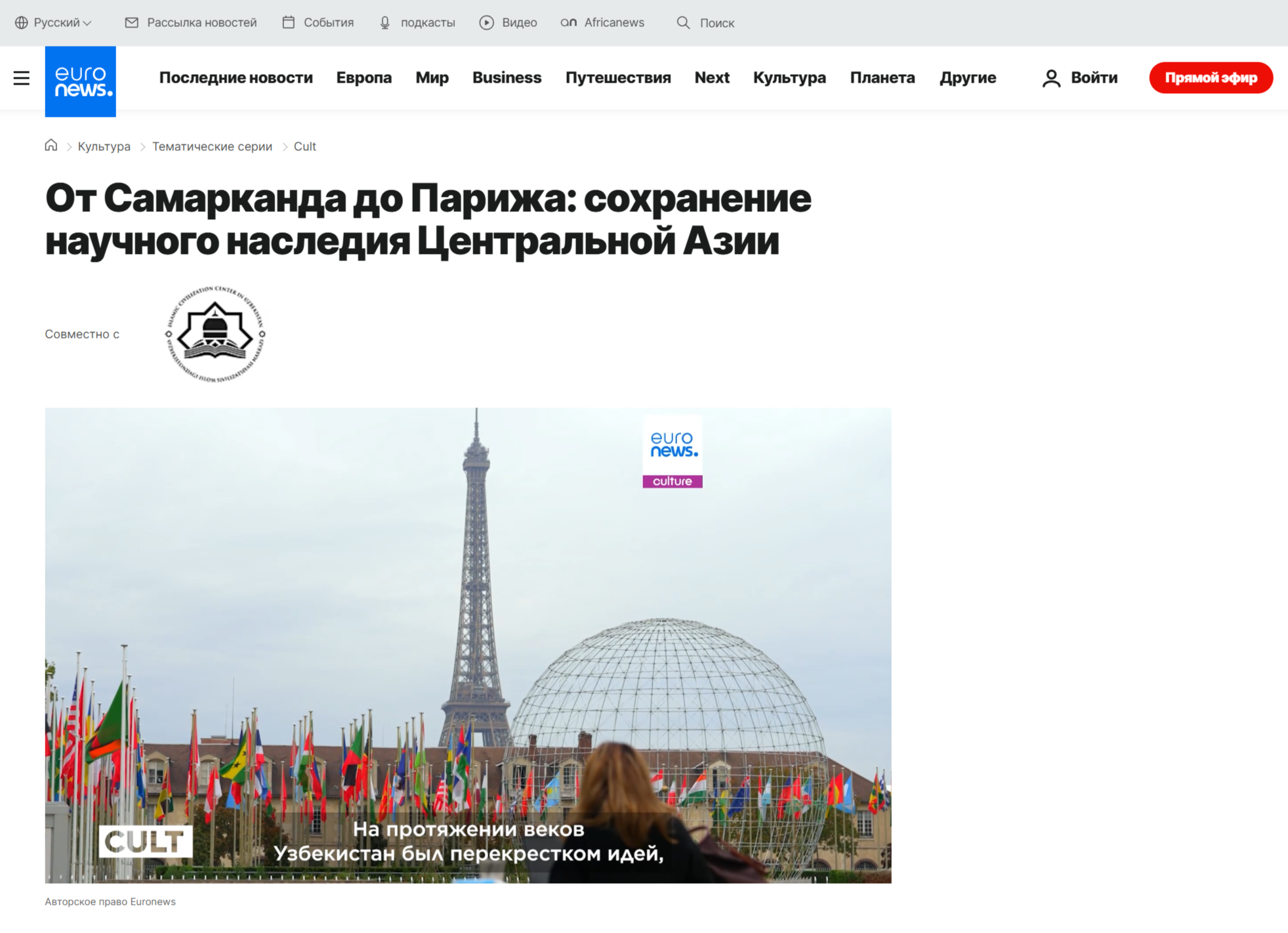
Euronews, a leading international news network serving global and European audiences, recently highlighted Uzbekistan’s initiatives to preserve, study, and promote Central Asia’s profound scientific legacy on the international stage. The article underscores the international conference held at UNESCO Headquarters in Paris and the contribution of great scholars to the development of world civilization. It also emphasizes the pivotal role of the Islamic Civilization Center in Uzbekistan in studying unique manuscripts, digitizing cultural heritage, and developing international scientific cooperation.
From the renowned thinkers of the Great Silk Road to the new research institutions in Tashkent, Uzbekistan continues its dedicated mission to bring its rich historical heritage to the global community. Experts gathered at UNESCO Headquarters in Paris to discuss the contribution made to the development of world civilization and the value of shared cultural heritage.
For centuries, Central Asia was a crossroads of scientific discovery, scholarship and cultural exchange. Its historic cities, including Samarkand and Bukhara, developed into important centers of learning, connecting intellectual traditions across the Silk Roads and contributing to advances in mathematics, astronomy, medicine, and religious thought.
Building on this profound history, modern Uzbekistan is dedicated to making its intellectual heritage accessible to the world. Through advanced research institutions, museum collections, digital technologies, and international academic cooperation, the country is strengthening its historical role as a center of knowledge and learning.
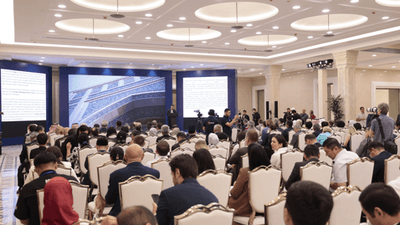
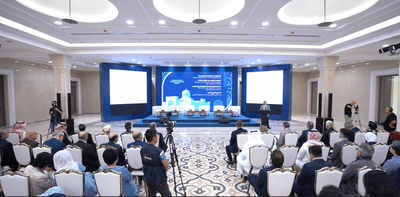
These efforts were explored at an international conference held at UNESCO headquarters in Paris, bringing together more than 300 participants, including scholars, diplomats and representatives of international organizations, according to the organizers.
The event was organized by the Islamic Civilization Center in Uzbekistan in cooperation with the Permanent Delegation of the Republic of Uzbekistan to UNESCO, the National Commission of the Republic of Uzbekistan for UNESCO, the Ministry of Foreign Affairs of the Republic of Uzbekistan, and a number of scientific and cultural partner institutions.
The initiative has its roots in a broader effort outlined by Uzbekistan’s President Shavkat Mirziyoyev at the UN General Assembly in 2017, when he called for greater international recognition of Central Asia’s intellectual heritage and emphasized the importance of education and religious tolerance.
In a further address to the UN in September 2025, he proposed presenting the scientific and spiritual legacy of the region’s leading scholars at major international venues. The Paris conference, alongside presentations at UN venues in New York and Geneva, formed part of that programme.
Central Asia’s intellectual legacy
Much of the discussion focused on Mawarannahr, historically known as Transoxiana, the region between the Amu Darya and Syr Darya rivers, encompassing much of present-day Uzbekistan and parts of neighbouring Central Asian countries.
The region produced or attracted scholars whose work influenced intellectual traditions across the Islamic world and beyond.
In an address reported by the Islamic Civilization Center, Mahmud Erol Kılıç, Director General of the Research Centre for Islamic History, Art and Culture (IRCICA), highlighted the contributions of Khwarizmi, Farabi, Ibn Sina and Biruni.
Their work reflected a scholarly tradition in which mathematics, medicine, philosophy and religious studies developed through exchanges of knowledge across different regions.
Farhan Ahmad Nizami, Director of the Oxford Centre for Islamic Studies, also stressed that the region's historical monuments reflect a broader history of creativity and cultural exchange.
“Civilizations are not growing in isolation. We cross-fertilize each other, and it is a message that we need to share to see that we have much more in common than elements that separate us,” Salima Dalibey, representing the Organization of Islamic Cooperation, told Euronews.
Mehrdad Shabahang, head of UNESCO’s Silk Roads Programme, highlighted the role of research institutions in documenting that shared history.
“These centers like the Uzbekistan Islamic Civilization Center can help us to identify, to document and also to promote our shared past, our shared history,” he said.
Firdavs Abdukhalikov, Director of the Islamic Civilization Center, also emphasized the international significance of this heritage.
“Cultural heritage and our great ancestors belong to the whole world,” he told Euronews.
Beyond the museum
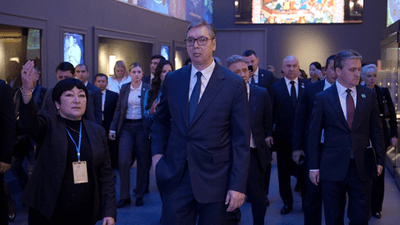
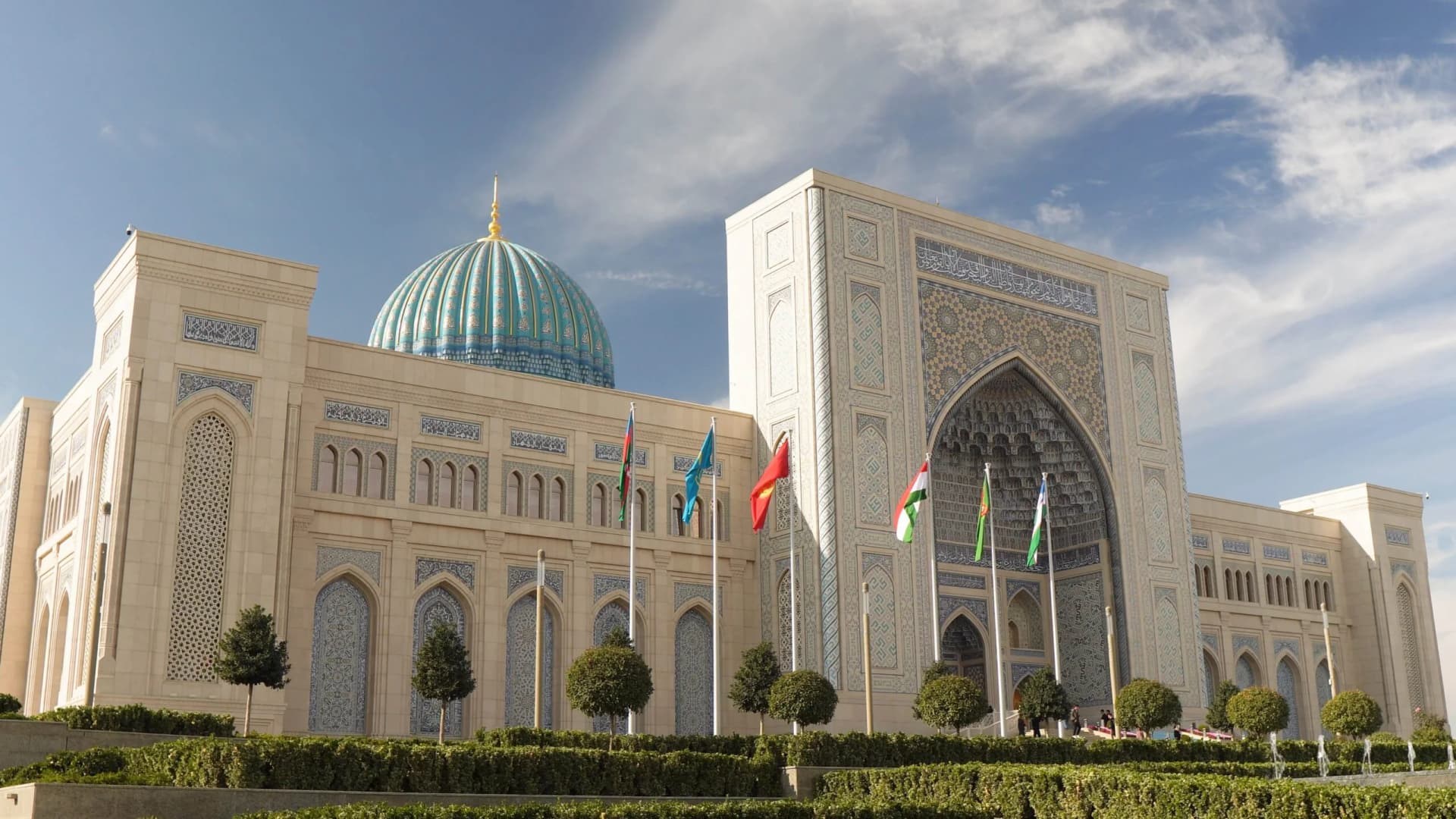
A central part of this effort is the Islamic Civilization Center in Tashkent, whose museum exhibitions trace more than 3,000 years of history on the territory of present-day Uzbekistan, according to the Center.
Its activities include the study of rare manuscripts and historical artefacts, alongside digital technologies designed to support research and make collections accessible to a broader audience.
Abdukhalikov emphasised that its purpose extends beyond displaying historical objects.
“It is not just a beautiful, large building and museum. It is a major platform for scholarship and education,” he told Euronews.
Frédérique Beaupertuis-Bressand, a specialist in the history and art of the Timurids, described the museum as a valuable resource for researchers and visitors.
“Finally, culture is being given the prominence it deserves. We can see these objects, touch them, and study them,” she said, adding that access to collections offers further opportunities for historical research.
He also added that access to the collections opens up new opportunities for deeper historical research.
The Center is also connected to a wider network of specialised institutions, including international research centers dedicated to Imam Bukhari, Imam Termizi and Imam Maturidi.
Sali Shahsivari, managing director of the Al-Furqan Islamic Heritage Foundation, welcomed the expansion of these institutions, saying they were helping to bring greater attention to the region’s cultural heritage.
The discussions in Paris also explored opportunities for international research cooperation, including joint studies, the digitization of historical sources and closer collaboration between academic institutions. The Center also highlighted its use of digital technologies and artificial intelligence in researching and presenting cultural heritage.
The discussions also considered how a better understanding of shared cultural heritage could contribute to dialogue between different societies.
“We live in a time where hate speech spreads very fast, so these opportunities to sit, speak, exchange ideas and dialogue help people understand each other and prepare for a culture of peace,” Salima Dalibey of the Organization of Islamic Cooperation told Euronews.