
Agenda Nexus: "Central Asia's cultural heritage was showcased at the UN in Geneva"
An analytical article has been published on the official website of Sweden’s Agenda Nexus, the publication of the Institute for Diplomacy and International Relations, about the presentation of Central Asia’s scientific and spiritual heritage to the international community at the UN in Geneva. It covers the international conference and the exhibition “Civilizations, Personalities, and Discoveries,” organized with the participation of the Islamic Civilization Center in Uzbekistan; President Shavkat Mirziyoyev’s initiative aimed at the in-depth study and international promotion of the legacy of great scholars; and the prospects for developing scientific cooperation with the UN library and archives. The author emphasizes that Central Asia’s rich scientific and cultural heritage holds an important place in strengthening international dialogue, intercultural understanding, and peace.
On October 22, the Islamic Civilization Center in Uzbekistan presented the scientific and spiritual heritage of Central Asia to the international community through an exhibition and an international conference held at the UN in Geneva.
Geneva, October 22, 2026
Uzbekistan strengthens international dialogue on the shared knowledge heritage of civilizations
Central Asia’s historical contribution to the development of science, philosophy, and religious thought was the main theme of an event at which the Islamic Civilization Center in Uzbekistan presented the region’s intellectual and cultural heritage at the UN Office in Geneva.
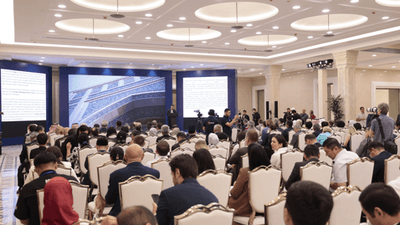
Through an international conference and a wide-ranging exhibition held at the Palais des Nations, the importance of knowledge, cultural understanding, and international cooperation, and their role in an era of growing geopolitical tensions, was discussed.
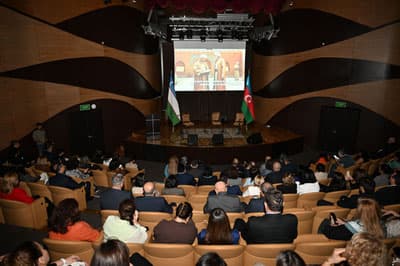
The event was attended by diplomats, representatives of international organizations, scholars, and cultural figures. This initiative is part of Uzbekistan’s broad-scale efforts to make the historical and scientific heritage of Central Asia more open and understandable to the international community, while also strengthening the country’s international cultural and diplomatic ties.
From UNESCO in Paris to the United Nations in Geneva
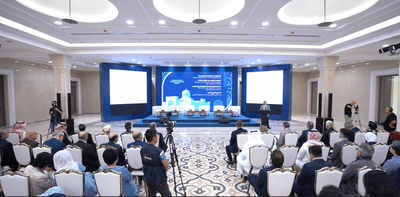
The conference “Islamic Civilization: Mawarannahr's Great Spiritual and Scientific Heritage and the Horizons of Enlightenment” highlighted the contribution of the scholarly traditions formed in Bukhara, Samarkand, and Termez to the development of world knowledge.
The meeting in Geneva was a logical continuation of the international dialogue that began on October 7, 2026, at UNESCO headquarters in Paris.
At the core of this initiative lies the proposal put forward by the President of Uzbekistan, Shavkat Mirziyoyev, on September 23, 2025, at the 80th session of the UN General Assembly. In that speech, the head of state stressed the need for in-depth scholarly study and broad international promotion of the scientific and spiritual heritage of great scholars such as Imam Bukhari, Imam Termizi, and Imam Maturidi.
This initiative expresses the aspiration to present Central Asia as a historical center of science, religion, and cultural exchange, and to use this shared heritage in developing international dialogue.
Cultural heritage demonstrating the common ground between science and civilizations
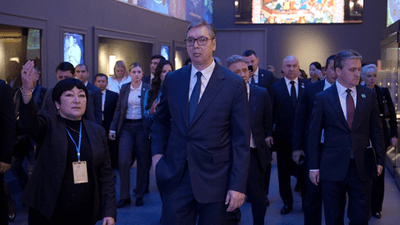
The conference began with the exhibition “Civilizations, Personalities, and Discoveries.”
The exposition included scholarly publications, decorated books, miniatures, and historical materials devoted to Central Asia’s famous thinkers and their discoveries.
Through the exhibition, the region’s scientific and artistic traditions were showcased, along with the processes by which knowledge was formed, preserved, and passed down from generation to generation.
One of the main ideas of the event was to emphasize that the history of Central Asia is not only a regional cultural heritage but also an important part of humanity’s common scientific and intellectual progress.
The UN stressed the importance of cultural understanding and international cooperation
The opening speeches of the conference were delivered by Tatiana Valovaya, Director-General of the UN Office at Geneva, and Eldor Toshmatov, Permanent Representative of Uzbekistan to the UN and other international organizations in Geneva.
Tatiana Valovaya particularly emphasized the importance of dialogue among civilizations, noting that increasing peoples' and societies' historical and cultural knowledge of one another serves to strengthen mutual trust and understanding.
She also gave high praise to the activities of the Islamic Civilization Center in Uzbekistan, especially recognizing its ability to combine historical heritage with modern technologies and educational methods.
According to Valovaya, the Center is an institution suited to the demands of the twenty-first century and has great potential, particularly for reaching and engaging the younger generation.
She also welcomed the cooperation planned between the Center and the library of the UN Office at Geneva.
Akmal Saidov, Director of the National Human Rights Center of the Republic of Uzbekistan and a deputy of the Legislative Chamber of the Oliy Majlis, also took part in the opening session of the conference.
The UN library and archives are opening new opportunities for scientific research
The keynote address at the conference was delivered by Firdavs Abdukhalikov, Director of the Islamic Civilization Center in Uzbekistan and Chairman of the World Society for the Study, Preservation, and Popularization of the Cultural Legacy of Uzbekistan (WOSCU).
Speaking about the Center's international tasks, he emphasized that museum activity, academic research, and educational initiatives are being united within a single institutional system.
Abdukholikov noted that the initiative put forward by President Mirziyoyev at the UN General Assembly in 2025 is now being realized through concrete international events and practical work.
According to him, the presentations held at UNESCO in Paris and at the UN in Geneva have significantly increased international interest in Uzbekistan's historical and intellectual heritage.
One of the conference's important announcements was that an agreement had been reached with the leadership of the UN Office at Geneva on using the organization's library and archives for scientific research.
This may create new opportunities for identifying and studying historical documents related to the development of Central Asia and Uzbekistan, as well as previously little-studied sources.
In this way, the cooperation is expected to serve to strengthen the international scientific environment aimed at studying the region's history and cultural heritage.
Central Asian thinkers and their significance for today’s society
An important part of the conference was devoted to the legacy of three great scholars who hold a major place in the history of Islamic thought and science: Imam Bukhari, Imam Termizi, and Imam al-Maturidi.
Their scholarly activity is closely tied to the scientific traditions formed in Bukhara, Termez, and Samarkand.
The discussions addressed issues such as scholarly reliability, the critical analysis of sources, the transmission of knowledge, ethical responsibility, and the relationship between faith and reason.
These topics are especially relevant today, when societies are facing problems such as disinformation, religious conflicts, and misunderstandings among different cultural and religious traditions.
Robert Blum, Chairman of the Geneva Diplomatic Circle, emphasized the importance of Samarkand as a historical place where people of different religious and cultural views meet.
He noted that differences in religious beliefs need not be an obstacle to mutual understanding. On the contrary, he stressed that a shared aspiration for knowledge can create a foundation for mutual respect and cooperation.
Kathleen Goebel, Director of Cultur-Cooperation International in Berlin and a member of WOSCU, drew attention to the need to unite international efforts for the sake of peace.
She stressed that governments, public institutions, and international organizations must cooperate to solve the problems of a world full of conflict, fear, and human suffering.
Craig Taylor, the UN representative for relations of Latter-day Saint Charities, also spoke about the relevance today of the views of Imam Maturidi and Abu Rayhan Biruni. He emphasized that, regardless of religious affiliation, every person bears the responsibility to contribute to creating an environment of peaceful coexistence.
Science, enlightenment, and tolerance in focus
The conference's scientific session was held under the chairmanship of Bahrom Abdukhalimov, Vice President of the Academy of Sciences of Uzbekistan.
He focused on the historical discoveries of Central Asian scholars and their contribution to the development of international science.
Davronbek Makhsudov, First Deputy Chairman of the Committee on Religious Affairs of the Republic of Uzbekistan, delivered a report on the importance of enlightenment and tolerance in today's society.
Komiljon Shermukhamedov, Director of the Imam Maturidi International Scientific Research Center, analyzed questions of reason, moderation, and ethical responsibility within the scholar's intellectual legacy.
Otabek Mukhammadiyev, Deputy Director of the Imam Bukhari International Scientific Research Center, gave information on the methods of source study and of verifying the reliability of hadiths developed by Imam Bukhari and Imam Termizi.
The scientific presentations showed how historical traditions of knowledge can contribute to discussions on modern education, scientific methodology, religious understanding, and responsibility to society.