
QNA: Symposium at the Diplomatic Institute Highlights the Role of the Islamic Centers of Qatar and Uzbekistan in Promoting Islamic Civilization
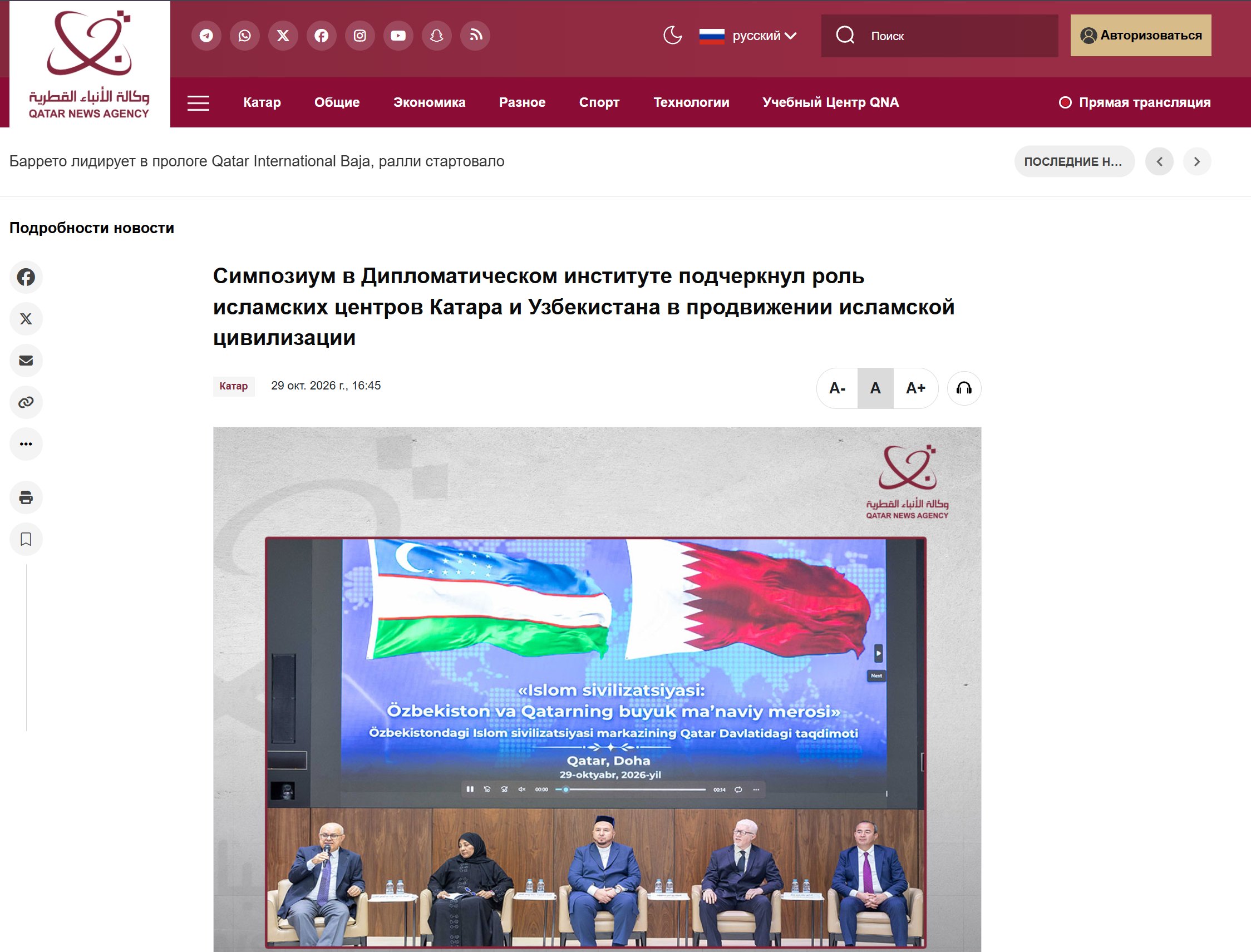
On October 29, 2026, the official website of Qatar’s Qatar News Agency (QNA) featured an article titled “Symposium at Diplomatic Institute Highlights Role of Islamic Centers of Qatar and Uzbekistan in Promoting Islamic Civilization,” which is available at this link. The article covers the international symposium held in Doha by the Diplomatic Institute of the Ministry of Foreign Affairs of Qatar in cooperation with the Qatar Committee for the Alliance of Civilizations, the speech delivered by Firdavs Abdukhalikov, Director of the Center of Islamic Civilization in Uzbekistan, as well as the prospects for preserving the historical and spiritual heritage shared by the two countries, expanding scientific and educational cooperation, and promoting Islamic civilization internationally.
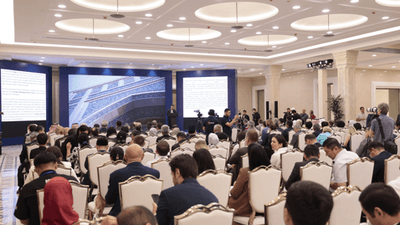
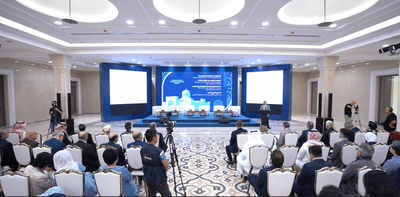
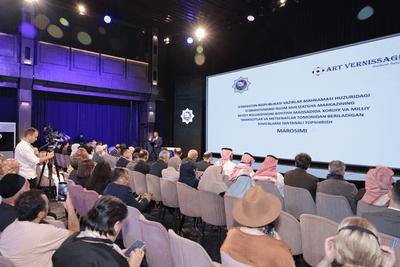
DOHA, October 29 (QNA) — A symposium organized by the Qatar Committee for the Alliance of Civilizations in cooperation with the Diplomatic Institute of the Ministry of Foreign Affairs highlighted the role of the Islamic centers of Qatar and Uzbekistan in promoting Islamic civilization. The event formed part of the joint efforts of the two countries to foster cultural cooperation and widely promote the Islamic cultural heritage.
The symposium, held today at the Diplomatic Institute, was attended by Minister of State and President of the Qatar National Library Dr. Hamad bin Abdulaziz Al-Kawari, Ambassador of the Republic of Uzbekistan to the State of Qatar Ashraf Khodjaev, as well as diplomats, officials, and heads of academic and religious institutions.
In his opening remarks, Dr. Hamad bin Abdulaziz Al-Kawari emphasized that the State of Qatar has adopted cultural diplomacy as a consistent approach to building bridges between different cultures. He noted that culture can sometimes achieve what politics cannot, and that books can reach hearts that are difficult to open through negotiations.
He stressed that the Qatar National Library sees itself not merely as a repository of books, but as a window connecting peoples and nations. The Library’s collection includes rare manuscripts and printed editions reflecting the scholarly heritage of the scholars of Mawarannahr. Moreover, the Library’s expertise in heritage preservation, restoration, and digitization can contribute to developing cooperation between the State of Qatar and the Republic of Uzbekistan in promoting Islamic civilization.
Dr. Hamad bin Abdulaziz Al-Kawari announced that he had discussed prospects for cooperation with the head of the Islamic Civilization Center in the Republic of Uzbekistan. He underlined the importance of steadily continuing cooperation aimed at building a more just and humane future through heritage preservation and digitization, exhibitions and the exchange of expertise, as well as support for researchers from both countries.
For his part, Ambassador of the Republic of Uzbekistan to the State of Qatar Ashraf Khodjaev noted the deep history and strength of the strategic relations between the two countries, placing particular emphasis on the historical and cultural ties that unite our peoples.
The Ambassador stressed that bilateral relations continue to develop steadily and are based on mutual interests, commitment to mutual obligations, and constructive cooperation. He also emphasized that high-level reciprocal visits by the leaders of the two countries play an important role in strengthening their strategic partnership across various fields.
Ashraf Khodjaev also spoke about the historical significance of Islamic civilization and its contribution to the development of science, education, philosophy, and literature. He noted that great centers of civilization took shape on the land of Uzbekistan, which gave rise to such renowned scholars as Imam al-Bukhari, Imam al-Tirmidhi, and Muhammad al-Khwarizmi.
According to the Ambassador, preserving this intellectual heritage is not only a way of commemorating the past, but also an investment in the future and a means of strengthening the mechanisms of intercivilizational dialogue. He expressed hope that the symposium would further advance diplomatic and cultural cooperation and pave the way for practical initiatives between the two countries.
Secretary of the Qatar Committee for the Alliance of Civilizations, Ambassador Abdullah bin Ahmed Al-Sada, also emphasized that Islamic centers in the State of Qatar play an important role in promoting Islamic civilization and disseminating its humanitarian and cultural values. He noted that, through educational and outreach activities, lectures, seminars, and exhibitions, these centers showcase Islamic history and its contribution to the development of art and literature.
The Ambassador stressed that the significance of these centers lies, above all, in strengthening intercultural dialogue and demonstrating the principles of Islam based on tolerance, justice, solidarity, and respect for human dignity. According to him, such efforts are of particular importance given the cultural openness of the State of Qatar and the coexistence of people of various nationalities and cultures. For this reason, Islamic centers serve as an effective means of strengthening mutual understanding between Muslims and followers of other religions.
Director of the Center of Islamic Civilization in the Republic of Uzbekistan Dr. Firdavs Abdukhalikov also emphasized that bilateral relations between Qatar and Uzbekistan continue to develop steadily on the basis of mutual respect, shared values, and the commitment of the two countries’ leaders to strengthening cooperation in various fields.
He outlined the Center’s work in preserving historical and scholarly heritage and in highlighting the contribution of Muslim scholars and great figures to world civilization. In particular, he spoke about efforts to study and promote the heritage of Imam al-Bukhari, Imam al-Tirmidhi, Abu Rayhan al-Biruni, and other scholars who left an indelible mark on the history of human civilization.
As he explained, the Center’s activities are built on several key areas: the preservation and study of manuscripts and historical documents, the establishment of exhibition halls and miniature museums, and the use of modern technologies to present history and cultural heritage. Other important areas of the Center’s work include strengthening scientific and educational cooperation through the exchange of experience among scholars and young researchers, as well as developing international cultural dialogue among museums and cultural and educational institutions.
The symposium concluded with a panel discussion on the theme “Islamic Civilization: The Great Spiritual Heritage of Uzbekistan and Qatar,” moderated by Dr. Nawzad Abdulrahman Al-Hiti.
The discussion featured Dr. Aisha Yousef Al-Mannai, Director of the Mohammed bin Hamad Al Thani Center for Muslim Contribution to Civilization at Hamad Bin Khalifa University; Dr. Mukhtar Mohammed Mukhtar, Researcher at the Abdullah bin Zaid Al Mahmoud Islamic Cultural Center; and Dr. Ilhomjon Bekmirzaev, Vice-Rector of the International Islamic Academy of Uzbekistan. (QNA)