


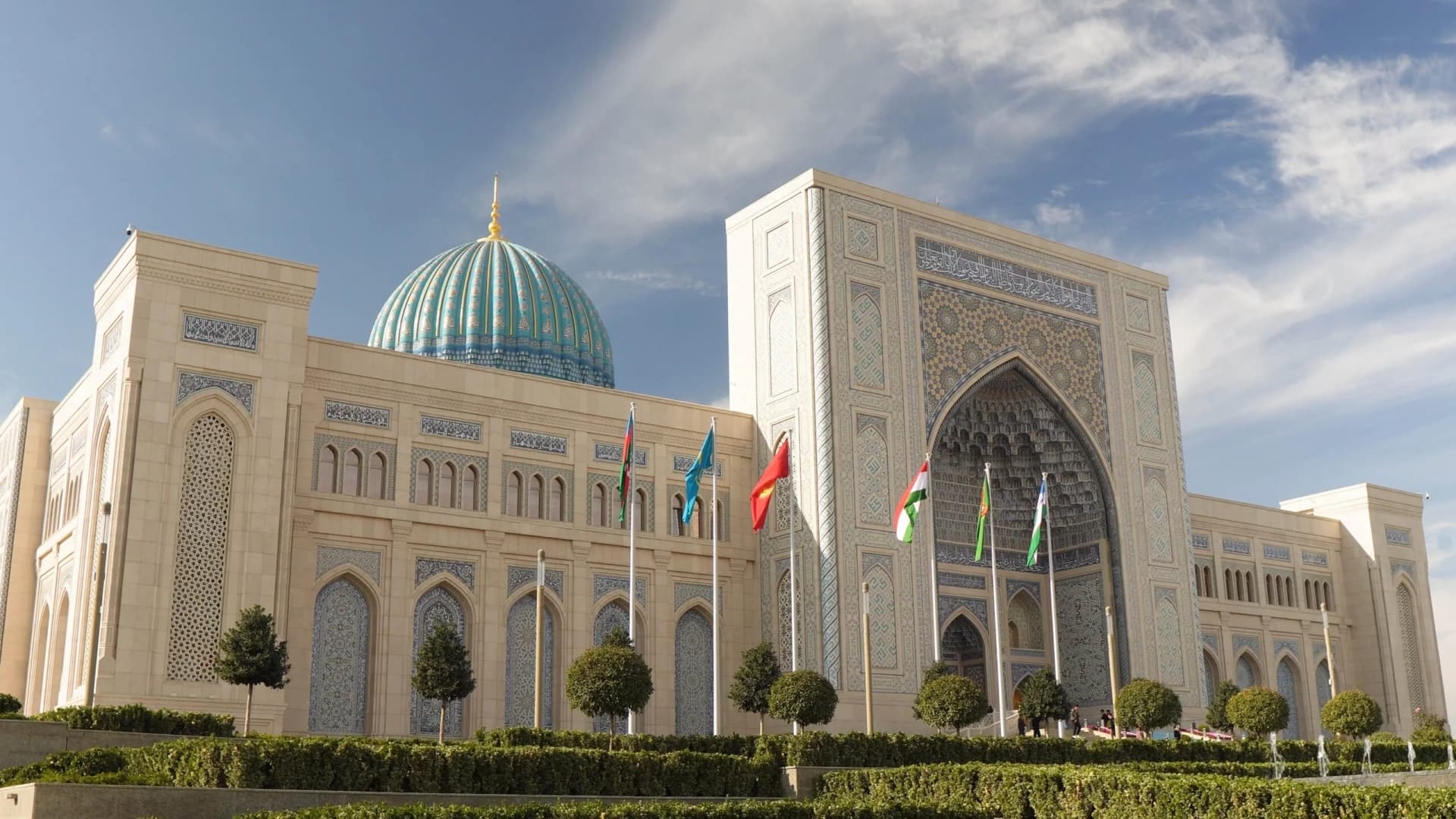


Why is the global scientific community showing great interest in the scholarly heritage of the scholars of Movarounnahr?
The international scholarly community is showing strong interest in studying the spiritual and intellectual heritage of the scholars of Movarounnahr, who made significant contributions not only to Islamic civilization but also to world civilization as a whole, mastering both religious and secular sciences and applying them to social life. A key reason for this is the museum expositions organized at the Islamic Civilization Center, established at the initiative of the President of Uzbekistan.
In New Uzbekistan, extensive efforts are being undertaken to deeply study and promote the scientific and spiritual legacy of great ancestors and to educate the younger generation in the spirit of national traditions. As President Shavkat Mirziyoyev has emphasized, “The purpose of our work in this field is to express our faith in Islam and our respect for our great scholars through knowledge. Being worthy of our ancestors is a great duty for us.”
In this context, it is of particular importance to thoroughly research the life and scholarly works of eminent figures such as Imam Bukhari, who enjoys high recognition throughout the Islamic world, and to promote his works among the wider public.
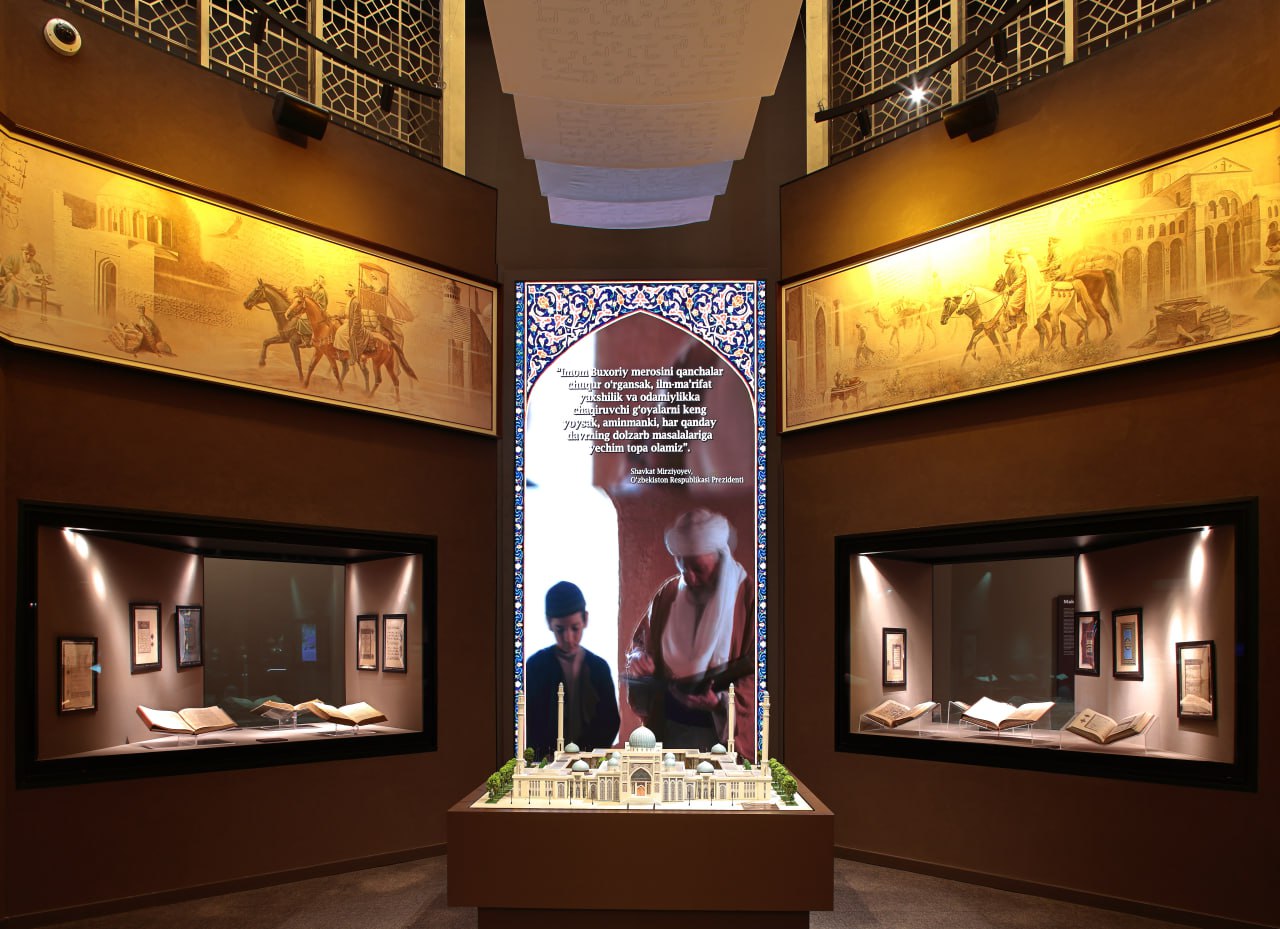 Within the First Renaissance section of the Center’s museum exposition, a special capsule is dedicated to the great muhaddith Imam Bukhari, who was born in Bukhara. This exposition not only highlights the scholar’s life and intellectual legacy but also demonstrates the high level of source studies and hadith scholarship within Islamic civilization.
The capsule presents rare manuscripts, travel maps, scholarly compilations, and artifacts related to Imam Bukhari’s life, academic journeys, and invaluable heritage. The most significant feature of the exposition is the display of two original manuscript copies.
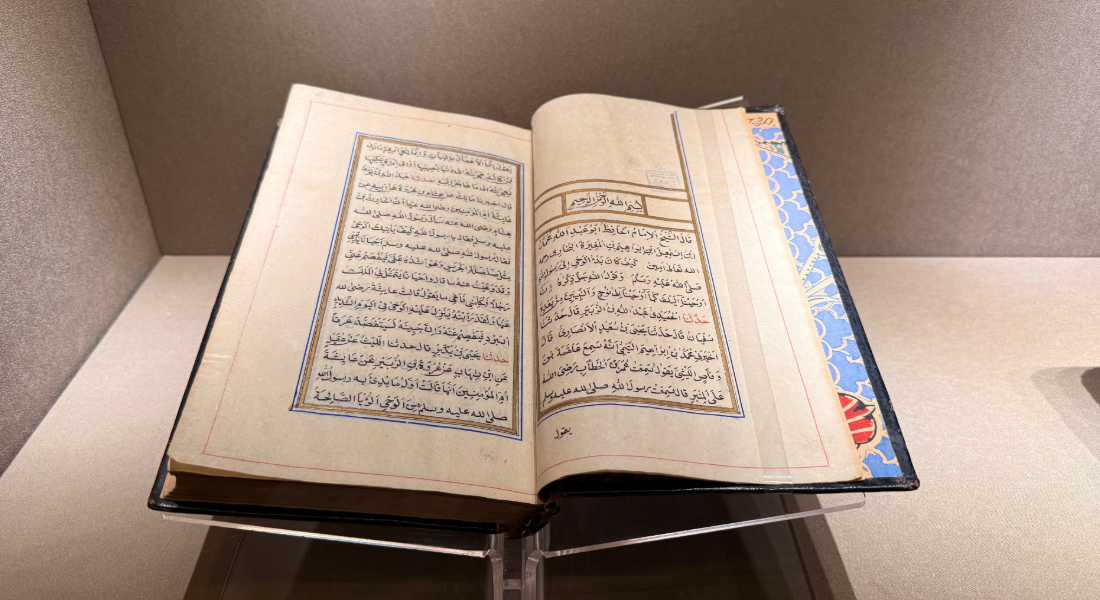 One of them is “Al-Jami‘ as-Sahih,” recognized in the Islamic world as the most authentic collection of hadith. This copy, written in Arabic on Eastern paper in naskh script, was transcribed by the scribe Sulayman Ibrahim Alavi.
“Al-Jami‘ as-Sahih,” compiled by Abu Abdullah Muhammad ibn Ismail al-Bukhari (810–870), is considered the first among the six most authoritative hadith collections known as “Kutub as-Sitta.” The work consists of 97 books and 3,881 chapters and contains nearly 4,000 of the most authentic narrations selected from approximately 600,000 hadiths. Including repetitions, the total number of hadiths reaches 7,563. As Hafiz Ibn Hajar al-Asqalani noted, this count does not include mawquf narrations attributed to the Companions or maqtu‘ reports related to the Followers.
Imam Bukhari began writing this monumental work around 833, at the age of 23, in the Masjid al-Haram, and completed it over the course of 16 years, finishing it in 849 before reaching the age of forty. The full title of the work is “Al-Jami‘ al-Musnad as-Sahih al-Mukhtasar min Umuri Rasulillahi sallallahu alayhi wasallam wa sunanihi wa ayyamihi,” and it is recognized as an authentic, musnad, and comprehensive source encompassing the life, Sunnah, and rulings of the Messenger of Allah (peace be upon him).
The very term “Al-Jami‘” indicates the comprehensive nature of the work. It addresses a wide range of subjects, from faith and monotheism to acts of worship and legal transactions, as well as jihad, history, Qur’anic exegesis, marriage, ethics, and asceticism. In hadith scholarship, such a broad and all-encompassing work is referred to as a “jami‘.”
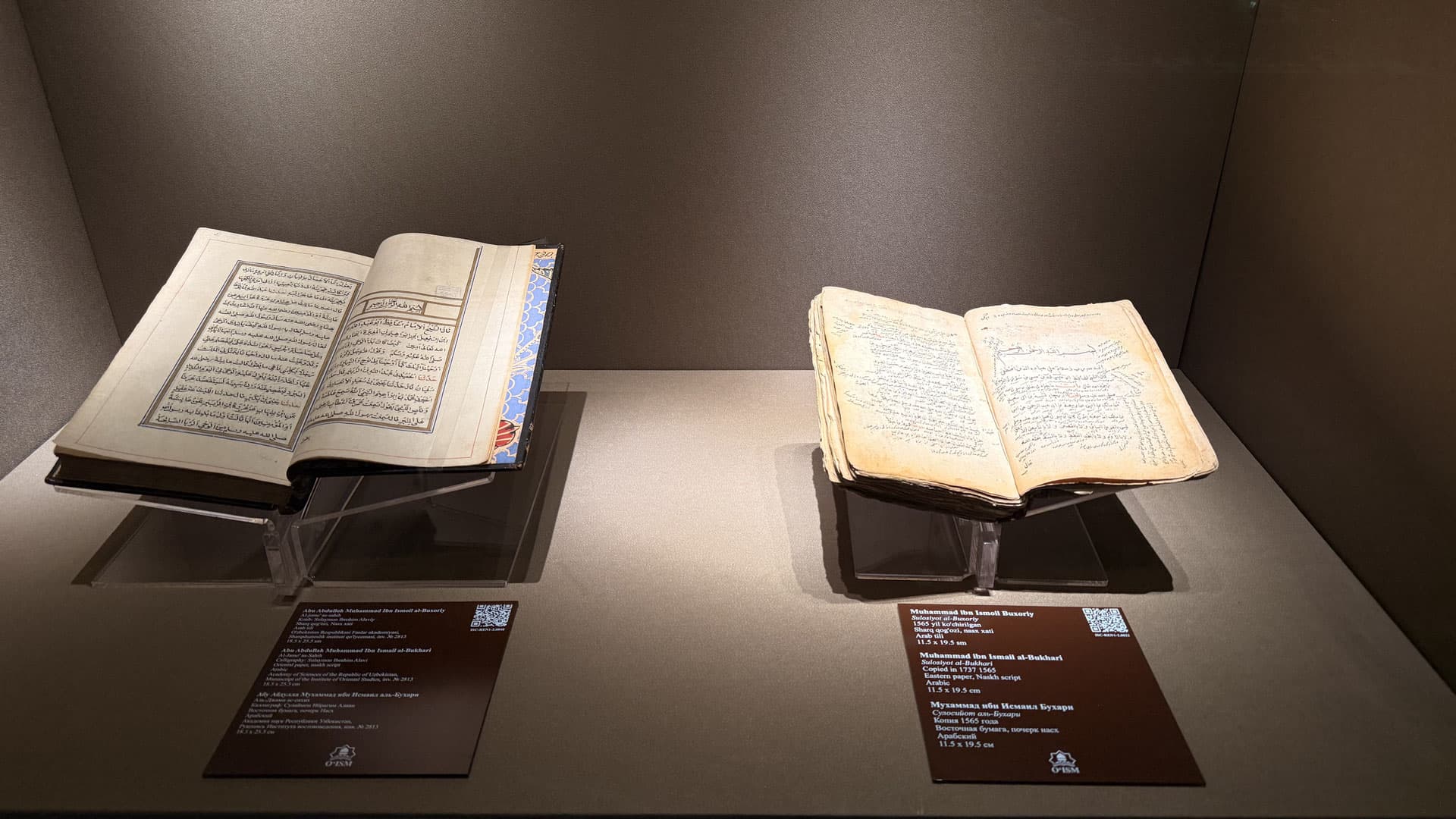
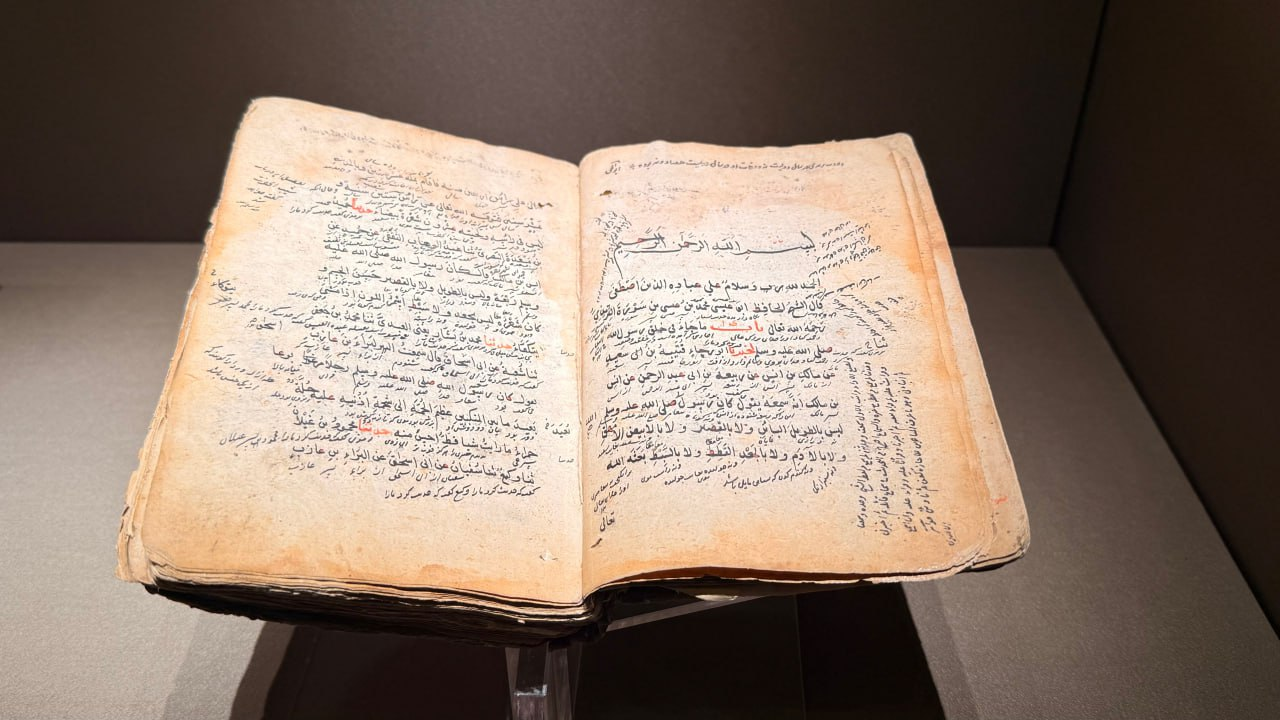 The second rare source displayed in the exposition is the manuscript “Sulosiyot al-Bukhari.” The term “Sulosiyot” means “triplets.” This collection includes hadiths from “Al-Jami‘ as-Sahih” that were transmitted through only three generations after the Prophet Muhammad (peace be upon him) — namely through the Companions, the Followers, and the Followers of the Followers. The brevity of the chain of transmission determines the high level of authenticity of these narrations. Hafiz Ibn Hajar al-Asqalani emphasized that among the sulosi hadiths are narrations unparalleled in authenticity.
Abdurasul Yaxshiboyev, a researcher at the Center, noted that this manuscript was recopied in 1565 and is currently being thoroughly studied by specialists.
The “Sulosiyot al-Bukhari” manuscript displayed in the exposition is preserved in the Manuscripts Fund of the Islamic Civilization Center. Reproduced in 1565 (Hijri–Gregorian), it is now undergoing detailed scholarly examination. Researchers are studying the period and author of the copy, the type of paper used, the calligraphic style, and the content of marginal annotations and commentaries. These studies aim to further reveal the manuscript’s historical, scholarly, and source-critical value.
Another original copy of “Al-Jami‘ as-Sahih” displayed in the capsule has been brought from the Oriental Manuscripts Fund. Both manuscripts are rare sources that demonstrate the unparalleled scholarly potential of Imam Bukhari’s legacy.
In today’s complex era, the issue of interpreting hadiths objectively and fairly on the basis of authentic sources has become increasingly relevant. In a context where core Islamic concepts — such as faith, jihad, migration, caliphate, and imamate — are interpreted differently across various periods and movements, it is essential to study Imam Bukhari’s heritage on a solid scholarly foundation and convey it accurately to society.
The capsule within the museum exposition serves precisely this noble purpose. It vividly reflects the scholarly courage of the great muhaddith and highlights the prominent place of scholars who flourished on Uzbek soil within world civilization.
Shahnoza Rahmonova
P.S. The article may be republished with a link to the Center’s official website