
The Times of India: “The Islamic Civilization Center in Uzbekistan represents ‘Third Renaissance’ vision”
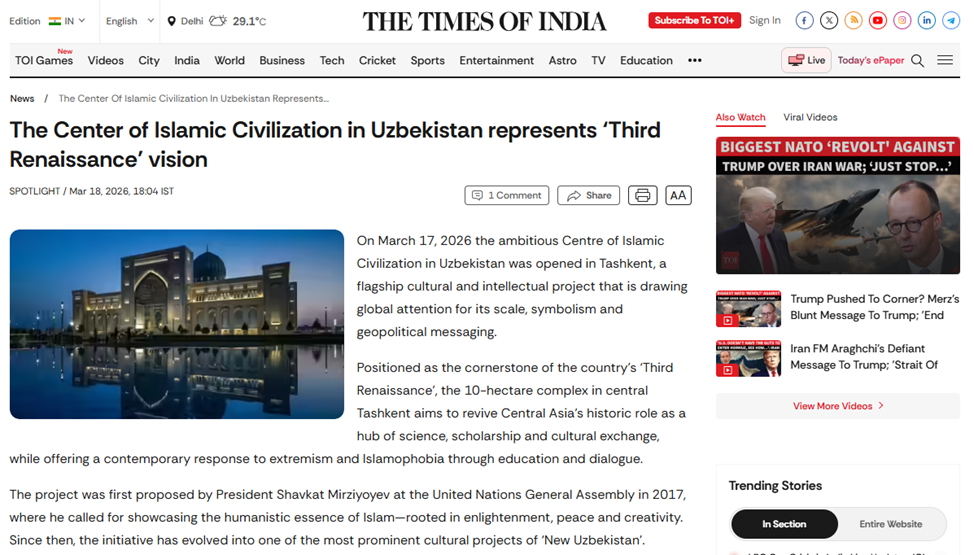 The Times of India published an article about the Islamic Civilization Center in Uzbekistan. According to the publication, the Center, opened in Tashkent, is attracting global attention as a major cultural and intellectual project embodying Uzbekistan’s idea of the “Third Renaissance.” It aims to restore the country’s scientific and educational potential, harmonize its rich historical heritage with modern technologies, and become a platform for international dialogue.
On March 17, 2026, the Islamic Civilization Center in Uzbekistan was officially inaugurated in Tashkent. It is a large-scale cultural and intellectual project that is drawing global attention due to its scale, symbolic significance, and geopolitical relevance.
 Considered one of the main pillars of the country’s “Third Renaissance,” the 10-hectare complex aims to restore Central Asia’s historical role as a center of scientific, educational, and cultural exchange. At the same time, it offers a modern approach to countering extremism and Islamophobia through education and dialogue.
The project was first proposed in 2017 by President Shavkat Mirziyoyev at the United Nations General Assembly, where he called for demonstrating the humanistic essence of Islam based on enlightenment, peace, and creativity. Since then, the initiative has become one of the most prominent cultural projects of “New Uzbekistan.”
“Three thousand years of history are presented in a modern and impressive way. Here, one truly feels history — it is impossible to remain indifferent,” said President of Finland Alexander Stubb.
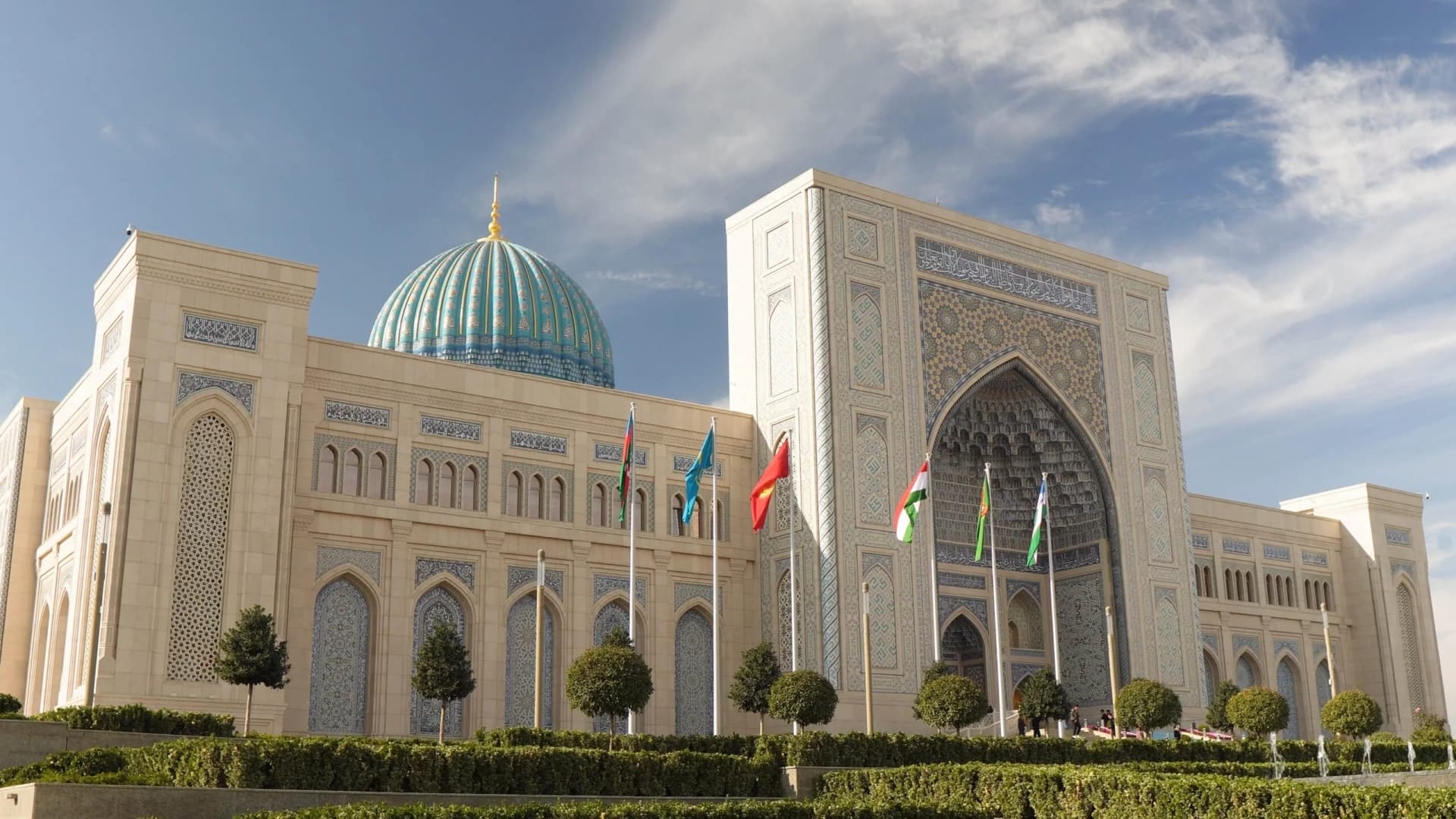
Architecturally, the Center combines Timurid traditions with modern design. Its 65-meter turquoise dome and four grand portals symbolize national unity, while sustainable planning and landscaped public spaces make it both a cultural and urban landmark.
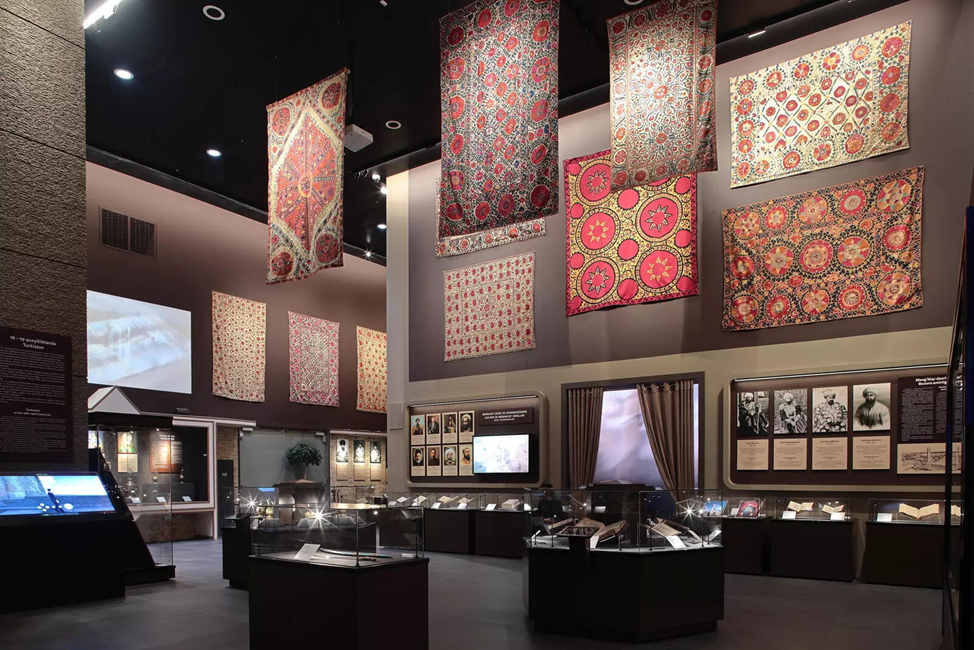 The core concept of the Center is the harmony of faith and knowledge. The inscription of the Qur’anic verse “Iqra” (“Read”) reflects the idea of learning as a spiritual duty. One of its most unique exhibits is the 7th-century Uthman Qur’an, included in UNESCO’s Memory of the World Register.
Unlike traditional museums, the Center features an interactive exhibition format based on the theme “Civilizations — Personalities — Discoveries.” Visitors journey from the pre-Islamic period through the Golden Age of Islam to modern Uzbekistan, reflecting what officials describe as a new stage of intellectual revival.
President of Paraguay Santiago Peña stated: “Many of humanity’s scientific and cultural achievements originated here. Unfortunately, the world does not always fully recognize that key works in algebra and medicine were created on this very land.”
One of the key installations at the Center is the “Wall of Civilizations and Discoveries,” which reflects the continuous development of human knowledge. Scholars such as Al-Khwarizmi, Ibn Sina, and Al-Biruni are presented through modern technologies. Advanced tools such as virtual and augmented reality, holograms, and artificial intelligence recreate ancient observatories and bring manuscripts to life. Additionally, the “1001 Inventions” laboratory has been established to inspire children’s interest in science.
Officials emphasize that the Center is part of broader efforts to restore Uzbekistan’s dispersed cultural heritage. In cooperation with international institutions and auction houses, nearly 2,000 manuscripts and artifacts — including works related to Ibn Sina and Al-Biruni — have been returned to the country in recent years. Facsimile copies of rare works preserved in foreign libraries have also been produced.
The Center includes a scientific library housing over 200,000 books, restoration laboratories, digital archives, and a calligraphy school. It is expected to become a global scientific hub in cooperation with organizations such as ICESCO, IRCICA, and the Oxford Centre for Islamic Studies.
More than 1,500 specialists from over 40 countries participated in the project. Following a presidential review in January 2025, the exhibitions were further enriched with the scientific and innovative achievements of thousands of researchers.
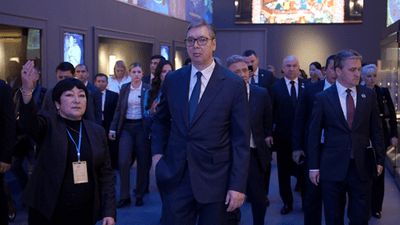
 World leaders and international organizations have also shown particular interest in the project. During his visit, United Nations Secretary-General António Guterres highly praised Uzbekistan’s emphasis on dialogue and enlightenment. Leaders of Kazakhstan, Azerbaijan, and other countries described the Center as a shared platform for scientific research and cultural exchange in the region.
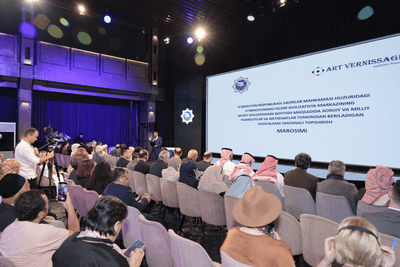
Even before its opening, the project received international recognition. In February 2026, it was included in the “World’s Most Beautiful Museums” list by Prix Versailles. It has also been featured in prestigious publications such as National Geographic, BBC, and Smithsonian Magazine, placing it among the world’s major museum projects.
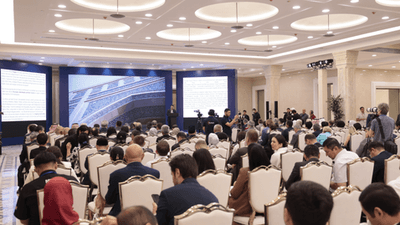
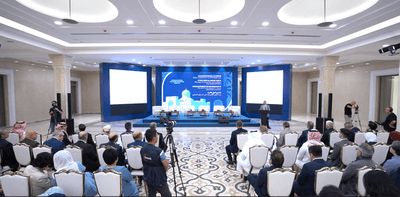
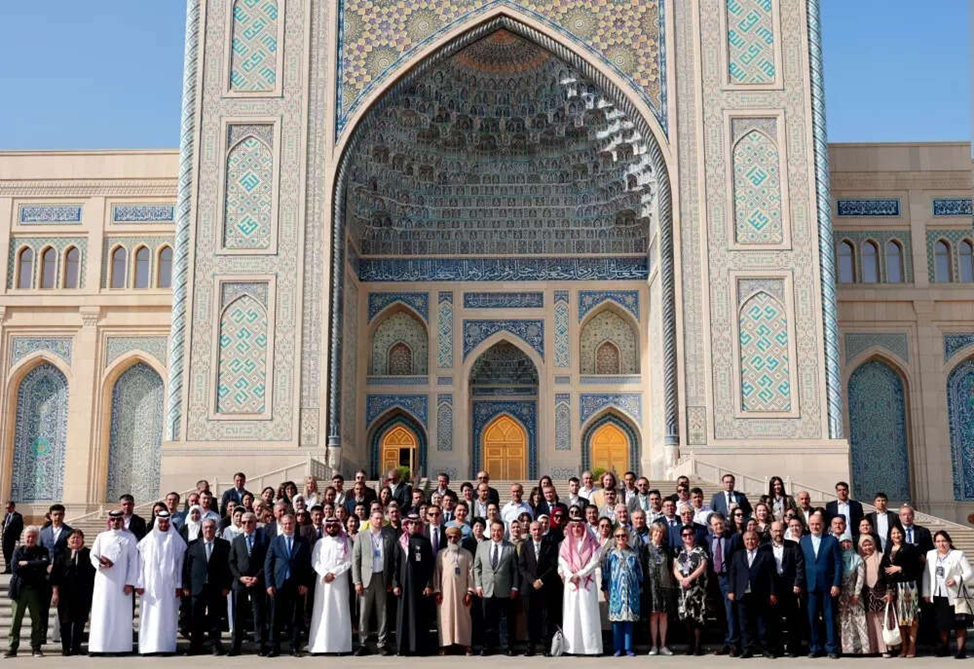
At a regional congress attended by five presidents and more than 300 scholars, the Center was presented as a symbol of shared cultural heritage for Central Asia and beyond.
The opening ceremony, held during the holy month of Ramadan, carries special symbolic significance. The foundation of the Center was also laid during Ramadan in 2018, marking an eight-year journey from concept to realization.
As Uzbekistan strengthens its position at the crossroads of heritage and modernity, the Islamic Civilization Center is expected to become a major tourist destination as well as a global platform for dialogue. It aims to connect the region’s intellectual heritage with future aspirations.