
Condé Nast Traveller: “Inside Tashkent’s Islamic Civilization Center, a new landmark for Uzbek culture”
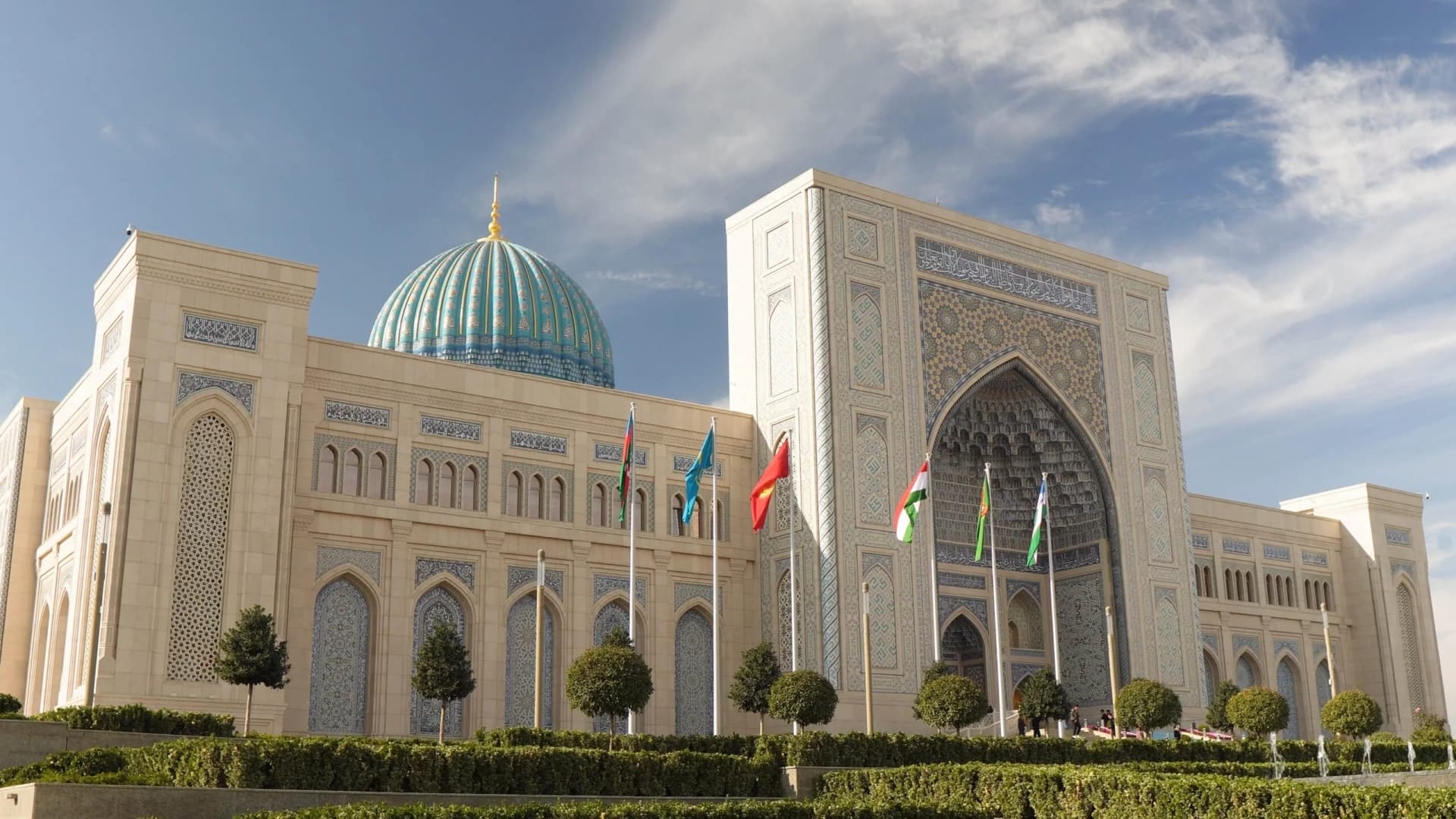
 Condé Nast Traveller Middle East has published an article about the Islamic Civilization Center in Uzbekistan. The article notes that the Islamic Civilization Center, opened in Tashkent, is emerging as a new cultural symbol of Uzbekistan, helping to redefine the city’s place on the global cultural map. The complex is described as a unique educational space that bridges the past and the future by harmoniously combining historical heritage, modern architecture, and advanced technologies.
Walking along Zarkaynar Street through Tashkent’s old mahalla, or neighbourhood, it feels like another era has been carefully brought back to life. Its lanes are flanked by mudbrick walls, and the hum of renovation work fills the air as builders transform once-abandoned homes into cafes, hotels and boutiques. Some of these transformations are already complete: the Okhun Gazar Craft Salon now occupies a restored 18th-century mosque, while the Farovon Boutique Hotel looks like a madrasa of old, its arched lattice balconies and pomegranate motifs spilling across rugs, murals, ceramics and carved wood. Nearby, the soon-to-open Centre for Contemporary Arts has restored sections of these historic quarters into artist residencies in an effort towards multi-disciplinary and cross-cultural collaboration on a global scale.
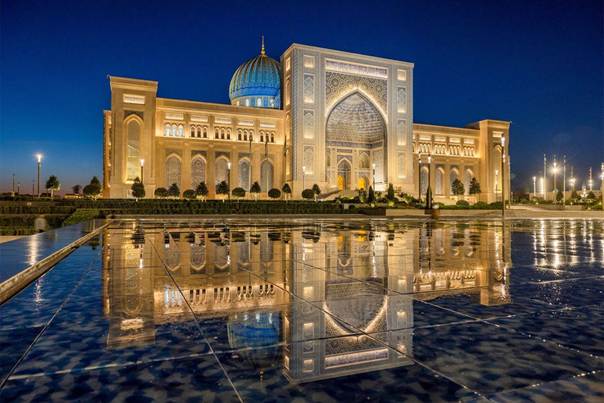
Islamic Civilization Center
The opening of the vast new Islamic Civilization Center on a 10-hectare site next to the architectural wonders of Hazrati Imam Complex feels like a bold statement: Tashkent is a city seemingly determined to recalibrate its place on the global cultural map.
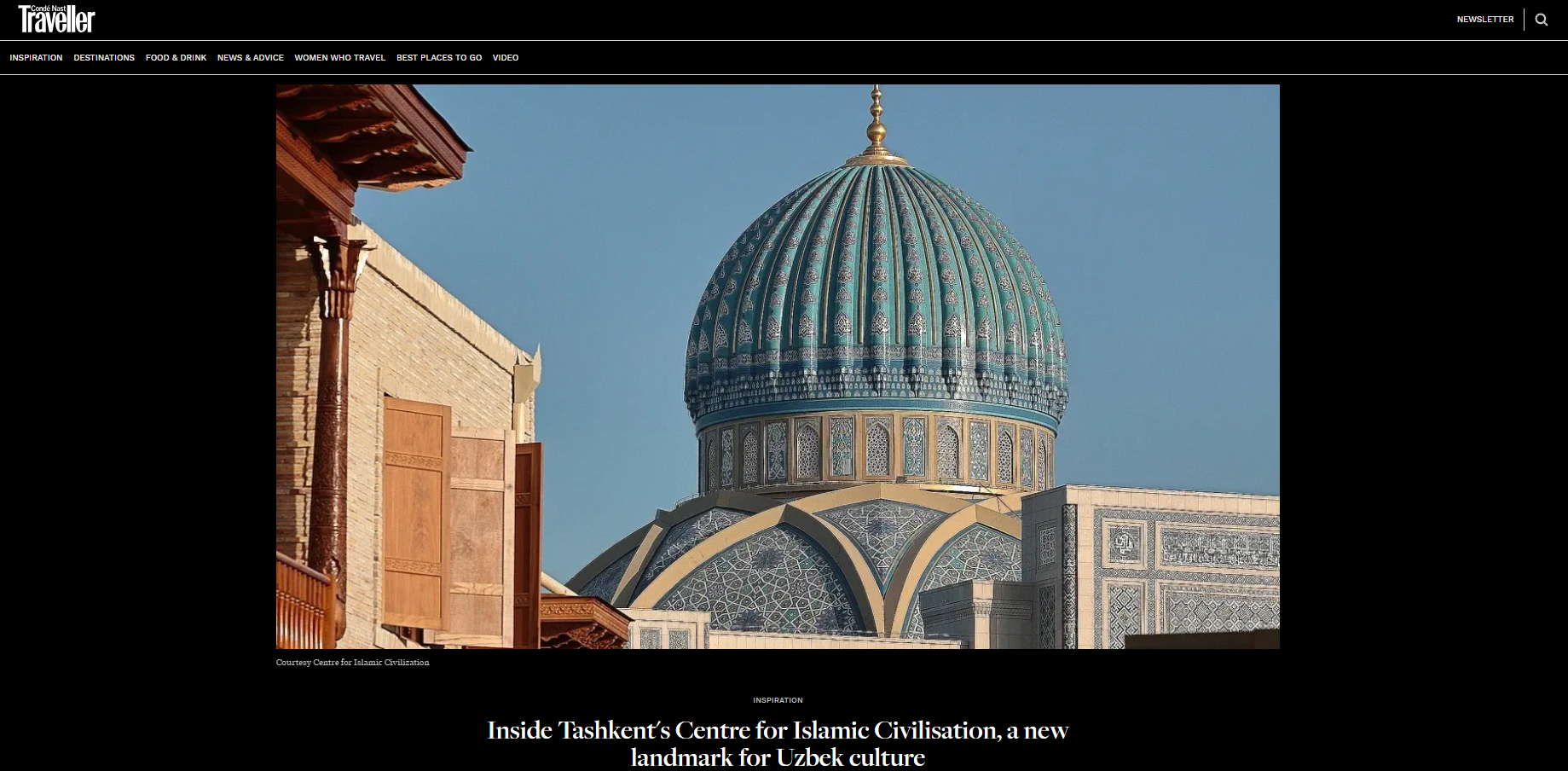
There is nothing subtle about this unmissable building: its turquoise mosaic dome crowned with a sparkling gilded finial is visible from the narrow lanes of Zarkaynar itself. Up close, its four monumental portals – each rising to around 34 metres – come into view. Designed as tributes to Uzbekistan’s historic learning centres of Samarkand, Bukhara, Kokand and Khorezm, they function as entrances and symbolic gateways into a region that once stood at the crossroads of empires and ideas.
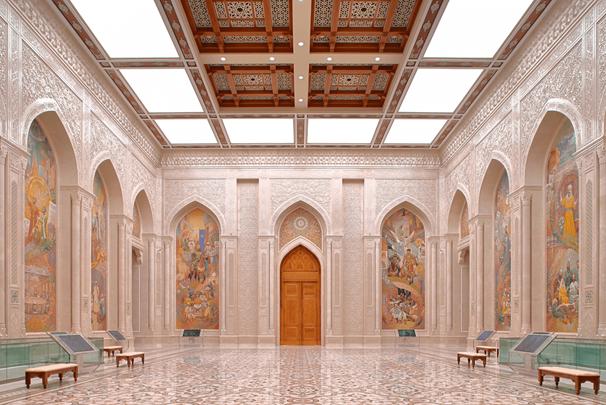
Hall of Honour, Islamic Civilization Center
The visit begins in the Hall of Honour, a soaring entrance way in which 14 mosaic paintings sit within arched niches. Each depicts a figure or milestone from Central Asia’s intellectual past – names that were once in circulation across the Islamic world but are only now being celebrated again, including Ibn Sina (Avicenna), Al-Khwarizmi, Al-Biruni, and Al-Farabi. Beneath each panel, interactive screens offer context in nine languages.
From here, the Centre unfolds across four main exhibition halls, loosely organised as a chronological journey through pre-Islamic heritage, the First Islamic Renaissance, the Second Renaissance and modern “New Uzbekistan”.
Courtesy Islamic Civilization Center
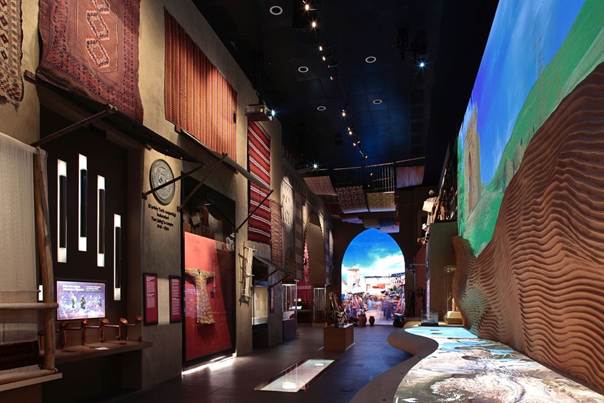
The Pre-Islamic hall reaches further back in time than one might expect. Stone tools from the Obi-Rahmat site trace habitation in the region back roughly 80,000 years, while gold jewellery from ancient Bactria points to a sophisticated culture long before the arrival of Islam. Across the Centre, interactivity is key. Here, petroglyphs from Nurata are digitally reconstructed alongside ancient scripts; Avesta, Greco-Bactrian, Kok-Turkic and Khorezmian are rendered onto touchscreens, allowing visitors to watch their own words transform into long-lost alphabets.
Courtesy Islamic Civilization Center
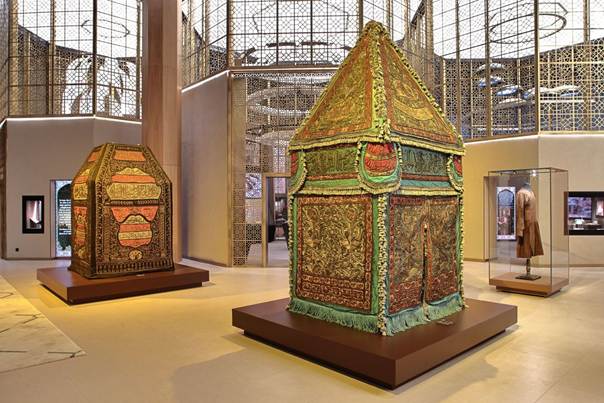
The First Renaissance hall marks the arrival and expansion of Islam in Central Asia between the 8th and 13th centuries. Architecturally, the space shifts into muted tones of sand and beige, echoing early Islamic settlements, but the displays themselves are richly layered. Copies of Imam al-Bukhari’s Al-Jamiʿ a'-Sahih – one of the most authoritative hadith collections – sit alongside philosophical works such as Al-Farabi’s Ara Ahl al-Madinah al-Fadila (The Virtuous City). A reconstructed Bayt al-Hikma or House of Wisdom stages scenes from the working lives of scholars, while immersive projections evoke the Mamunid era of Khorezm, when figures like Ibn Sina and Al-Biruni were actively shaping global science.
Among the more striking objects is a fragment of the kiswah – the ceremonial cloth that covers the Kaaba – commissioned in 1859 under Ottoman Sultan Abdülmecid, displayed alongside a meticulously recreated golden door of the Kaaba and a set of original keys to the city of Makkah from the Mamluk period.
If the first two halls build context, the Second Renaissance hall delivers both spectacle and substance. This is the Timurid era of the 14th to 16th centuries, when Central Asia reasserted itself as a global centre of science, art and architecture, with cities like Samarkand, Herat and Shakhrisabz at its intellectual core. The design reflects that shift with the palette deepening into the now-iconic blue and lapis tones synonymous with Timurid domes, and the narrative opens with an interactive map tracing the extent of Amir Timur’s empire. A digital Wall of Time allows visitors to browse copies of the Timur Tuzuklari, outlining his principles of governance and moral order. Elsewhere, a reconstruction of Mirzo Ulugh Beg’s Samarkand observatory, alongside models and projections, unpacks his astronomical work, while his star catalogue, Zij-i Kuragoni, is translated into a ceiling installation mapping over a thousand celestial bodies.
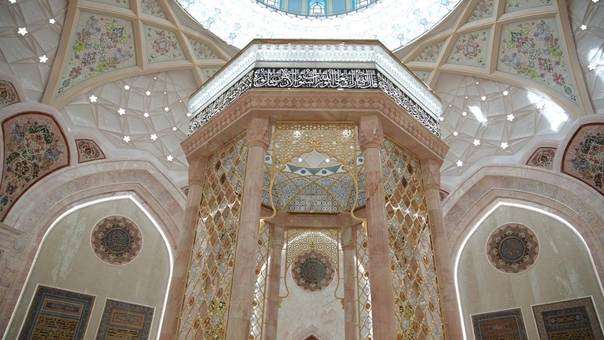
The Quran hall at the Islamic Civilization Center sits under the blue dome
At the heart of it all, beneath the Centre’s soaring blue dome, sits its most significant object: the 7th-century Mushaf of Uthman, widely regarded as one of the oldest Qur’ans in existence and listed on UNESCO’s Memory of the World Register. Suspended above it, a 50-tonne chandelier set with around 1.6 million Swarovski crystals casts a luminous glow across the space, while handwoven silk carpets are inscribed with verses from the Uthman Qur’an, their calligraphy woven directly into the fabric. Tradition holds that the manuscript also bears traces of the caliph’s blood from the moment of his assassination, lending the display a sense of reverence.
The final hall pivots decisively into the present – and, more pointedly, into the future. Framed as the "Third Renaissance” of a new Uzbekistan, it is less a conventional exhibition than an immersive manifesto, foregrounding themes of human dignity, education, interfaith dialogue and environmental awareness. Gone are the marble gravitas and domed symmetry of earlier halls; in their place is a lighter, more fluid landscape of glass, light and reflective surfaces.
Technology drives much of the visitor experience. Transparent OLED displays layer moving imagery over physical space, VR binoculars invite visitors into simulated environments and an LED theatre cycles through immersive sequences. At the centre stands the Tree of Mahalla, a large-scale installation threaded with roughly 14,000 fibre-optic points – each representing a neighbourhood community across Uzbekistan. Around it, stories of contemporary figures – youth leaders, artists, entrepreneurs – unfold through short films, symbolising a collectively authored future.
At three to four hours to explore in full, the Islamic Civilization Center is not a casual stop on your itinerary but a destination in itself. For travellers already drawn to Uzbekistan’s Silk Road cities, a visit to the Centre adds depth, offering context for the monuments of Samarkand and Bukhara, and a framework through which to understand their blue domes and geometric precision.
For those starting in Tashkent, it also offers a reason to linger in a city otherwise known for its Soviet-era modernism, brutalist hotels and monumental public buildings. And in a city increasingly defined by both preservation and reinvention – perhaps its most significant achievement.