





Luxury preserved from the Timurid court to the present day: the historical mystery of a rare 15th-century green silk garment
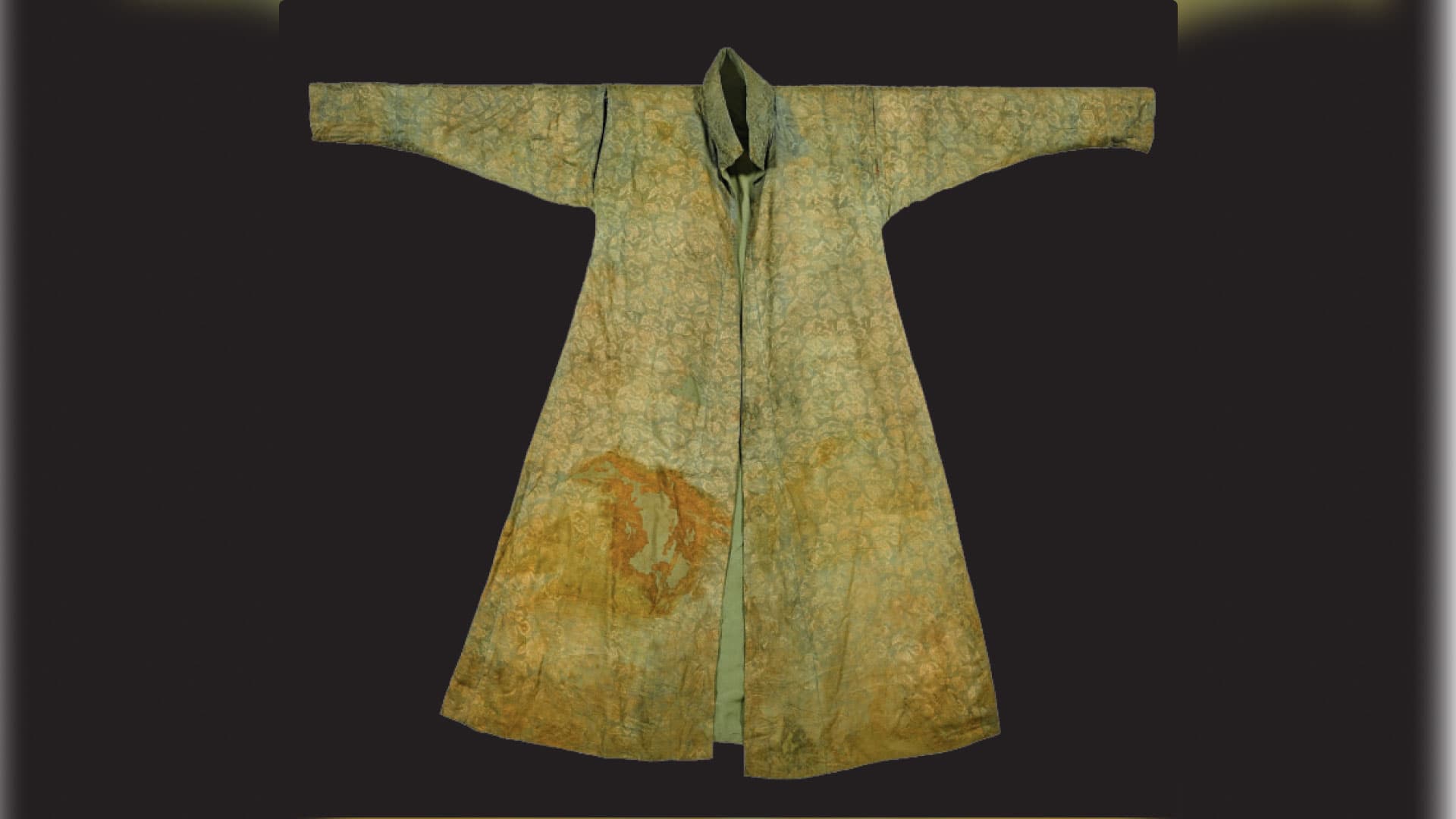
The garment was created in Central Asia in the first half of the 15th century and belongs to the category of luxurious court garments of its time. Its wide and long sleeves are characteristic of ceremonial clothing typical of the Timurid period and served as an important indicator of the wearer’s social status. The garment is constructed from several pieces of fabric, with an open front, a short collar, and wide sleeves. This structural design ensured not only comfort but also a majestic appearance. The garment is woven from silk and decorated with a complex ornamental pattern known as the “cloud band.” This motif, with its flowing, wave-like lines, creates an impression of movement and light across the surface of the fabric.
The “cloud band” motif is one of the widely распространенных decorative elements in the history of Eastern art. It originated in Chinese art and later spread to Central Asia and Iran. By the Timurid period, it had become a key decorative feature in court art and textiles. In addition to cloud band patterns, the fabric of this garment also features images of dragons, phoenixes, lotus, and peony flowers. Each of these motifs carries symbolic meaning in Eastern tradition: the dragon represents power and authority, the phoenix symbolizes renewal and eternity, while lotus and peony flowers signify purity, prosperity, and well-being. For this reason, textiles adorned with such complex and symbolic designs were typically reserved for court environments or members of the elite.
The decorative elements and overall form of the garment closely resemble garments depicted in Timurid miniature paintings. In some 15th-century miniatures, nobles are shown wearing garments adorned with cloud band motifs, indicating that such garments were indeed widely used in real court life. Art historians interpret these similarities as evidence of strong connections between fine arts and applied arts during the Timurid period. Miniature painters, in portraying court life, sought to depict contemporary clothing with precision. Therefore, miniatures today serve as important sources for the study of historical garments.
The quality of the silk fabric is another crucial factor that determines the value of the garment. During the Timurid period, Central Asia was recognized as one of the major centers of silk production and textile craftsmanship. Cities such as Samarkand and Herat were especially renowned for their artisan traditions. Textiles produced in these regions stood out for their high-quality silk fibers, intricate patterns, and vibrant colors. The sheen of the fibers and the smooth flow of the patterns give the fabric a sense of depth, as if it were woven with light itself. Such artistic solutions reflect the refined taste and aesthetic principles formed within the Timurid court.
Today, this unique artifact preserved at the Islamic Civilization Center offers valuable insights into the culture and court aesthetics of 15th-century Central Asia. It not only demonstrates the high level of textile craftsmanship during the Timurid era but also reveals the symbolic and social significance of clothing in that period. In this sense, the green silk garment stands as a material legacy of the Timurid Renaissance, possessing exceptional historical, scientific, and cultural value.
Laylo Abdukakhkharova
P/S: The article may be republished with a link to the official website of the Center