



“Alfraganus”: The light of knowledge that journeyed from the East to Europe now shines even brighter today
When you enter the “Gallery of Great Figures” at the Center, it feels as though you come face to face with historical personalities. They are not merely portraits — they are living witnesses of an entire civilization.
During the early Renaissance in the East, great scholars and thinkers who emerged from the territory of present-day Uzbekistan made invaluable contributions to global science, culture, and the development of Islamic civilization. Their scientific legacy continues to be highly recognized by the international academic community to this day.
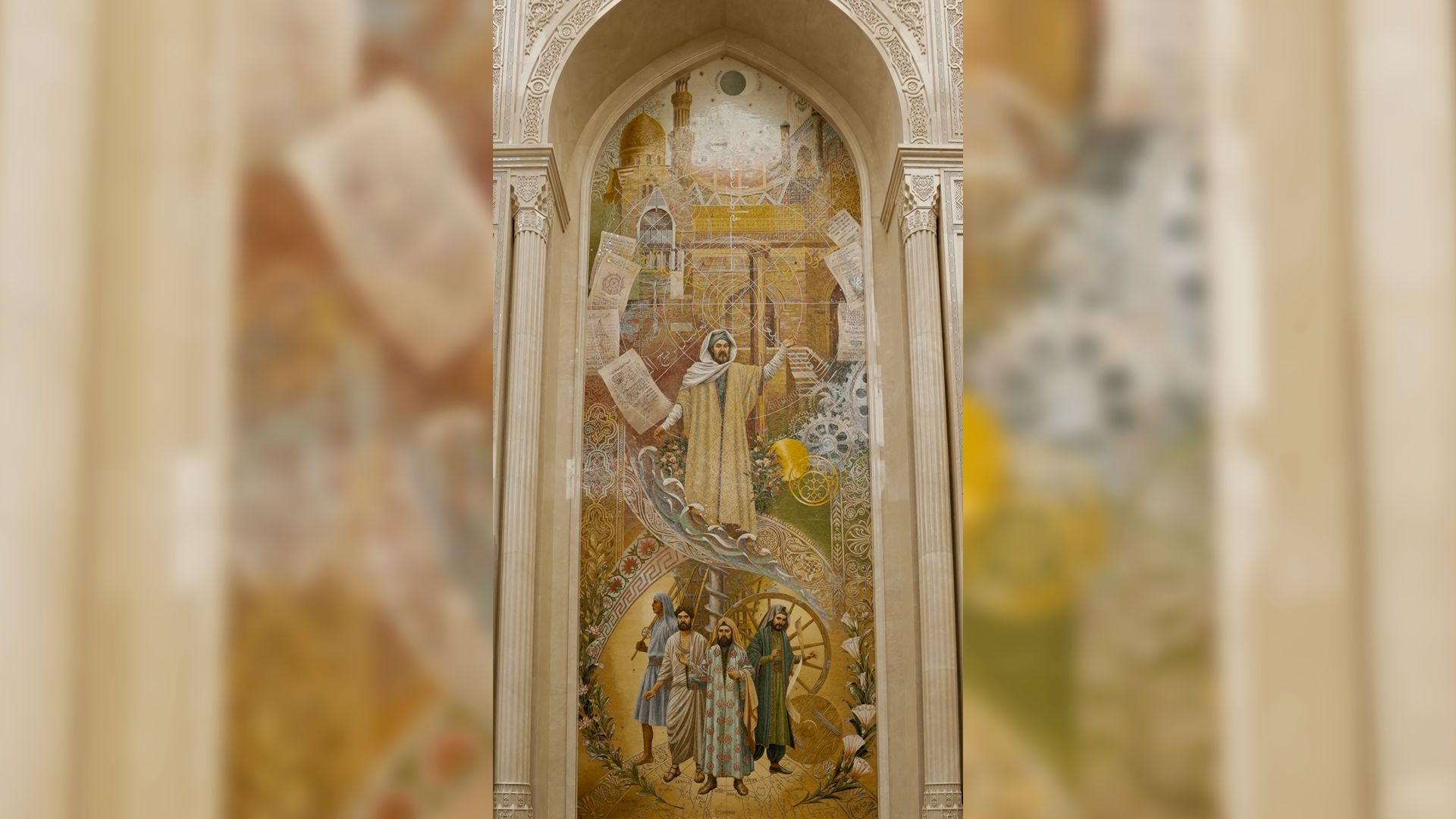 The third painting displayed in the “Gallery of Great Figures” at the Islamic Civilization Center in Uzbekistan is dedicated to the life and scientific activity of one such scholar — Ahmad al-Farghani.
Ahmad al-Farghani (798–861), a distinguished scholar and skilled engineer from our region who worked at the Bayt al-Hikma Academy in Baghdad, became known in Europe as “Alfraganus.” This artwork artistically reflects his immense contributions to the advancement of world science, as well as his major discoveries and practical engineering achievements.
The scholar scientifically demonstrated the spherical shape of the Earth, identified the presence of spots on the Sun, and predicted the solar eclipse of 832 based on scientific calculations.
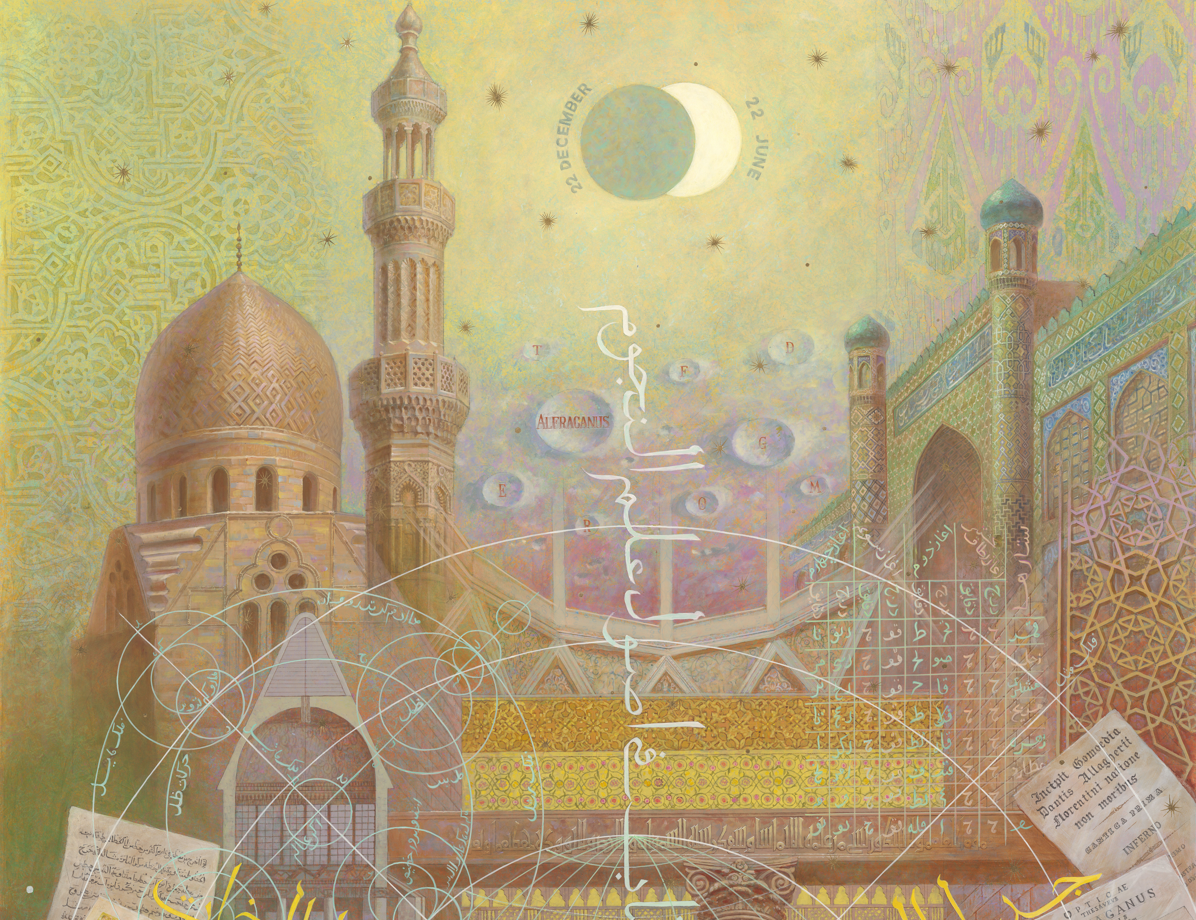 At the top of the panel, the phenomenon of a solar eclipse — when the Sun is obscured by the Moon — is visually depicted based on his scientific explanation. Around it are inscriptions marking the longest day of the year — June 22 — and the longest night — December 22, determined through Ahmad al-Farghani’s mathematical calculations.
Additionally, at the upper part of the painting, an image of the Alfraganus crater on the Moon is included as a clear symbol of the international recognition of his achievements in astronomy.
The artwork also features a cross-section of the Nilometer — one of Ahmad al-Farghani’s greatest engineering projects — along with his technical drawings. This structure remained in use until 1971, when the Aswan Dam in Egypt was put into operation. It was used to fairly determine taxes from farmers based on the water level of the Nile River, as well as to warn the population in advance of potential floods.
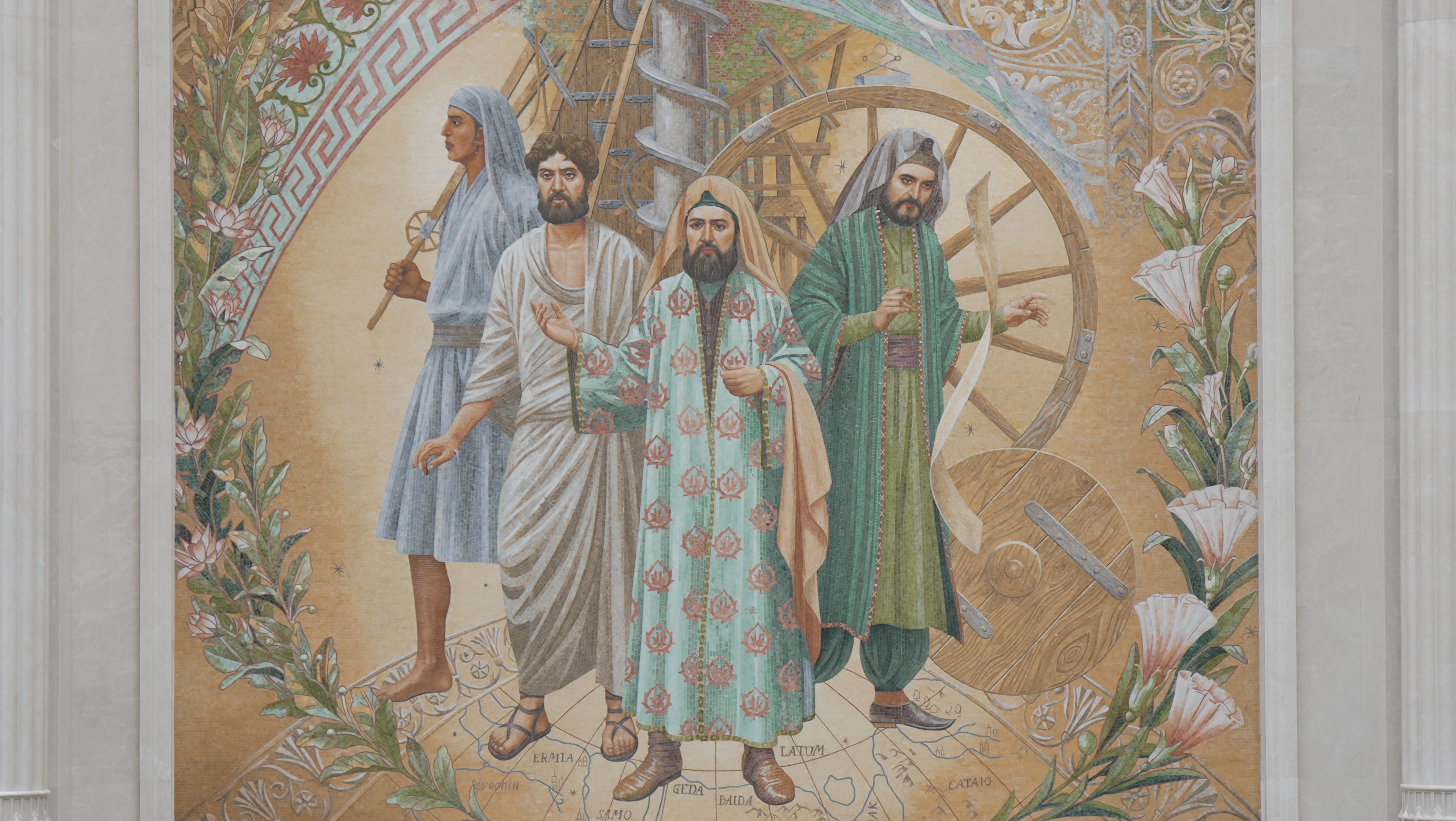 In 828, a group of scholars led by Ahmad al-Farghani at the Bayt al-Hikma Academy in Baghdad measured the length of one degree of the Earth’s meridian in the Sinjar desert, located between Syria and Iraq. According to the scholar, the result of this research determined the length of one degree to be approximately 110 kilometers, which was remarkably accurate for the science of that time. This important discovery is also depicted as a separate scene in the painting.
Zohidulla Munavvarov, Chief Researcher at the Center:
Ahmad al-Farghani was a prominent astronomer. His work “Elements of Astronomy” was translated into Latin in the 12th century and later widely disseminated across Europe. In the 16th century, it was republished four times, and until the 17th century it served as a primary textbook on astronomy in European educational institutions. The work was highly valued by many great scholars and writers.
In particular, the famous 13th-century poet Dante Alighieri made use of al-Farghani’s cosmography in his work “The Banquet,” while the prominent Renaissance figure Regiomontanus delivered lectures based on his works at the University of Padua in the mid-15th century.
The scholar’s scientific legacy and the titles of his works are artistically represented in Arabic calligraphy in the form of “rays” spreading outward from the center. On the right side of the composition, examples of his works published in various foreign languages are displayed, demonstrating his international recognition.
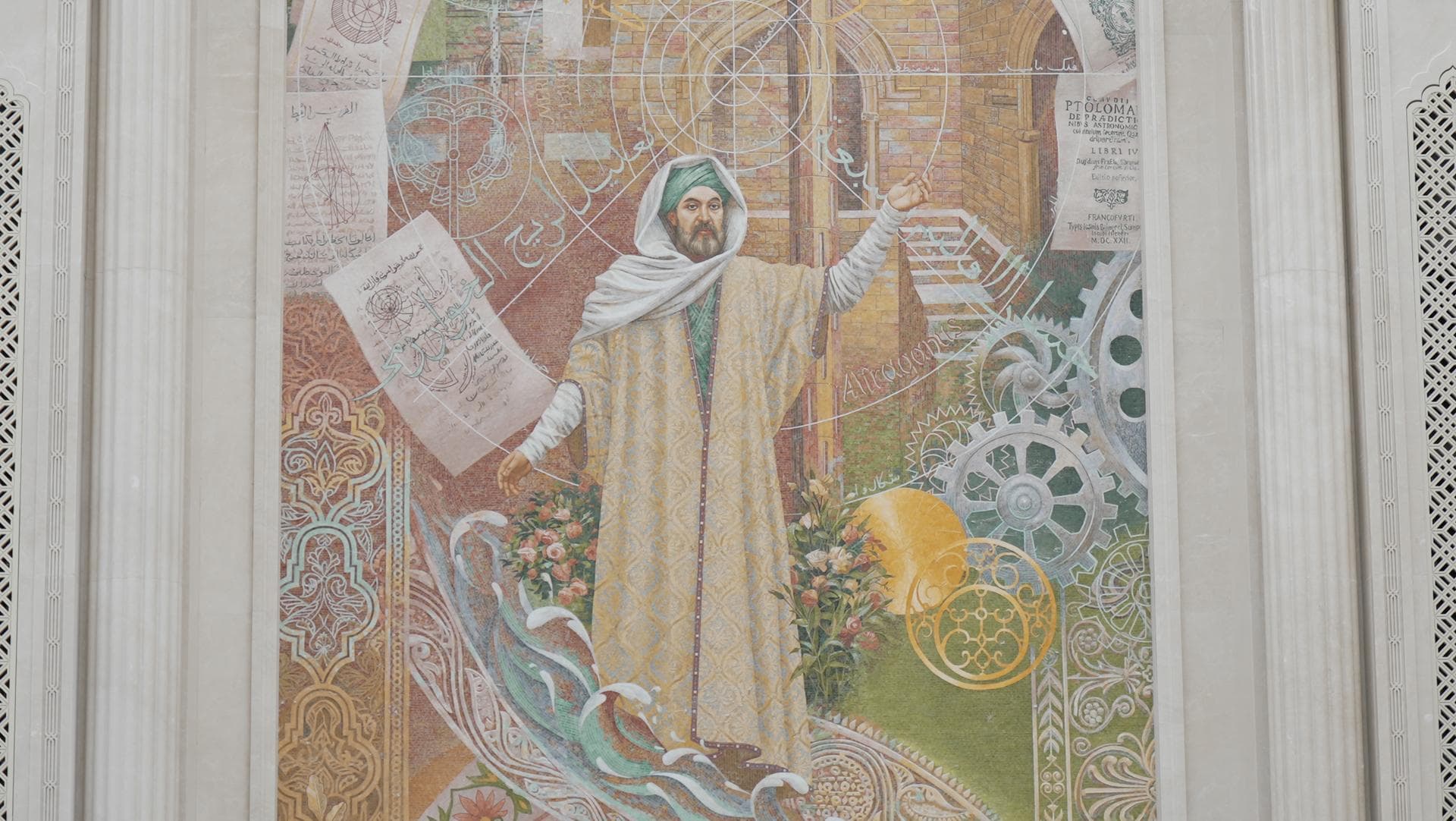
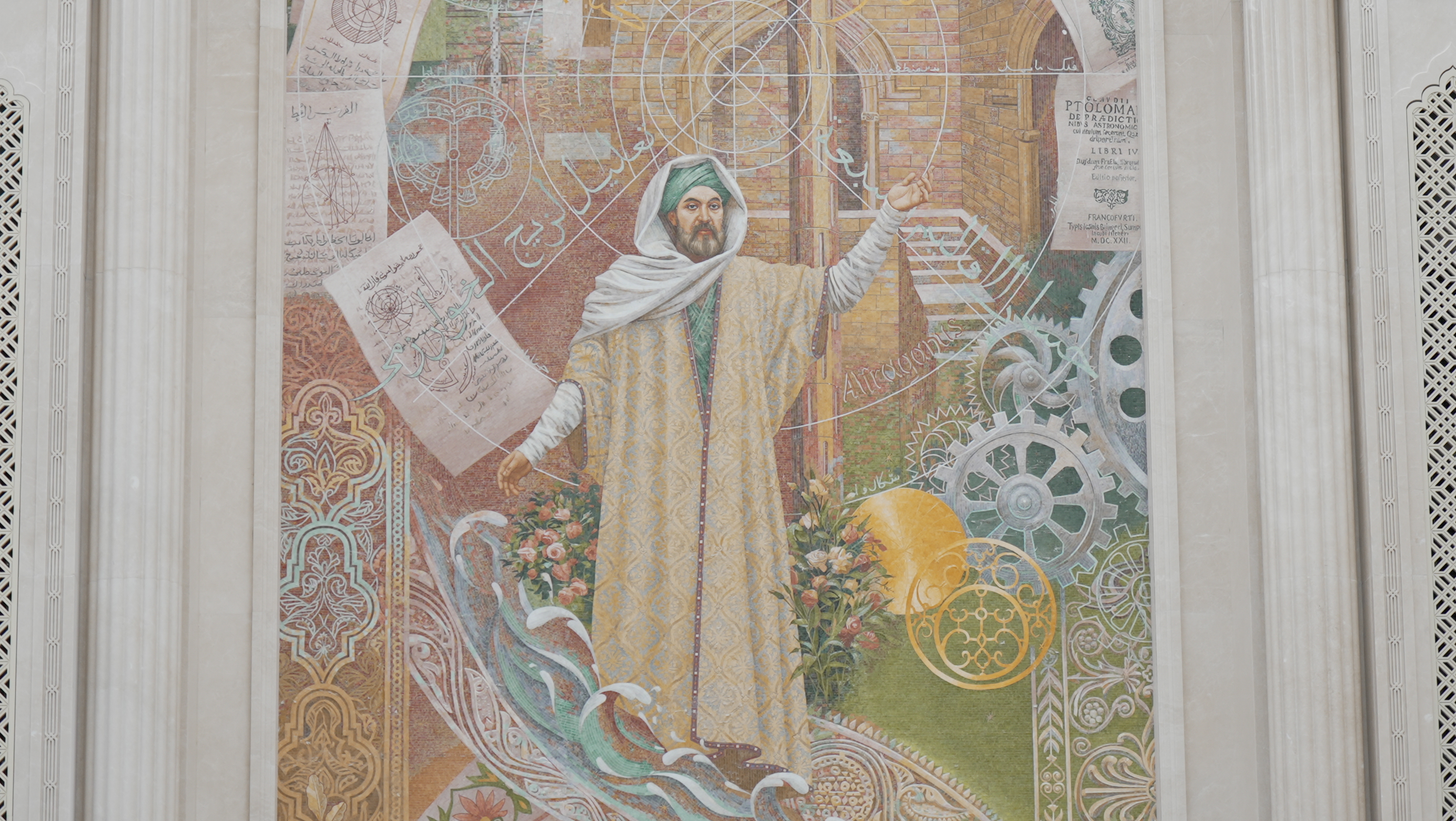 At the center of the artwork stands the figure of Ahmad al-Farghani. His image is enriched through a composition that includes engineering tools and astronomical instruments he used — such as the astrolabe — along with ornamental patterns and floral motifs. In this same space, his Latin name widely known in Western scientific circles — “Alfraganus”—is also depicted.
The panel also includes imagery of the laurel plant and Greek ornaments, symbolizing the sources of inspiration behind his scientific work. Continuing this theme, the lower part of the artwork depicts a group of scholars from antiquity, interpreted from left to right as Arab, Greek, Assyrian, and Persian scholars.
Behind them are symbols of the most significant discoveries of that era, as well as instruments used for scientific and practical purposes. The composition dedicated to Ahmad al-Farghani concludes with the depiction of a map from the ancient world.
It is worth noting that special attention is given to Ahmad al-Farghani’s legacy within the First Renaissance exhibition of the museum. In the Bayt al-Hikma capsule, a model of the Nilometer and other rare exhibits related to his scientific heritage are displayed, offering visitors a comprehensive and profound understanding of his invaluable contributions to the development of science.
Shahnoza Rahmonova
P.S. The article may be republished with a link to the Center’s official website