



ALWATAN: “We saw in real life in Uzbekistan what we had read about in books”
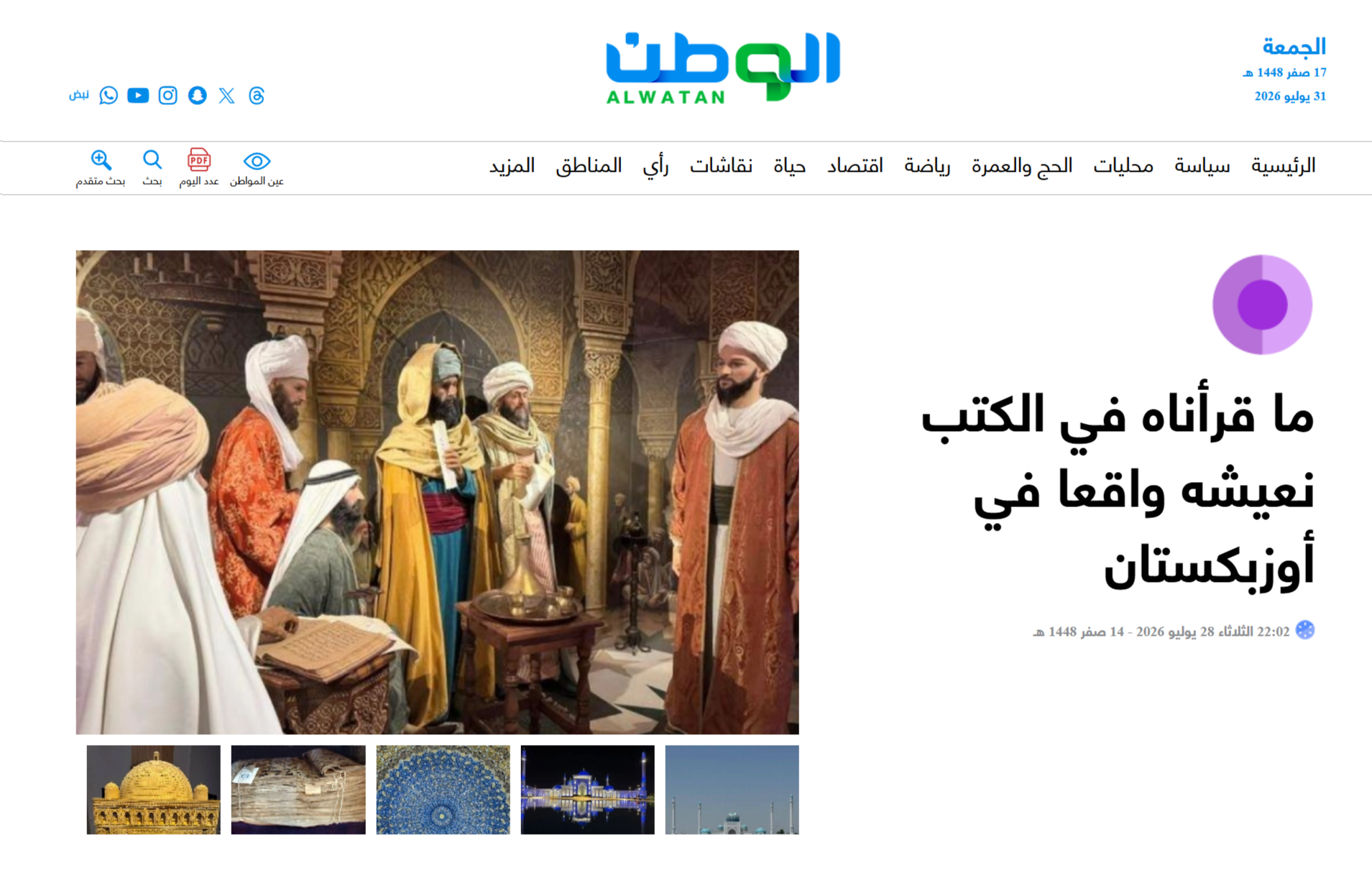 In his article published in the Saudi newspaper ALWATAN, Dr. Othman Mahmoud Al-Sini describes Uzbekistan as one of the greatest centers of Islamic civilization. Reflecting on his journey across the country, the author emphasizes that the historical knowledge he had acquired from books about Mawarannahr, Shash, Samarkand, Bukhara, Fergana, Khorezm, and Termez came to life before his eyes. In his view, with its rich scholarly and intellectual heritage, outstanding scholars, and cultural traditions preserved for centuries, Uzbekistan is an invaluable civilizational space that connects the past with the present and unites the entire Islamic world.
Being amazed by a picture, a living landscape, a piece of music, or a written text is an inherent human quality. Sharing that sense of wonder with others is a unique characteristic that reflects our humanity. Yet enriching our lives with a constant and multifaceted sense of amazement has become one of the most difficult perhaps even nearly impossible—tasks in the age of globalization.
Today, things are becoming increasingly similar to one another, alternatives are multiplying, while uniqueness and originality are gradually fading away. At the same time, in this era of digital communication, we live amid an overwhelming flow of information. People are surrounded by data that vary in value and scale and are often chaotic and, at times, even contradictory.
This is also the age of an endless stream of images. With the help of artificial intelligence, it seems as though everything has already happened, is happening now, or will happen in the future. In this environment, the images seen through the eyes and tastes of others become intertwined with what they wish to show us and with the limits imposed by their personal and technological capabilities. As a result, countless images pass before our eyes, yet in the end, it feels as though we have never truly seen reality itself.
It is as if the Abbasid-era poet Di’bil Khuza’i foresaw this reality more than 1,200 years ago when he said:
“When I open my eyes, I look upon countless things, yet I see no one.”
Here, I am not speaking of the wonder experienced by a child seeing things for the first time, nor of the amazement born of knowledge that belongs to scholars and philosophers. The wonder I have in mind is the wonder of rediscovering ourselves. It is the process of reinterpreting the knowledge, memories, and ideas stored in our minds. Over time, through constant repetition and familiarity, they have hardened into fixed concepts and general expressions that seem to explain everything, yet in reality convey no clear meaning to us.
We pass by them as if we do not see them. We live alongside them, but because our emotions have lost their sensitivity toward them, they no longer touch our hearts as they once did.
We experience this sense of wonder even more deeply when we visit the republics of Central Asia. It is then that we realize that our knowledge of these lands has been shaped largely by the literature of the Islamic conquests. Through history books, works of literature, biographies, and accounts of scholars who lived, studied, or attained great prominence in these regions, names such as Shash, Mawarannahr, the rivers Sayhun and Jayhun, Fergana, Khorezm, and Bukhara have become deeply embedded in our consciousness.
These names and the events associated with them occupy a firm place on our intellectual map. The image that has been formed since the earliest Muslim historians began writing about the Islamic conquests has remained largely unchanged. Works such as Al-Maghazi by Waqidi (d. 207 AH), Futuh al-Buldan by Baladhuri (d. 279 AH), and Tarikh al-Rusul wa al-Muluk by Tabari (d. 310 AH), along with many other sources, have reached us across the centuries.
However, following the fall of Baghdad and the Mongol invasion of Central Asia, the region remained outside the focus of attention for a long time. Later, it became part of the Soviet Union and was enclosed within the framework of the communist system, gaining independence only in 1991.
If you were to ask most people in the Arab world today what they know about the countries ending in “-stan” Uzbekistan, Tajikistan, Kyrgyzstan, Turkmenistan, Tatarstan, or Turkestan you would find that their knowledge of contemporary realities is quite limited. Yet our historical heritage preserves an immense wealth of information about Bukhara, Shash, Fergana, the rivers Sayhun and Jayhun, and Khorezm. Unfortunately, there has been an almost complete rupture between historical imagination and present-day reality.
In Uzbekistan, one does not merely recall memories of history; one lives them. Here, it is not as though you are traveling to the past or the future in an imaginary time machine, nor are you simply envisioning the events of ancient history. On the contrary, the knowledge stored in your mind, together with its heroes and events, merges with the physical environment in which you actually find yourself.
This harmony is manifested through material culture—historical monuments, magnificent buildings, and architectural masterpieces as well as through intangible culture, embodied in traditions passed down from generation to generation, in people's way of life, and in the fact that they continue to live this cultural heritage. They not only preserve this heritage but also experience its influence and, in turn, shape it through their own lives.
Previously, our knowledge of the monuments of Islamic civilization in this region resembled the knowledge of someone who had memorized facts without truly understanding them. Today, however, the information stored in our minds is beginning to find its rightful place. It is taking shape within a geographical, human, and civilizational landscape that reveals an unbroken connection stretching from contemporary reality back through more than fourteen centuries of history.
In this way, the bond between history and culture, between the images preserved in the deepest layers of our consciousness and modern life, is restored once again.
The moment you set foot in Tashkent, you discover that the Islamic Civilization Center in Uzbekistan, in cooperation with the Islamic World Educational, Scientific and Cultural Organization (ICESCO) and under the leadership of its Director-General, Dr. Salim Mohammed AlMalik, has hosted a two-day forum on Islamic civilization. At that moment, you realize that you are standing in the ancient land of Shash, into which Qutaybah ibn Muslim Bahili entered in 95 AH at the head of an army sent by Hajjaj ibn Yusuf.
At the Islamic Civilization Center in Uzbekistan, you also encounter the Mushaf copied during the caliphate of Uthman ibn Affan in 25 AH. According to tradition, this is the very manuscript that Caliph Uthman was reciting from at the moment of his martyrdom.
You then arrive in Samarkand. Here, two scholarly conferences were held in honor of Muhammad ibn Ismail Bukhari, who passed away in 256 AH, and Abu Mansur Maturidi, who died in 333 AH and is renowned as the “Imam of Ahl al-Sunnah” and the founder of the Maturidi school of thought.
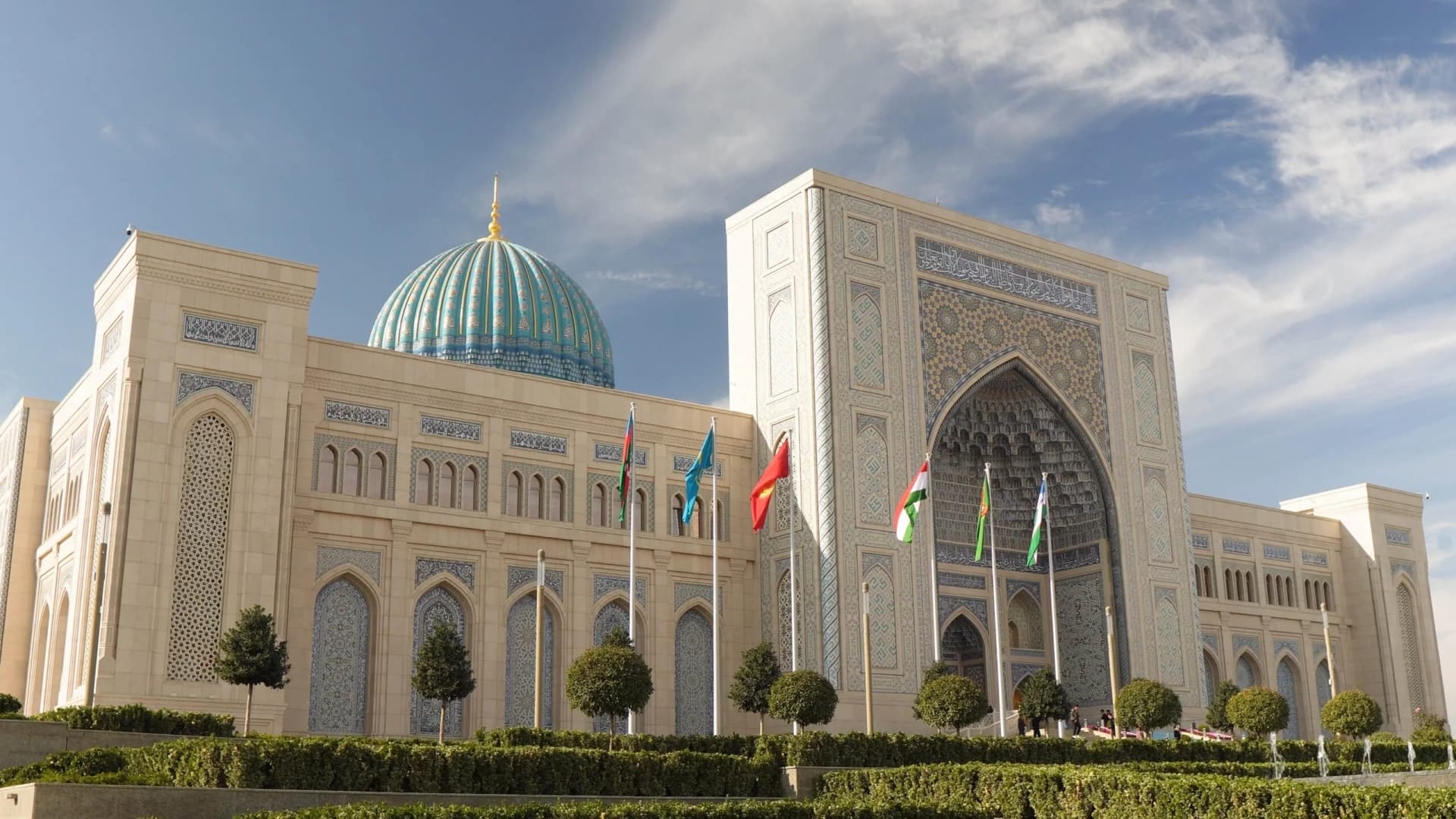
The moment you enter the magnificent Imam Bukhari Complex in Samarkand, you are captivated by its unique architecture. The intricate ornaments and colorful mosaics adorning its walls, domes, and doors reveal an astonishing harmony of geometric and floral designs. Faced with such beauty, one cannot help but pause, as if all the senses have turned into eyes, carefully contemplating every detail.
You then stroll through the ancient quarter of Samarkand a true living museum that embraces unparalleled architectural masterpieces. Here stands the mausoleum of Qusam ibn Abbas, a cousin of the Prophet Muhammad (peace and blessings be upon him), who took part in the conquest of Mawarannahr and was martyred in Samarkand in 57 AH. Not far away rises the mausoleum of the great commander Amir Timur, who passed away in 807 AH.
Equally remarkable is the famous ensemble of madrasas in Registan Square. Beginning in 821 AH (1418 CE), disciplines such as astronomy, mathematics, chemistry, and philosophy were taught here, and this tradition continued until the Russian conquest in 1920.
The journey then leads to Bukhara, the birthplace of Imam Bukhari, and afterward to Khorezm, present-day Khiva. This is the land that produced the celebrated mathematician, astronomer, and geographer Muhammad ibn Musa Khwarizmi. Few people realize that the term “algorithm,” now used worldwide and especially familiar to programmers, is derived from his name. It was also here that the renowned Qur’anic exegete Zamakhshari passed away in 538 AH.
At the end of the journey, you arrive in the city of Termez, which was conquered during the reign of Abd Malik ibn Marwan. It was in this land that Muhammad ibn Isa Tirmidhi, the author of As-Sunan, who passed away in 279 AH, was born. A major international scholarly conference dedicated to his intellectual legacy was also held here.
Previously, we knew the cities of Andijan, Namangan, Margilan, and Kokand only as the homelands of some of our friends with whom we had studied or lived as neighbors in Taif. Like Bukhara, Samarkand, Tashkent, Turkestan, and Kashgar, these cities existed in our minds merely as geographical names.
However, when you visit these lands, you are once again overwhelmed with amazement. You see with your own eyes that all these cities are located in the heart of the famous Fergana Valley, a region that has been mentioned countless times throughout history. Numerous references to the valley can be found in historical sources from the Umayyad and Abbasid periods, as well as in accounts describing social life in the courts of caliphs and military commanders.
The fame of Fergana continued in the centuries that followed. The renowned Arab writer Jurji Zaydan even dedicated his celebrated novel The Bride of Fergana (Arus Fargana), part of his series of historical novels on Islamic history, to this very region. All of this leaves one with the profound realization that the names once encountered only in the pages of history are now unfolding before one's eyes in real life, filling the heart with a renewed sense of wonder.
After the spread of Islam to these lands, the relationship between the Arab world and the “-stan” countries of Central Asia was not characterized by the interaction of two separate cultures or by cultural exchange alone. Rather, a single Islamic cultural and civilizational sphere emerged. Although various dynasties and states arose over time, cultural life developed as a unified system in which all participants contributed on equal terms.
In that era, scholars traveled from one land to another in pursuit of knowledge, while students from different regions journeyed to study under them. The works they produced spread throughout the Islamic world without political or cultural barriers.
One of the clearest examples of this is Imam Bukhari. In search of knowledge, he left Bukhara and traveled thousands of kilometers to Mecca and Medina, where he spent nearly six years studying under renowned scholars. He later settled in Basra and traveled to Kufa, Wasit, and Baghdad eight times, where he met Imam Ahmad ibn Hanbal. He also journeyed to Damascus, Caesarea, Ascalon, Khurasan, Nishapur, Merv, Herat, Egypt, and many other cities.
Describing his travels, Imam Bukhari once said:
“I traveled to Syria, Egypt, and Jazira twice; I went to Basra four times; I lived in the Hijaz for six years. As for the number of times I entered Kufa and Baghdad, I cannot even count them.”
He later returned to Nishapur and spent the final years of his life near Samarkand, where he eventually passed away. Numerous students from different lands studied under him, and his works, preserved in manuscript form, spread from East to West over the centuries.
For this reason, it is more accurate to view that period not as a relationship between two separate cultures, but rather as a single cultural sphere.
Even in the modern era, the relationship between Central Asia and the Arab world has been marked not so much by genuine cultural exchange as by a certain degree of cultural separation. Nevertheless, the cultural environment that emerged during the early centuries of Islam continued to exist for centuries across different regions as an integral part of the Arab and Islamic heritage.
At the same time, both in the past and in the present, the example of Uzbekistan demonstrates the interaction and debate between different cultural perspectives within a single society. This can be illustrated through two examples.
The first example is the ancient works of art and archaeological artifacts preserved in museums. Statues of humans and animals, images of Buddha, and other representations dating from the Stone Age to the early centuries of Islam can still be found. Later, however, this artistic tradition disappeared and was replaced by miniatures, geometric and floral motifs, ornaments, and mosaics.
The second example reflects the interaction between local culture and Islamic civilization. This can be clearly observed in the architecture of the Samanid Mausoleum in Bukhara. The mausoleum was built after the death of Ahmad ibn Asad in 278 AH (892 CE), nearly two centuries after Islam had arrived in these lands.
At that time, the construction of mausoleums over graves was generally not regarded as permissible under Islamic law. Nevertheless, Ismail Samani broke with this traditional prohibition and commissioned the construction of the mausoleum.
Even more interesting is the fact that the architecture of this structure was shaped by the traditions of pre-Islamic Sogdian architecture. It incorporates a four-arched domed design, while the decorations of the dome symbolize the sun, which was considered sacred in Sogdian culture. These motifs correspond to the “temples of the rising sun” that existed in the Fergana Valley before the spread of Islam.
Thus, the Samanid Mausoleum is not merely a unique architectural monument; it also stands as a vivid example of the interaction, synthesis, and cultural dialogue between local heritage and Islamic civilization.
In the modern era, however, the Russian conquest of the Central Asian republics and the replacement of Islamic beliefs with communist ideology throughout the Soviet Socialist republics marked the beginning of a new phase of cultural conflict and debate.
Following independence, different perspectives emerged between those who took pride in Islamic civilization and reformers who were more inclined toward Russian or Western models of development. Nevertheless, among all generations, the sense of belonging to Islamic civilization and pride in its great scholars has remained a dominant sentiment.
You also come to realize that, during the period of the Islamic conquests, many Arab tribes from the Arabian Peninsula settled in these lands. Some of their members were martyred there, while others ruled the region and established family ties with the local population.
One of the clearest pieces of evidence for this can be found in the genealogies of the authors of the famous collections of hadith known as the Sihah and Sunan. Six of the authors of the nine major hadith compilations belonged to Arab tribes:
- Muslim ibn Hajjaj Nishapuri (d. 261 AH), author of Sahih Muslim, belonged to the Banu Qushayr tribe.
- Abu Dawud Sulayman ibn Ash’ath Sijistani (d. 275 AH), author of Sunan Abu Dawud, belonged to the Azd tribe.
- Muhammad ibn Isa Tirmidhi, author of Sunan Tirmidhi, belonged to the Banu Sulaym tribe.
- Abdullah Darimi Samarqandi (d. 255 AH), author of Sunan al-Darimi, came from the Banu Darim branch of the Tamim tribe.
In addition, Ahmad ibn Hanbal belonged to the Shayban tribe, Malik ibn Anas to the Asbah tribe, while Imam Bukhari was a mawla of the Banu Ju’fi clan of the Madhhij tribe, which was part of the Qahtani confederation. Ibn Majah was a mawla of the Banu Rabi’ah, and Ahmad ibn Shu’ayb Nasa’i originated from the city of Nasa, located in present-day Turkmenistan.
For this reason, one comes to understand more deeply the significance of the warm welcome offered in Arabic by university students volunteers at the Islamic Civilization Forum—such as Abdulaziz Khayrullah, Imron, Madina, and Jaloliddin, to the guests arriving from Saudi Arabia:
“Marhaban bikum, asatidhatana wa aba’ana, duyuf Imam Bukhari”—“Welcome, our teachers and fathers, honored guests of Imam Bukhari!”
These words embody not only hospitality, but also profound respect for a shared history, a common civilization, and a collective spiritual heritage.