



The Standard: “From Tashkent’s new museum to Samarkand’s ancient wonders”
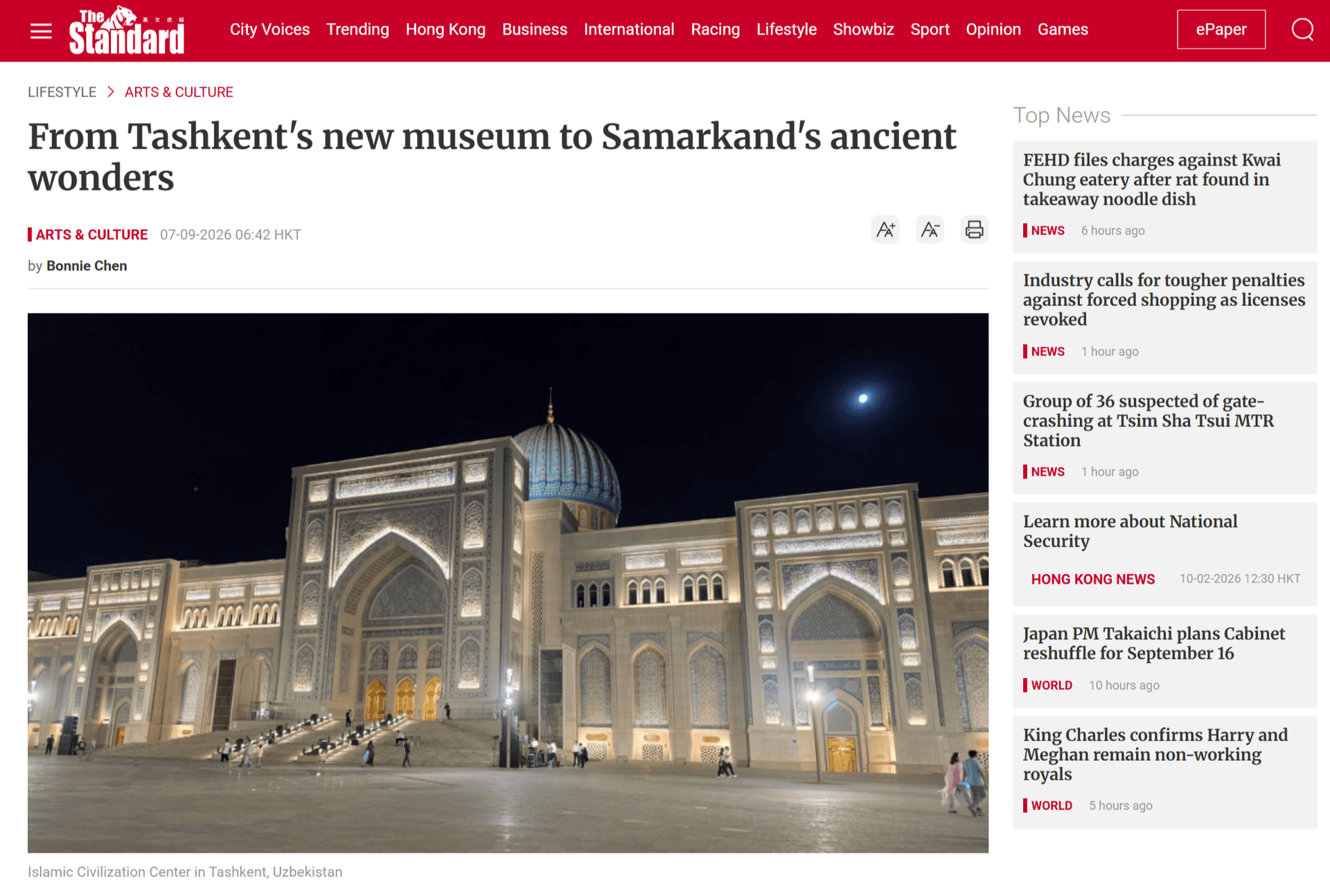
Continuing her journey from Tashkent to the Imam Bukhari Complex, Registan Square, and Ulugbek Observatory in Samarkand, the author portrays the route as a distinctive journey through the legacy of history, science, and spirituality.
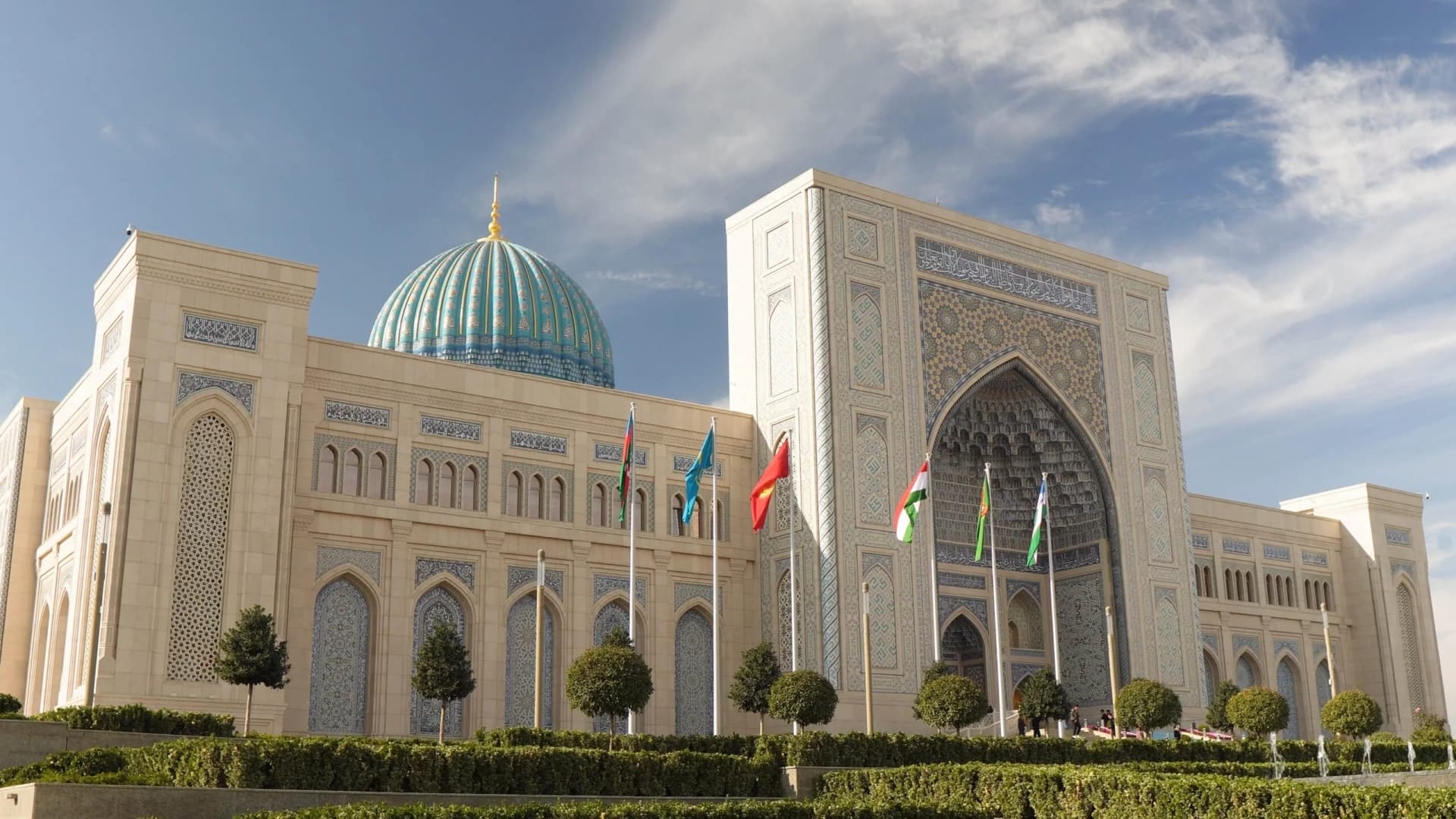
It begins with a dome. A vast, 65-meter azure dome rising above Tashkent’s skyline, its ceramic tiles catching the sunlight like fragments of polished lapis lazuli. Stepping into the newly opened Islamic Civilization Center in the Uzbek capital, you are immediately struck by a sense of discovery – a space where history meets innovation, inspiring visitors to journey deeper to the legendary city of Samarkand itself.
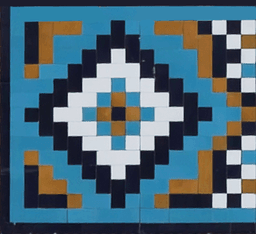
Here, along the ancient Silk Road, Persian geometry meets Turkic craftsmanship, and Chinese ceramic techniques inspired the very turquoise glazes that adorn these walls. This is not a foreign history; it is a shared one.
The Center is far more than a museum. It is a living hub of intellectual exchange, housing a library, a publishing house, and laboratories dedicated to artifact and manuscript preservation. It regularly hosts conferences, such as an international media forum held last month.
In addition to publishing, it holds a rare book collection, including volumes on astronomy, medicine, mathematics, and theology – testaments to the region's golden age of scholarship. The Center also houses the revered 7th-century Uthman Quran, but its most captivating feature is how it uses technology to bring the past to life. Interactive panels let visitors converse with digital avatars of great scholars – an experience that sparks a natural curiosity to visit the very places where these thinkers lived and worked.
For any traveler inspired by this encounter, the journey leads to Samarkand, a legendary trading hub on the ancient Silk Road and the glorious capital of the Timurid Empire. One of the highlights is the newly expanded Imam Bukhari Memorial Complex. Born in 810 CE, the Imam was one of the most revered scholars in Sunni Islam. Over 16 years, he traveled across the Islamic world collecting over 600,000 hadith reports.
From these, he selected just over 7,000 he deemed authentic, compiling them into the Sahih Bukhari – the most trusted collection of prophetic traditions after the Quran itself. Meaning “report” in Arabic, hadith are the recorded sayings and actions of the Prophet Muhammad, serving as a practical guide to Islamic life alongside the Quran.
The complex, which opened in spring 2026, is breathtaking. Imagine numerous turquoise domes shimmering against the pale blue sky, four 75-meter minarets rising like candles, their surfaces covered in intricate carved plaster.
The tiles are a spectrum – from deep indigo to brilliant cerulean – with bands of gold calligraphy spiralling around the domes. Inside the main mosque, which holds 10,000 worshippers, windows filter harsh sunlight into soft pools of amber and sapphire. The Imam Bukhari Innovation Museum uses holograms and augmented reality to bring the scholar's journey to life.
No visit is complete without Registan Square, where three magnificent madrasahs – Islamic schools of higher learning – form a symphony of tile and ambition.
The Ulugbek Madrasah (1417) is the oldest, its facade covered in turquoise star patterns. The Sherdor Madrasah (1636) features rare mosaic tigers flanking its entrance, with a radiant sun above and deer beneath – symbolizing divine light illuminating knowledge, with the soul humbly submitting to the divine. The Tillakori Madrasah (1660) is named “gilded”—its interior covered entirely in gold leaf, shimmering like a celestial garden.
Finally, the Ulugbek Observatory – built by the astronomer-king in the 15th century – stands as a monument to scientific inquiry. Its 40-meter marble sextant, carved into the earth, was used to create a star map so accurate it was revered for centuries. It is a powerful reminder that this region was once a global center for both faith and science.
What begins as a visit to a museum in Tashkent quickly becomes a profound journey. The Islamic Civilization Center does not just display history; it acts as a gateway, sparking a curiosity that finds its ultimate fulfilment in the ancient, timeless streets of Samarkand. It is a journey through the legacy of the mind and the spirit – and it starts with a single, majestic dome.