


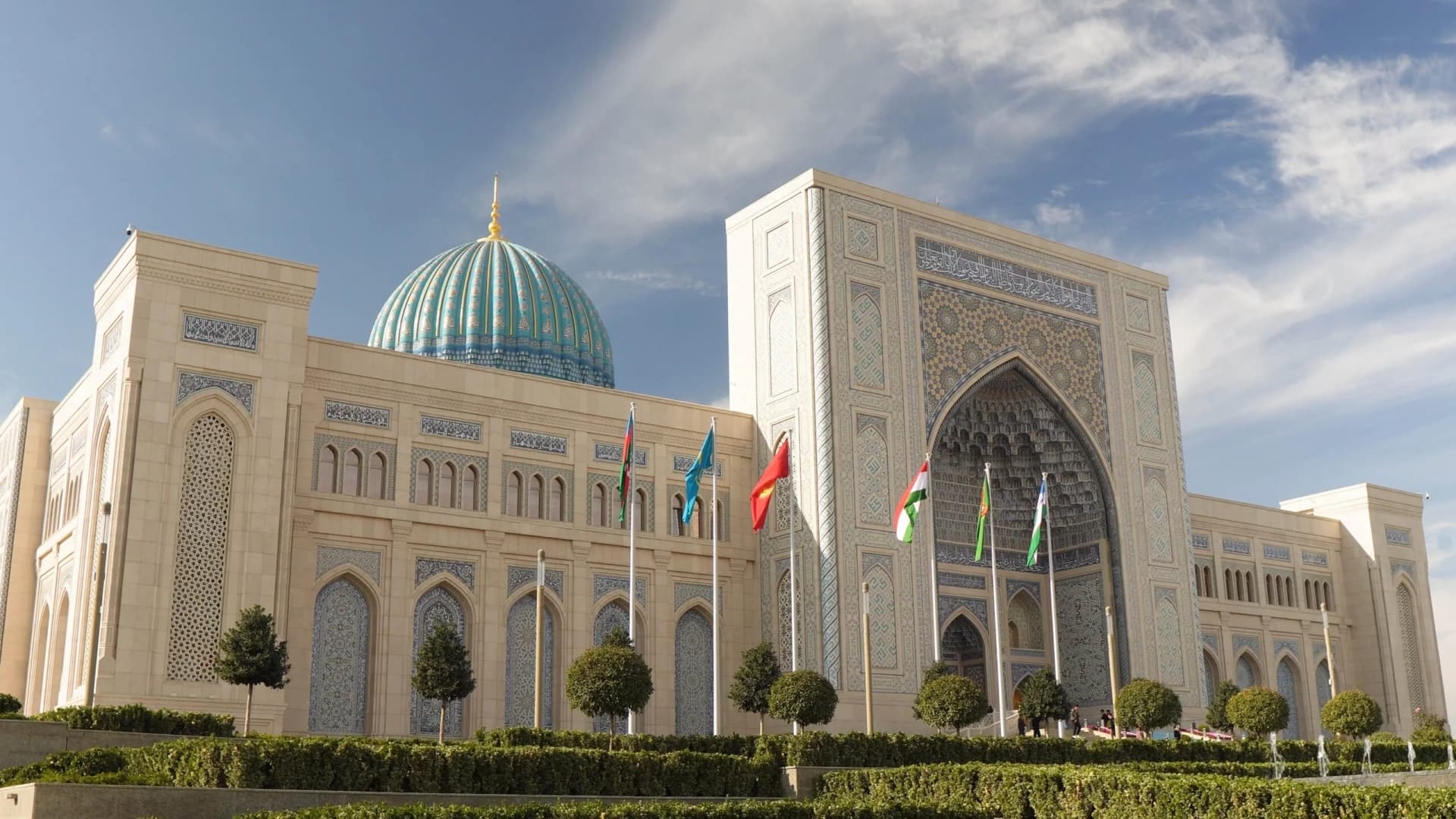


Al-Seyassah: “From Samarkand to Failaka: when the earth speaks the language of civilization”

While participating in the international media forum “Islamic Civilization: A New Perspective — New Discoveries” held in Tashkent, the author drew attention to the distinctive parallels between the histories of Samarkand and Kuwait. He noted that, for centuries, both places served as crossroads of trade routes, cultural exchange, and human interaction. Samarkand was an important stop for caravans, while Kuwait played a similar role for ships, and both became centers for something far more valuable than trade itself — dialogue, mutual understanding, and cultural ties among different peoples. Today, these historical bonds have acquired new meaning and continue through such modern areas as investment, education, technology, media, and cultural cooperation.
Millennia-old cities reveal a striking similarity between the history of Uzbekistan and the story of Kuwait.
Kuwait was not located at the heart of the continent, yet its position at the head of the Persian Gulf turned the sea into a gateway to the wider world.
Beneath the ground lies a history stretching back more than 7,000 years, to the end of the sixth millennium BCE.
Archaeological excavations in the Subiya region have revealed settlements associated with the Ubaid culture, as well as workshops where shell beads were produced.
Samarkand and Kuwait were both stops along major trade routes, and each created something greater than wealth through commerce — human connections and cultural exchange.
To understand the meaning of hospitality in Kuwait and the Persian Gulf, there is no need to read a history book — this value is naturally ingrained in the people.
The markets of Kuwait were not merely places of commerce, but spaces where people met, formed connections, and encountered new cultures.
Caravans and ships may not have provided a direct route linking Kuwait and Samarkand, but they were among the most important means of communication between the two regions.
The most important impression I took away from the forum was that discussions about civilization cannot be confined solely to museums and books.
In August 2026, I participated in the international media forum “Islamic Civilization: A New Perspective — New Discoveries,” held in Tashkent. It brought together nearly 300 experts and media representatives from around 50 countries. Throughout the forum’s sessions and visits, another aspect became especially clear — the history that still preserves its traces on this land to this day.
Speaking at the forum, I expressed the view that the real task facing the media today is not only to preserve the memory of Islamic civilization, but also to present it anew to the younger generation in a language that allows them to see themselves as part of that history. It is important to help them understand that this history is not merely contained in the pages of old books, but is part of their own history and story.
The idea of similarities between cultures and civilizations in Tashkent and Samarkand is not unfamiliar to me. I see them in buildings, markets, mosques, roads, and even in the way people welcome guests. It was from this perspective that the comparison with Kuwait began.
I looked at the land of Kuwait in the same way I looked at Samarkand, and through many historical sites I came to realize that Kuwait’s story, too, has a similar history when viewed from the perspective of civilization.
Samarkand — a millennia-old crossroads of civilizations
Today, Samarkand stands as one of the oldest historic cities in Central Asia. According to UNESCO, evidence of human settlement in this area dates back to around 1500 BCE.
The ancient part of Samarkand — the city of Afrasiab — took shape in the seventh century BCE.
Yet Samarkand did not become a great city merely because of its antiquity. The secret of its greatness lay above all in its location. The city stood at the crossroads of caravan routes that carried goods, ideas, and cultures between China, Central Asia, Iran, and the Middle East.
By the early centuries CE, Samarkand had become one of the major centers along the Silk Roads. In the fourteenth and fifteenth centuries, during the Timurid era, it reached the height of its development. For this reason, UNESCO describes it as a “crossroads of cultures.”
When examining the history of Samarkand, its scholars, jurists, mosques, and architecture, it is difficult to regard these figures and structures merely as historical monuments. They are the legacy of an era in which architecture, science, astronomy, trade, and politics were all integral parts of a single civilizational project.
Tashkent — a history that began before its name appeared
The story of Tashkent takes me back to the region of “Chach” and the ancient city of Kanka.
According to UNESCO, Kanka was the first capital of Chach. It was a vast fortified city through which branches of the Silk Roads passed.
Agriculture had already developed in this region in the centuries BCE. Water, farming, and trade became key factors in the growth of urban settlements.
This reveals an important point worth considering for the Persian Gulf region: ancient civilizations did not wait for ideal conditions; rather, they treated geography itself as an opportunity.
Uzbekistan had no access to the sea, but it was located at the heart of Asia. Therefore, it turned caravan routes into its lifelines.
Kuwait, by contrast, was not located at the center of the continent, but at the head of the Persian Gulf. For that reason, it turned the sea into a gateway to the world.
Kuwait — a story spanning more than 7,000 years
Beneath the land of Kuwait, known today for its modern cities, ports, roads, and markets, lies a history stretching back to the end of the sixth millennium BCE — more than 7,000 years ago.
In particular, archaeological excavations in the Subiya region of northern Kuwait have revealed settlements associated with the Ubaid culture, as well as workshops where beads were made from shells.
Evidence of maritime activity has also been discovered, including a clay model of one of the earliest known seagoing boats.
Samarkand and Kuwait — caravans and trading ships
I have not come across clear evidence of an ancient route that directly connected Samarkand and Kuwait. However, the similarities in their locations and historical roles are noteworthy.
If Samarkand served as a stop for caravans, Failaka and Kuwait served as stops for ships.
While Samarkand opened its gates to those arriving from the East and West, Kuwait opened its shores to those coming from the northern, eastern, and southern parts of the Persian Gulf.
Both created something through trade that was greater than money: societies capable of getting to know others, building relationships with them, and benefiting from their differences.
First and foremost — the guest
A similarity between Kuwaiti and Uzbek homes
In Kuwait and the Persian Gulf region, there is no need to read a history book to understand the meaning of hospitality.
The guest room, coffee, dates, food, asking after the guest’s well-being, and the host’s desire to treat them with honor and respect — all of these are values naturally ingrained in Kuwaitis and the people of the Gulf.
I felt something very similar in Uzbekistan. Generosity expressed through tea, bread, sharing meals with the family, and warmly welcoming guests is not merely a custom associated with tourism, but part of the deeply rooted social culture of the Uzbek people.
Even the markets themselves reveal a similar connection.
Just as the ancient markets of Samarkand and Tashkent were not merely places of buying and selling, the old markets of Kuwait were more than simply collections of shops. They were spaces where people met, exchanged news, formed connections, and where new cultures entered society.
A similar parallel can also be seen in the respect accorded to knowledge and learning.
While Samarkand was associated with scholars of astronomy, mathematics, medicine, and religious sciences, Kuwait also had schools, religious education, and scholarly gatherings from an early period. Over time, this system developed into modern education.
The details may differ, but in both experiences the value placed on knowledge and the role of learning in society appear remarkably similar.
The modern story of Kuwait and Uzbekistan
One of the most remarkable aspects of the history of Kuwait and Uzbekistan is that their story is not confined to the past.
On February 17–18, 2025, the visit of President of Uzbekistan Shavkat Mirziyoyev to Kuwait marked the beginning of a new stage in relations between the two countries.
The two countries announced the elevation of their relations to the level of a comprehensive strategic partnership. The announced value of the package of agreed economic deals and projects amounted to nearly USD 4.9 billion.
They covered a wide range of areas, including industry, aviation, labor, smart cities, healthcare, tourism, culture and the arts, as well as cooperation with the Kuwait Fund for Arab Economic Development.
In the past, caravans and ships may not have formed a direct route connecting Kuwait and Samarkand. Yet they were among the most important means of trade and cultural exchange in both regions.
Today, however, this dialogue is carried forward through investment, aviation, technology, artificial intelligence, education, and development projects.
The Kuwait Fund for Arab Economic Development is one of the clearest examples of the practical dimension of Kuwait’s relations with other countries.
Established in 1961, the Fund has become more than simply a financing mechanism; it has emerged as one of Kuwait’s most recognizable instruments of engagement with developing countries.
The Fund has also financed a number of development projects in Uzbekistan. These include a loan of 9 million Kuwaiti dinars — approximately USD 30 million — for a project aimed at developing housing infrastructure in rural areas.
It has also participated in a project to equip medical facilities specializing in urology, kidney diseases, dialysis, and kidney transplantation.
Today, however, in the context of the progress and development taking place in modern Uzbekistan, dialogue is expanding into an even broader range of areas — infrastructure, logistics, agriculture, green energy, healthcare, industry, services, and investment.
It is precisely this path that can transform political relations into partnership projects that contribute to civilizational development.
From the memory of civilization to the future of cooperation
The most important impression I took away from the forum in Tashkent was that the conversation about civilization should not remain confined to museums and books.
A true civilization is one that can move from memory toward the future.
That is why, when I think of Samarkand today, I do not see it as a distant and unfamiliar city in Central Asia, but as a city that shares many similarities with Kuwait.
Because both have long understood that openness to the world can be a source of strength rather than a threat to national identity.
While the caravans of Samarkand carried silk and ideas, Kuwaiti ships carried pearls, goods, and news.
Today, airplanes, investments, universities, media, and culture can carry something even greater — cooperation between the two peoples.
Both nations have deep historical roots, and both aspire to the future.
We are not required to live in the past. Rather, we need to understand it well so that we do not build the future without roots.
From Samarkand to Failaka, from the Silk Roads to the routes of the Persian Gulf, times and means may change.
Yet people continue to seek communication, learning, trade, and mutual understanding. They discover the other side and return home enriched with new knowledge about the world.
Perhaps there was never a single ancient route between Kuwait and Samarkand that could be clearly traced on a map.
But there is a very ancient idea connecting them:
civilization begins when geography is transformed from a boundary into bridges of cooperation and partnership.