



The figure who created wonders in the Turkic language
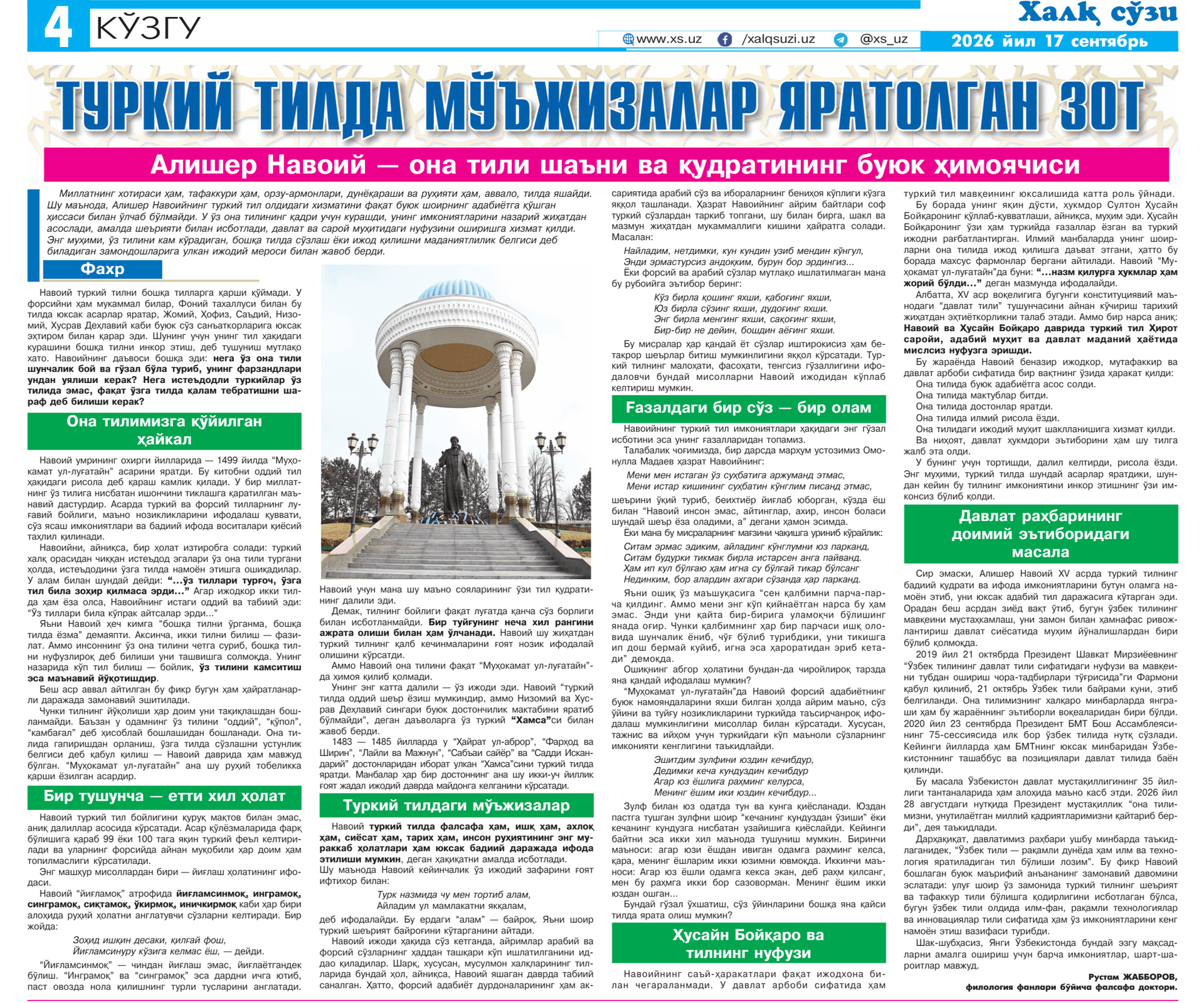
A nation’s memory, thought, aspirations, worldview, and spirit live first and foremost in its language.
In this sense, Alisher Navoi’s service to the Turkic language cannot be measured solely by the contribution of a great poet to literature. He stood up for the dignity of his mother tongue, theoretically demonstrated its potential, proved its expressive power through poetry, and helped enhance its prestige in the spheres of government and the royal court. Most importantly, he responded not merely with words, but with his immense creative legacy to those of his contemporaries who looked down on their own language and regarded speaking or writing in another language as a sign of sophistication.
Navoi did not set the Turkic language against other languages. He had a perfect command of Persian and, under the pen name Fani, created outstanding works in that language. He also held in the highest esteem such great masters of the word as Jami, Hafiz, Sa’di, Nizami, and Amir Khusrau Dehlavi. Therefore, it would be entirely wrong to interpret his advocacy for language as a rejection of another language. Navoi’s argument was different: why should the speakers of his own mother tongue feel ashamed of it when it was so rich and beautiful? Why should talented Turkic writers consider it an honor to write only in another language rather than in their own?
A monument to our mother tongue
In the final years of his life, in 1499, Navoi wrote Muhokamat ul-lug‘atayn (The Comparison of Two Languages). It would be insufficient to regard this book as merely a treatise on language. It is, in essence, a spiritual manifesto aimed at restoring a nation’s confidence in its own mother tongue. In the work, the Turkic and Persian languages are comparatively analyzed in terms of lexical richness, their capacity to express subtle shades of meaning, their possibilities for word formation, and their means of artistic expression.
Navoi was particularly troubled by one situation: talented people from among the Turkic peoples, despite having their own mother tongue, were eager to demonstrate their abilities in another language. With a sense of pain, he writes: “...while they had their own language, if only they had not expressed themselves in another tongue...” If a writer was capable of writing in both languages, Navoi’s wish was simple and natural: “If only they had written more in their own language...”
In other words, Navoi was not telling anyone, “Do not learn another language” or “Do not write in another language.” On the contrary, knowing two languages was a virtue. What concerned him was when people pushed their own mother tongue aside and regarded another language as more prestigious. In his view, multilingualism was an enrichment, while belittling one’s own language was a spiritual loss.
This idea, expressed five centuries ago, still sounds remarkably modern today.
A language does not always begin to disappear because it is prohibited. Sometimes the process begins when people start to regard their own language as “simple,” “crude,” or “poor.” Feeling ashamed to speak one’s mother tongue and treating the use of another language as a sign of superiority existed in Navoi’s time as well. Muhokamat ul-lug‘atayn was written precisely as a response to this kind of psychological subordination.
“One concept — seven different states”
Navoi demonstrates the richness of the Turkic language not through empty praise, but through concrete evidence. Depending on variations among the manuscripts of the work, he cites approximately 99 or 100 Turkic verbs and shows that exact equivalents for them cannot always be found in Persian.
One of the best-known examples is the expression of different states of crying.
Around the verb yig‘lamoq (“to cry”), Navoi gives such words as yig‘lamsinmoq, ingramoq, singramoq, siqtamoq, o‘kirmoq, and inichkirmoq, each conveying a distinct emotional state. In one passage, he writes:
Zohid ishqin desaki, qilg‘ay fosh,
Yig‘lamsinuru ko‘ziga kelmas yosh.
“Yig‘lamsinmoq” does not mean truly crying, but rather appearing as though one were crying. “Ingramoq” and “singramoq,” meanwhile, convey different shades of quietly lamenting while suppressing one’s pain within. For Navoi, these subtle distinctions in meaning were themselves proof of the expressive power of the language.
Thus, the richness of a language is not measured only by the number of words in its vocabulary. It is also measured by how many different shades of a single emotion it can distinguish. In this respect, Navoi demonstrated the remarkable ability of the Turkic language to express the most subtle movements of the human heart.
Yet Navoi did not defend his mother tongue only in Muhokamat ul-lug‘atayn.
His greatest proof was his own creative work. Navoi answered claims that “simple poetry may be written in Turkic, but it is impossible to create a great epic tradition like that of Nizami and Amir Khusrau Dehlavi” with his own Turkic Khamsa.
Between 1483 and 1485, he composed his monumental Khamsa in Turkic, consisting of the epics Hayrat ul-abror, Farhod va Shirin, Layli va Majnun, Sab’ai Sayyor, and Saddi Iskandariy. Sources indicate that each of these works was produced during this extraordinarily intense two- to three-year period of creative activity.
Wonders in the Turkic language
Navoi demonstrated in practice that philosophy, love, morality, politics, history, and even the most complex states of the human soul could all be expressed in Turkic at the highest artistic level.
In this sense, Navoi later expressed his creative triumph with great pride:
«Turk nazmida chu men tortib alam,
Ayladim ul mamlakatni yakqalam»,
Here, the word alam means “banner.” In other words, the poet declares that he had raised the banner of Turkic poetry.
When discussing Navoi’s works, some claim that he used an excessive number of Arabic and Persian words. Yet such a linguistic phenomenon was natural in the languages of the East, particularly among Muslim peoples, and especially during Navoi’s lifetime. Even many masterpieces of Persian literature contain a striking abundance of Arabic words and expressions.
What is particularly remarkable, however, is that some of Hazrat Navoi’s verses are composed entirely of Turkic words while remaining flawless in both form and meaning. For example:
Nayladim, netdimki, bir yo‘li chekib mendin ilik,
Endi ermastursiz andoqkim, burun bor erdingiz...
Or consider the following rubai, in which no Persian or Arabic words are used at all:
Ko‘z birla qoshing yaxshi, qabog‘ing yaxshi,
Yuz birla so‘zing yaxshi, dudog‘ing yaxshi.
Eng birla menging yaxshi, saqog‘ing yaxshi,
Bir-bir ne deyin, boshdin ayog‘ing yaxshi.
These lines clearly demonstrate that unique and beautiful poetry can be created without relying on any foreign words. Many similar examples can be found throughout Navoi’s works, vividly revealing the grace, eloquence, and incomparable beauty of the Turkic language.
A single word in a ghazal — a whole world
Perhaps the most beautiful proof of the expressive possibilities of the Turkic language can be found in Navoi’s ghazals.
I still remember how, during our student years, our late teacher Omonulla Madayev once read these lines by Hazrat Navoi in class:
Meni men istagan o‘z suhbatiga arjumand etmas,
Meni istar kishining suhbatin ko‘nglim pisand etmas,
As he recited the poem, he suddenly burst into tears and, with tears in his eyes, said: “Navoi cannot have been an ordinary human being. Tell me, can a human being really write poetry like this?”
Or consider these lines and try to grasp the depth of their meaning:
Sitam ermas edikim, aylading ko‘nglumni yuz parkand,
Sitam budurki tikmak birla istarsen anga payvand.
Ham ip kul bo‘lg‘ayu ham igna su bo‘lg‘ay tikar bo‘lsang,
Nedinkim, bor alardin axgari so‘zanda har parkand.
In other words, the lover says to his beloved: “You have shattered my heart into a hundred pieces. Yet even this is not what pains me most. What is even harder to bear is that you now wish to sew those pieces back together. For every fragment of my heart is burning so intensely in the fire of love, glowing like a live ember, that any thread used to stitch it would burn to ashes, while the needle itself would melt from the heat.”
Could the lover’s wretched state be expressed any more beautifully than this?
In Muhokamat ul-lug‘atayn, Navoi, while demonstrating his profound knowledge of the great representatives of Persian literature, shows through examples that certain shades of meaning, wordplay, and emotional nuance can be expressed more effectively in Turkic. In particular, he emphasizes the broad possibilities offered by polysemous Turkic words for tajnis and iyham—forms of wordplay based on similarity of sound and multiple meanings.
Eshitdim zulfini yuzdin kechibdur,
Dedimki kecha kunduzdin kechibdur.
Agar yuz yoshlig‘a rahming kelursa,
Mening yoshim iki yuzdin kechibdur...
The beloved’s tresses and face are traditionally compared to night and day. Navoi likens the tresses falling below the face to “night overtaking day,” or to the night becoming longer than the day.
The following couplet, however, can be understood in two different ways. In the first sense: if you feel compassion for someone whose face is drenched in tears, then look—my tears are washing both of my cheeks. In the second sense: if you feel pity for a person because he has reached the age of one hundred, then I deserve that pity twice over, for my age has surpassed two hundred...
In short, no further explanation is needed. Only one question remains: in what other language could such beautiful imagery and such intricate wordplay be created?
Husayn Bayqara and the prestige of the language
Navoi’s efforts were not confined to literary creation alone. As a statesman, he also played a major role in enhancing the status of the Turkic language.
In this regard, the support of his close friend and ruler, Sultan Husayn Bayqara, was especially important. Husayn Bayqara himself wrote ghazals in Turkic and encouraged literary creativity in the language. Scholarly sources note that he urged poets to write in their mother tongue and even issued special orders and decrees in this regard. In Muhokamat ul-lug‘atayn, Navoi refers to this in words to the effect that “orders were also issued for poetry to be composed...”
Of course, applying the modern constitutional concept of a “state language” directly to the realities of the fifteenth century requires historical caution. One thing, however, is clear: during the time of Navoi and Husayn Bayqara, the Turkic language attained unprecedented prestige at the Herat court, in the literary environment, and in the cultural life of the state.
In this process, Navoi acted simultaneously as a poet, thinker, organizer, and statesman.
He created great literature in his mother tongue.
He wrote letters in his mother tongue.
He composed epics in his mother tongue.
He wrote scholarly treatises in his mother tongue.
He helped foster an environment in which writers could create in their mother tongue.
And finally, he succeeded in drawing the ruler’s attention to that language as well.
He argued for it, presented evidence in its defense, and wrote a treatise about it. Most importantly, however, he created such extraordinary works in Turkic that, after him, it became impossible to deny the language’s immense potential.
A constant focus of the Head of State
It is well known that in the fifteenth century, Alisher Navoi demonstrated to the world the artistic power and expressive potential of the Turkic language, elevating it to the level of a highly developed literary language. More than five centuries later, strengthening the status of the Uzbek language and ensuring its development in step with the times remains one of the important priorities of state policy.
On October 21, 2019, President Shavkat Mirziyoyev issued the Decree “On measures to radically enhance the prestige and status of the Uzbek language as the state sanguage,” and October 21 was designated as Uzbek Language Day.
The use of our mother tongue on international platforms has also become one of the notable developments in this process. On September 23, 2020, the President addressed the 75th session of the United Nations General Assembly in Uzbek for the first time. In subsequent years as well, Uzbekistan’s initiatives and positions have been presented in the state language from the high rostrum of the United Nations.
This issue also took on particular significance during the celebrations marking the 35th anniversary of Uzbekistan’s state independence. In his speech on August 28, 2026, the President emphasized that independence “restored our mother tongue and our national values that were fading into oblivion.”
Indeed, as the Head of State stressed from this rostrum, “The Uzbek language must also become a language in which science and technology are created in the digital world.” This idea echoes the modern continuation of the great intellectual tradition begun by Navoi: while the great poet proved in his own time that the Turkic language was capable of serving as a language of poetry and thought, today the Uzbek language faces the task of fully demonstrating its potential as a language of science, digital technologies, and innovation.
Without a doubt, New Uzbekistan possesses all the necessary opportunities and conditions to achieve these noble goals.
Rustam Jabborov,
Doctor of Philosophy (PhD) in Philology