


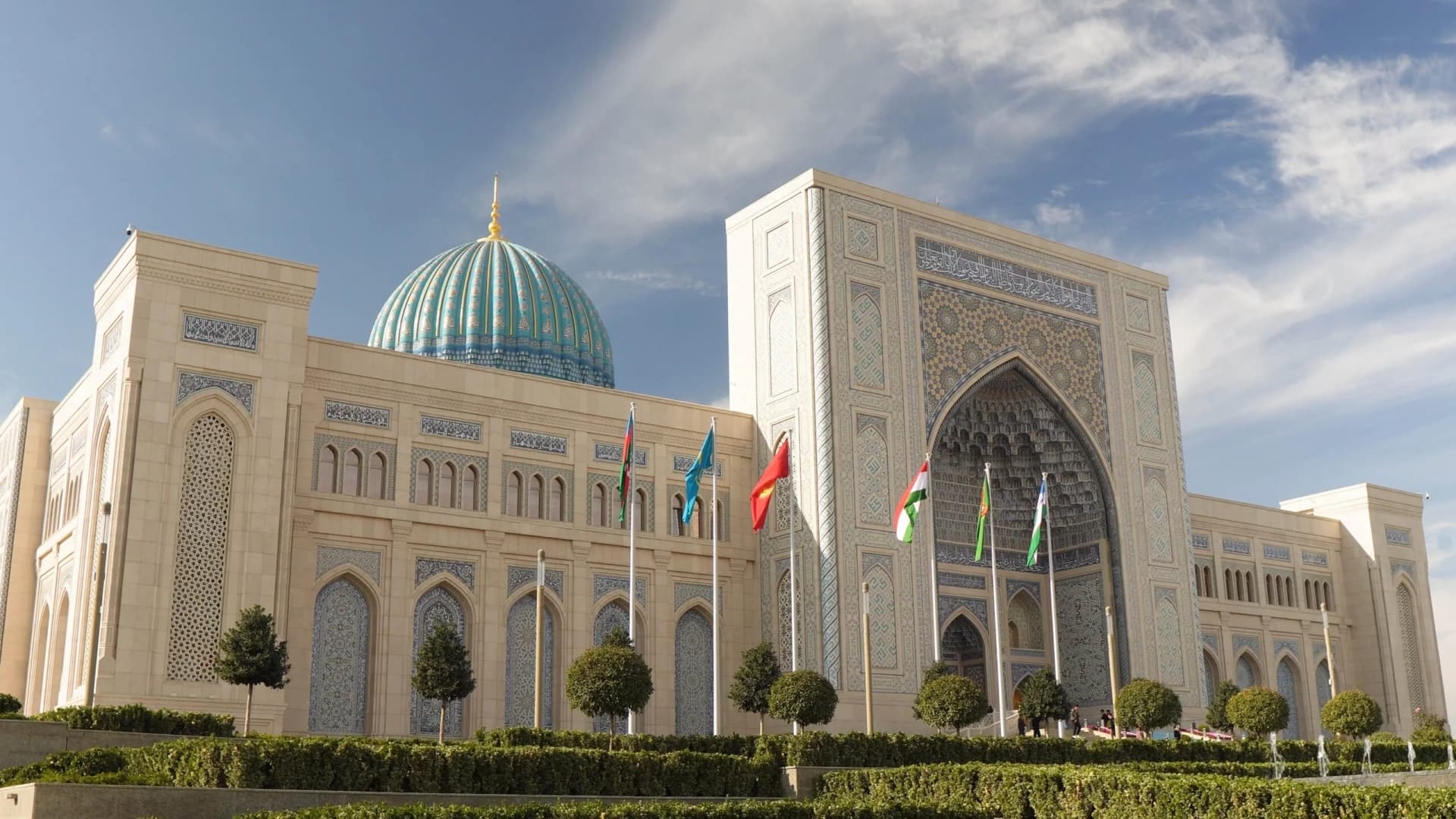


A study on book culture of the Timurid era discussed at the international academic and educational platform of the Islamic Civilization Center

During the meeting, a presentation and discussion were held on the dissertation entitled “The history and sources of Islamic book culture in the Timurid era”, prepared by the Center’s researcher Matluba Rakhmankulova for the degree of Doctor of Historical Sciences (DSc) in the specialty 24.00.01 — “Islamic History and Source Studies.”
This study is devoted to a comprehensive examination of the formation, development, and distinctive features of Islamic book arts and bookmaking traditions during the Timurid era. It analyzes the traditions of manuscript production and decoration, royal patronage, the activities of court libraries and bookmaking workshops, as well as the work of calligraphers, painters, illuminators, page designers, and bookbinders.
One of the key aspects of the research is a comparative study of the development of book culture in major cultural centers such as Samarkand, Herat, and Shiraz during the Timurid period, together with the scholarly and cultural interactions among them. Alongside identifying the distinctive characteristics of the bookmaking environments that emerged in these centers, the author also highlights the common Timurid traditions of book culture that connected them.
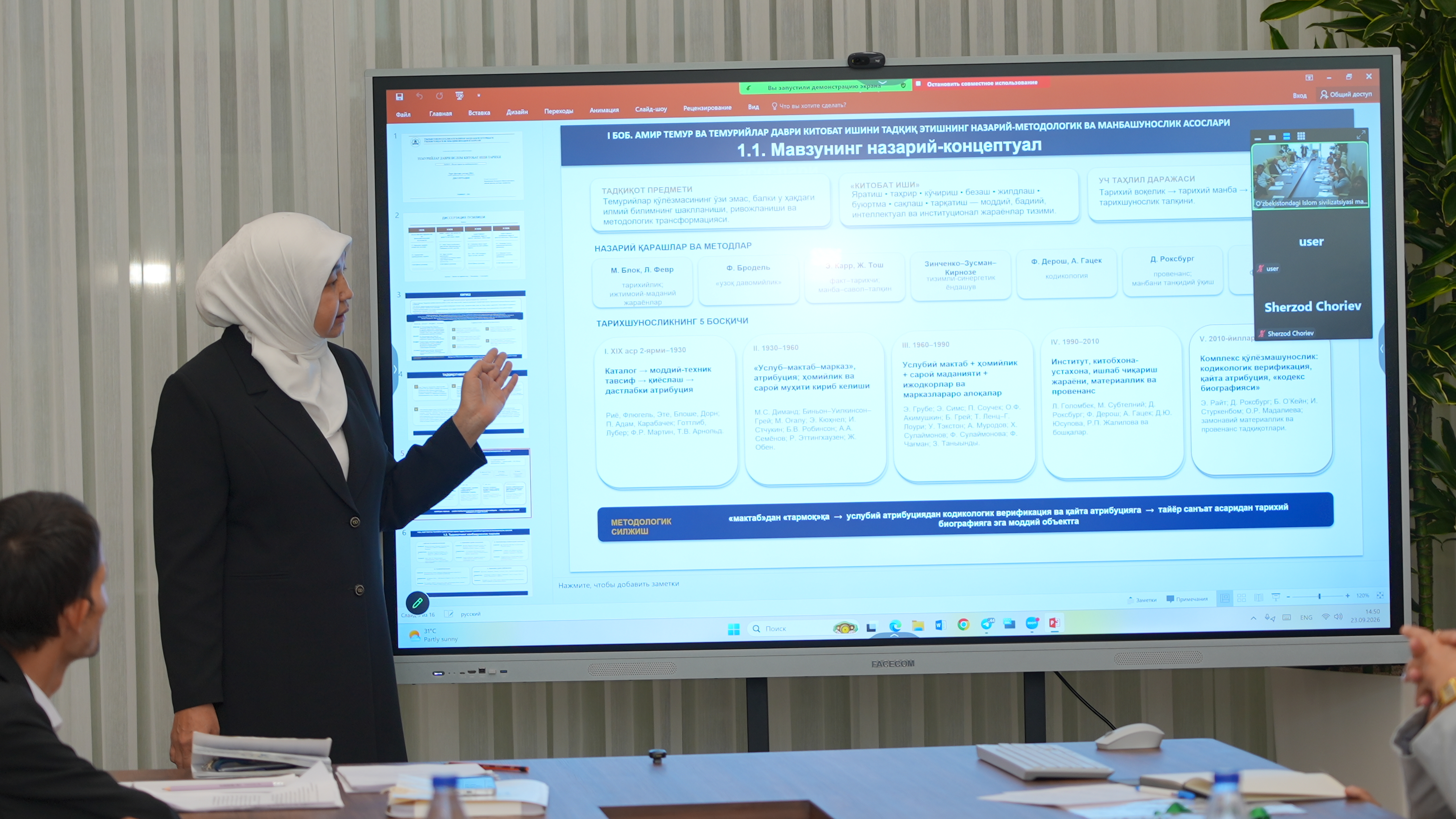
“In our dissertation, manuscripts are examined not merely as texts or works of art, but as important sources reflecting the socio-cultural environment of a particular historical period. Features such as colophons, seals and ownership notes, characteristics of handwriting, types of paper, decorative elements, the book block, and bindings are considered important tools of source studies for determining the history of their production, preservation, and subsequent provenance,” said researcher Matluba Rakhmankulova.
The study also pays particular attention to the role of Timurid rulers and princes in the development of book culture and bookmaking. In particular, manuscripts produced during the reigns of Sultan Husayn Mirza and Baysunghur Mirza, as well as the court libraries and bookmaking environments associated with them, are analyzed. The research demonstrates that royal patronage was one of the key factors in the development of systems for producing, decorating, and preserving books.
The study also provides a detailed account of stylistic changes and the enrichment of artistic traditions within the bookmaking environment of Herat. Particular attention is paid to the introduction of certain pictorial and decorative styles as a result of cultural exchanges among Eastern countries and to their integration with local traditions. Information relating to the activities of Ghiyath al-Din Naqqash, who traveled to China during the time of Baysunghur Mirza, is likewise analyzed from the perspective of these processes of cultural influence and creative adaptation.
The environment of book production and visual arts in Herat during the reign of Sultan Husayn Bayqara also constitutes one of the important areas of the research. The study examines the formation of an artistic milieu associated with renowned painters such as Kamaliddin Behzad, as well as the integration of calligraphy, illustration, ornamentation, and bookmaking in the process of manuscript production.
The analysis of the Shiraz bookmaking environment highlights such distinctive features as relatively small-format manuscripts, varied shapes of text panels, and the production of books intended for a broader readership. The bookmaking processes during the periods of Ibrahim Sultan and Iskandar Sultan, as well as the production of small-format collections and compendia, are also examined as characteristic features of this milieu.
During the discussion, it was emphasized that the study considers not only court bookmaking workshops but also book-production environments that served the market and the needs of a wider readership. This demonstrates that manuscript production during the Timurid period was not confined solely to royal courts, but that book culture developed in connection with different social strata.
The dissertation employs the principles of historicism, comparative and critical analysis, codicological approaches, and objectivity. In addition to scholarly literature published in Uzbekistan, the research draws on studies by foreign scholars, manuscript catalogues, and information on sources preserved in collections abroad.
The inclusion of foreign sources and scholarly studies is of particular significance. Many manuscripts dating from the Timurid period are currently preserved in libraries, museums, and manuscript collections in various countries. Therefore, foreign studies devoted to their scholarly description, cataloguing, and examination serve as important sources for reconstructing the history of book culture during this period.
The scholarly works of representatives of the local schools of source studies and historiography have also been extensively incorporated. These include A. A. Semyonov’s catalogues of Oriental manuscripts and his studies of the Herat school of book culture during the Timurid period, as well as the works of such scholars as Yusufova, Jalilova, Yuldoshev, Okhunjonov, and Fozila Sulaymonova, which have helped form the source-studies and historiographical foundation of the dissertation.
During the Academic Council discussion, questions were raised regarding the study’s source base and methodological approach, the relationship between the bookmaking environments of Samarkand, Herat, and Shiraz, the distinctive features of court and commercial book production, and the extent to which manuscripts themselves had been analyzed in the dissertation as primary sources.
In her responses to the questions raised, researcher Matluba Rakhmankulova provided detailed explanations of the dissertation’s main conclusions, the criteria used for selecting sources, and the characteristics of the manuscripts included within the scope of the study. In particular, it was noted that the research did not seek to cover all manuscripts produced during the Timurid period, but rather followed the principle of selecting sources associated with the patronage of Timurid rulers as the primary objects of scholarly analysis.
At the conclusion of the discussion, proposals and recommendations were made for further improving the dissertation and enriching certain scholarly conclusions and analyses.
This scholarly discussion represents one of the important areas of activity of the Islamic Civilization Center in Uzbekistan in supporting research on the history of Islamic civilization, studying manuscript and material heritage through modern academic approaches, and fostering an open environment for scholarly dialogue among researchers.
In this sense, the activities of the Center’s Academic Council extend beyond the discussion of individual dissertations. The Council is emerging as an academic and educational platform that contributes to reassessing the scholarly heritage related to the history and source studies of Islamic civilization, supporting new research, and bringing national and international academic experience together within a single intellectual space.