
A Majestic Symbol of the New Era (Величественный символ новой эпохи)
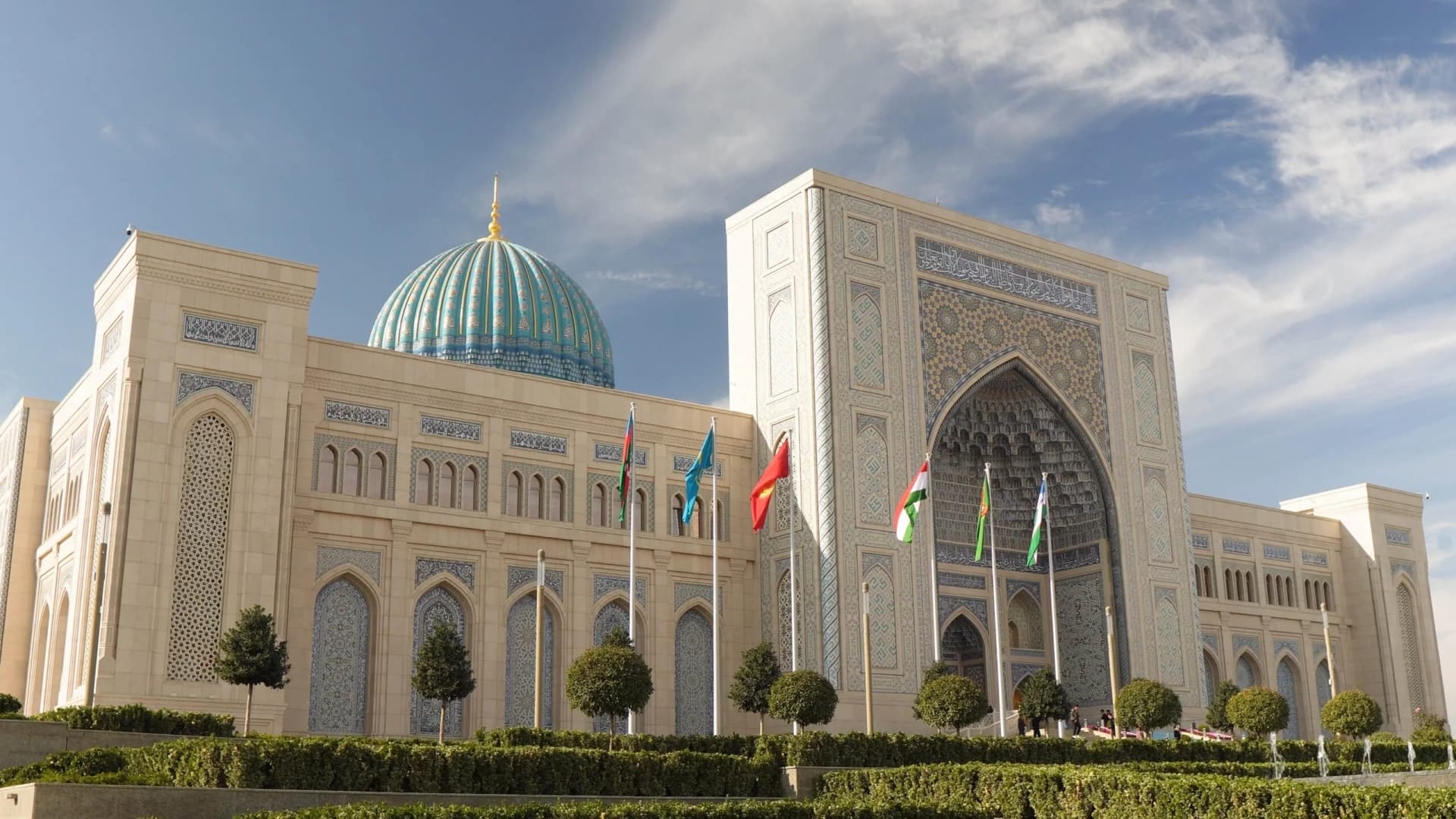
It should be emphasized that this visit was truly historic. Over the course of the past year, the construction of the Center’s building has been fully completed. To further enhance the Center’s activities and enrich its content, specialists and designers from more than 40 countries were engaged and mobilized in the implementation of this megaproject, which has been created based on the ideas and initiatives of the esteemed President.
In September 2025, the Head of State announced from the high rostrum of the United Nations that the construction of the Islamic Civilization Centerin Uzbekistan had been completed and that it would soon be put into operation. It is noteworthy that during this period the internal content of the Center was further enriched. As a result, the Center has become a unique landmark attracting the attention of the global community. Today, high-ranking guests from various parts of the world — including heads of states and governments, as well as leaders of international organizations — are closely familiarizing themselves with the Center’s activities and its scholarly projects dedicated to civilizations, historical figures, and discoveries. Prominent figures from around the world are openly acknowledging this reality.
Today, the world is undergoing a period of profound civilizational transformation. Technological progress is increasingly outpacing moral comprehension, while global crises — ranging from geopolitical confrontations to the erosion of cultural identity — are placing ever greater emphasis on humanity’s capacity for dialogue. At a time when religion is often instrumentalized as a tool of conflict and culture becomes a line of division, the need for new platforms capable of restoring the original, creative essence of civilizational dialogue is becoming increasingly urgent.
It is precisely at such a historic juncture that, in the very heart of Eurasia — on a land where great civilizations and empires once emerged, and where trade routes, religions, scientific schools, and cultures intersected for millennia — a unique new space has come into being: the Islamic Civilization Centerin Uzbekistan. Its establishment is neither accidental nor the product of populist ambition. Rather, it represents a direct expression of the strategic worldview of the President of the Republic of Uzbekistan, Shavkat Mirziyoyev.
In 2017, addressing the global community from the rostrum of the United Nations, the President called for restoring the true place of Islamic civilization in world history. He emphasized that at the heart of the sacred religion of Islam lie the values of enlightenment, science, and humanism, and stressed that extremism and ignorance can be overcome only through the power of knowledge and culture.
During his visit to the construction site of the Islamic Civilization Centerin Uzbekistan, the António Guterres, Secretary-General of the United Nations, gave high international recognition to this initiative, stating:
“Your President, Shavkat Mirziyoyev, is a great and influential leader who consistently promotes the ideas of dialogue, enlightenment, and mutual respect from the highest rostrum of the United Nations,” he stated.
These words reflect a truth that the international community has already come to recognize: under the leadership of Shavkat Mirziyoyev, Uzbekistan has ceased to be a peripheral observer of history and has instead emerged as one of its active architects.
In this context, the President’s address from the rostrum of the United Nations served as an intellectual and scholarly foundation for the Islamic Civilization Center in Uzbekistan — not merely as a monumental architectural complex, but as an entirely new humanitarian model of global significance. Within this model, Islam is presented through the prism of the history of great civilizations: civilizations within whose embrace scientific revolutions took place; where universities and academies, libraries and laboratories were established; where the foundations of medicine and philosophy, art and scientific inquiry were laid; and where the intellectual framework of the modern world was formed.
Thanks to the personal political will, strategic vision, and consistent leadership of the President of Uzbekistan, the idea of establishing the Islamic Civilization Center has been realized in a truly unprecedented format — unmatched in its scale, conceptual depth, and international relevance. A unique civilizational complex has been created, bringing together a next-generation museum, advanced research infrastructure, a state-of-the-art library, a national and international archival system covering the development of Central Asian civilizations, digital humanities technologies, and extensive networks of global scholarly and cultural cooperation.
The project has also received high praise from the President of the Republic of Kazakhstan, Kassym-Jomart Tokayev, who stated:
“This is a grand and unique complex. Indeed, it is a scholarly, tourist, and ethnocultural project. I fully agree with the view of the President of Uzbekistan: the Islamic Civilization Centerin Uzbekistan can become a common platform here in Tashkent for conducting highly important scientific and research activities.”
As international experts have noted, the Islamic Civilization Centerin Uzbekistan is not merely an infrastructure facility or a symbolic expression of cultural policy. Rather, it represents a conscious civilizational response by Uzbekistan’s leadership to the pressing challenges of the modern global era. For the first time in the history of the Islamic world, a project of such scale has been created as a truly global and permanently functioning platform for genuine dialogue between civilizations.
In essence, for the first time in its history, Uzbekistan has assumed a profound historical and spiritual mission: to confront the distortion and misrepresentation of Islam and Islamic civilization not through conventional rhetoric or declarative statements at international forums and conferences, but by creating a real, functioning intellectual space of global significance.
This idea was clearly articulated by the President of the Republic of Azerbaijan, Ilhom Aliyev, who emphasized:
“By visiting the Islamic Civilization Center in Uzbekistan, established at the initiative of the President of Uzbekistan, we once again witnessed the deep commitment of the country’s leadership to preserving and promoting the rich cultural and spiritual values of the Uzbek people. At a time when attacks against our religion are intensifying in some countries and Islamophobia is taking on a systemic character, the opening of the Islamic Civilization Centeris of particular significance. This Center clearly demonstrates to the entire world that Islam is a religion of creation, humanism, tolerance, friendship, and brotherhood.”
Experts and policymakers unanimously emphasize that this project has become a humanitarian shield against radicalism and the distortion of Islam’s image — a shield forged not through force, but through knowledge.
The process of reclaiming cultural heritage holds particular importance for the Center’s activities. Acting on the instructions of the President of the Republic of Uzbekistan, special state and diplomatic mechanisms were established, enabling the Center to develop systematic cooperation with the world’s leading auction houses — Sotheby’s, Christie’s, and Bonhams — as well as with major museum institutions and private collectors.
As a result, nearly two thousand rare artifacts have been returned to the country. Among them are manuscripts of Ibn Sina (Avicenna), works by Abu Rayhan al-Biruni, miniatures from the Timurid era, masterpieces of Islamic art, and many other invaluable relics that had been preserved outside the homeland for decades — and in some cases, for centuries.
This process represents not only the enrichment of the Center’s vast museum exhibitions, but also a tangible and practical expression of restoring Central Asia’s civilizational memory and reestablishing historical justice.
From this perspective, the President of the Republic of Paraguay, Santiago Peña, did not conceal his admiration while acquainting himself with the exhibitions of the Islamic Civilization Center in Uzbekistan, stating:
“My visit to the exhibitions of the Islamic Civilization Centerleft a very strong impression on me. Many scientific and cultural achievements that made an invaluable contribution to the development of human civilization first emerged precisely on this land. Unfortunately, not everyone in the world is aware that the earliest fundamental works in algebra, medicine, and other fields originated here. This visit inspired me and strengthened my confidence in Uzbekistan’s immense potential. The history of Uzbekistan is truly unique.”
These words stand as a recognition that, thanks to the policies of the New Uzbekistan, the country has once again begun to speak to the world in the authentic language of its own history.
According to experts and political leaders, the President of Uzbekistan is not limited to restoring the past and understanding the present, but is consistently and purposefully shaping the future. For this reason, the Islamic Civilization Center in Uzbekistan was conceived from the outset as a dynamically evolving system — an international scholarly platform, a media space, a publishing and educational hub. It is here that a new generation of Islamic studies, advanced museum technologies, and innovative directions in modern cultural diplomacy are taking shape.
Following his visit to the Center, the President of the Republic of Finland, Alexander Stubb, stated:
“To be honest, I found myself genuinely overwhelmed by unprecedented impressions here. Every exhibition, every hall, and every detail has been conceived with remarkable depth and precision. Conveying three thousand years of history to today’s generation in such a modern, powerful, and convincing format requires an exceptionally high level of artistry and great mastery. This Center has not only revived and reinterpreted the heritage of past centuries, but has also become a source of inspiration for future generations. The interactive exhibitions and innovative technologies are particularly striking — they truly engage young people. Here, history is not simply studied; it is felt. In such an environment, it is impossible to remain indifferent or bored. Every scene, every lighting accent, and every detail carries its own meaning and artistic logic. I am leaving this Center with sincere gratitude, deep respect, and a profound sense of admiration.”
Today, the Islamic Civilization Center in Uzbekistan is increasingly emerging as an intellectual hub taking shape step by step for the modern world. Much as the Bayt al-Hikma in Baghdad, the Ma'mun Academy of Khwarazm, and the Ulugh Beg Madrasah in Samarkand once played a decisive role in their respective eras, the Center is assuming a comparable significance today. It is not merely a place where knowledge is preserved and accumulated, but a space that transmits the very environment in which the intellectual and spiritual trajectory of civilizations is shaped.
At the same time, in the present historical moment, the mission of the Center encompasses far broader and more ambitious objectives. Whereas in earlier epochs such scholarly institutions developed within the confines of their time and culture, and ideas spread slowly over centuries through manuscripts, translations, and successive generations, today the Islamic Civilization Center has been envisioned by the President of Uzbekistan from its very inception as an open, global educational and cultural-humanitarian megaplatform.
The Islamic Civilization Center in Uzbekistan represents a new type of civilizational institution for the twenty-first century. Here, historical knowledge is integrated with digital technologies; manuscripts are transformed into global digital resources; the museum acquires the character of a research laboratory; and national heritage becomes a universal measure of international dialogue, mutual understanding, and creative cooperation.
It is fitting to conclude this article with the words of the President of the Republic of Serbia, Aleksandar Vučić, who stated:
“I have never seen a center like this anywhere before. The Islamic Civilization Center has been built and created in an exceptionally modern and beautiful style. Today, I learned a great deal, and I will certainly return here again. To all my fellow citizens of Serbia, I would say this: My dear friends, I have made a great mistake by never having visited this country before. Please come and see Uzbekistan as soon as possible.”
Firdavs Abdukhalikov
Director of the Islamic Civilization Center in Uzbekistan