



The rebirth and global dissemination of a great discovery through al-Khwarizmi
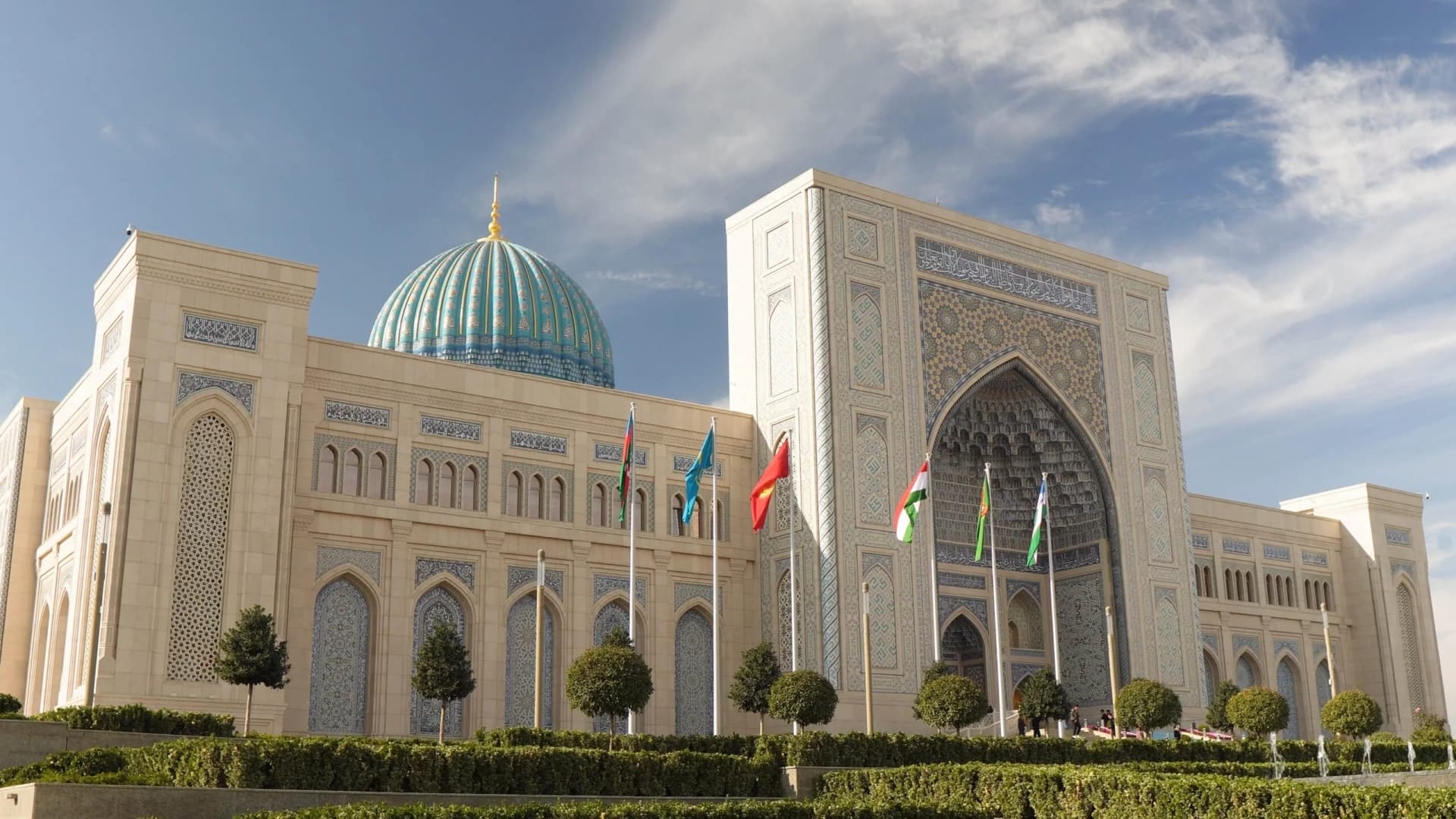
Today, these ideas are being confirmed in practice. The Islamic Civilization Center in Uzbekistan, which opened its doors on the eve of Ramadan Eid, has in a short time attracted public attention and become an important destination drawing visitors from both our country and abroad.
Built on the initiative of Shavkat Mirziyoyev, this Center serves as a conceptual space that fosters an understanding of national identity, a sense of continuity in scientific thought, and its interpretation in a modern context.
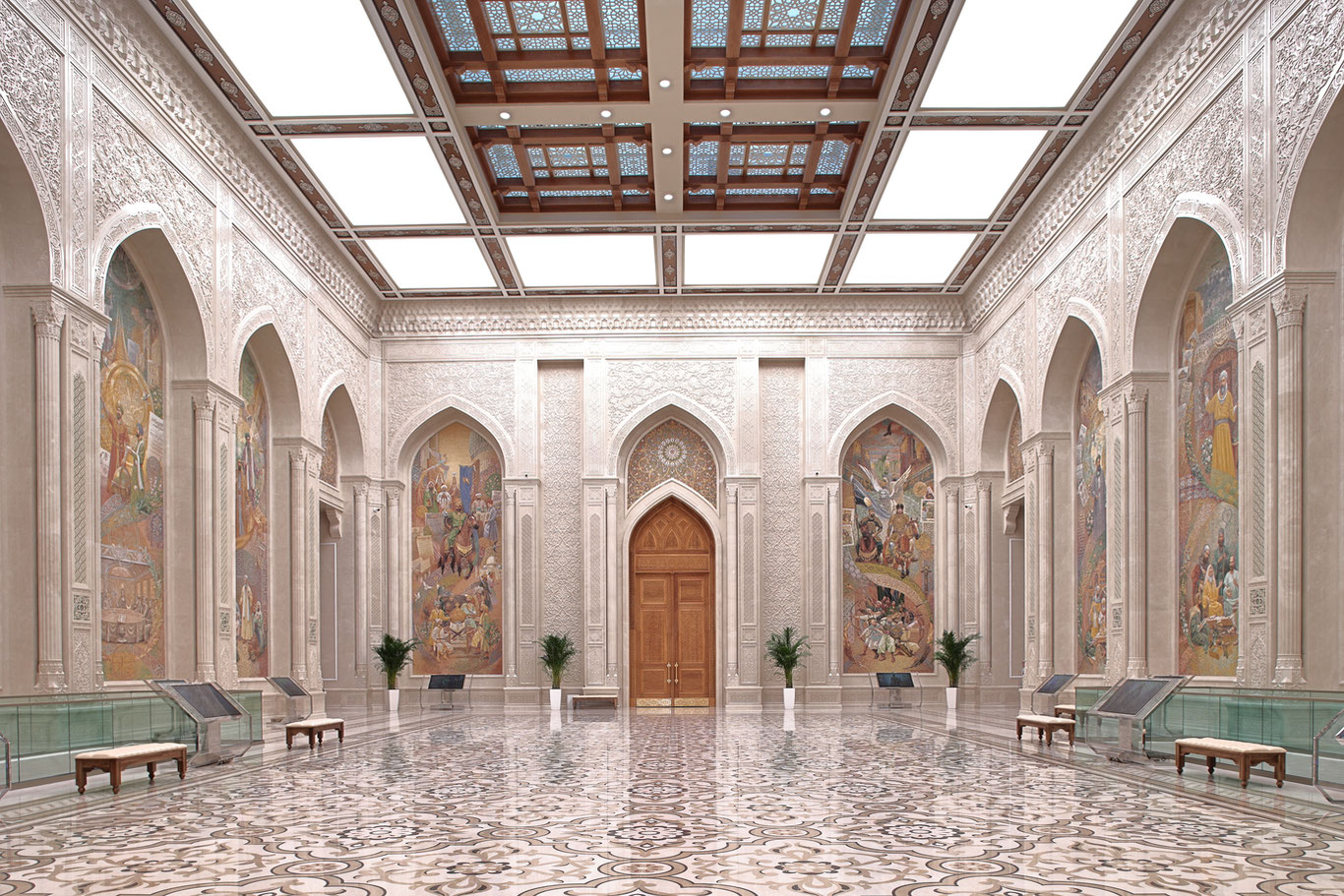 The Gallery of Great Figures, located in the entrance foyer of the Center, is the most vivid artistic expression of this idea. Through a grand composition consisting of 14 arches, scholars and historical periods that made unparalleled contributions to the development of humanity are presented in a logical sequence and high artistic harmony.
Thus, the Islamic Civilization Center in Uzbekistan, established on the basis of such a noble goal, is not only a place that preserves historical heritage but also a conceptual space reflecting the continuity of national identity and scientific thought. The Gallery of Great Figures at the entrance embodies this concept artistically. Through its monumental 14-arch composition, it highlights scholars and epochs that contributed immensely to human civilization in both logical coherence and artistic unity.
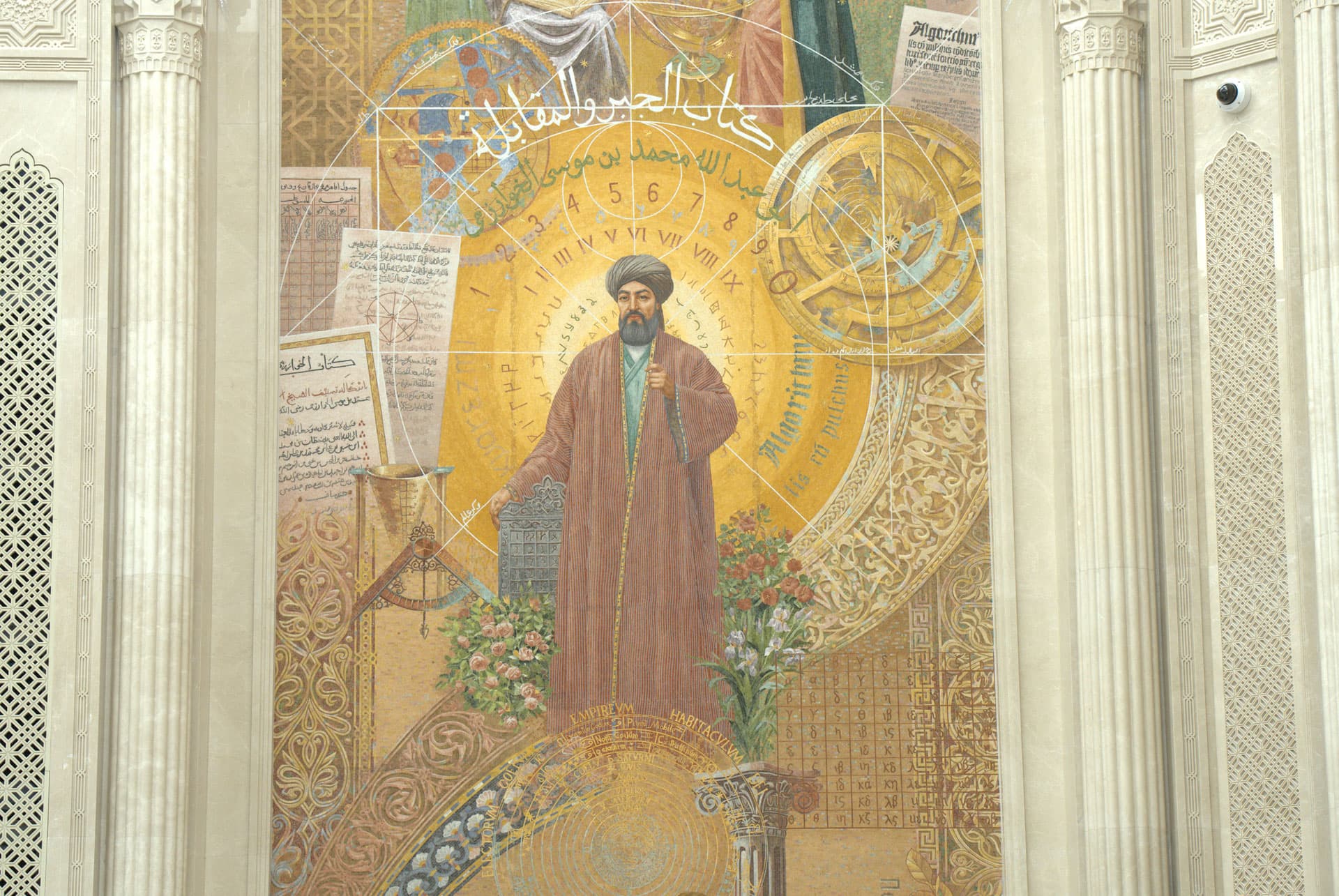
.jpg) One of the arches in the gallery is dedicated to Muhammad ibn Musa al-Khwarizmi (780–850), a great encyclopedic scholar and the first director of the “Bayt al-Hikma” (“House of Wisdom”) in Baghdad, one of the most prominent scientific centers of the 9th century.
One of the arches in the gallery is dedicated to Muhammad ibn Musa al-Khwarizmi (780–850), a great encyclopedic scholar and the first director of the “Bayt al-Hikma” (“House of Wisdom”) in Baghdad, one of the most prominent scientific centers of the 9th century.
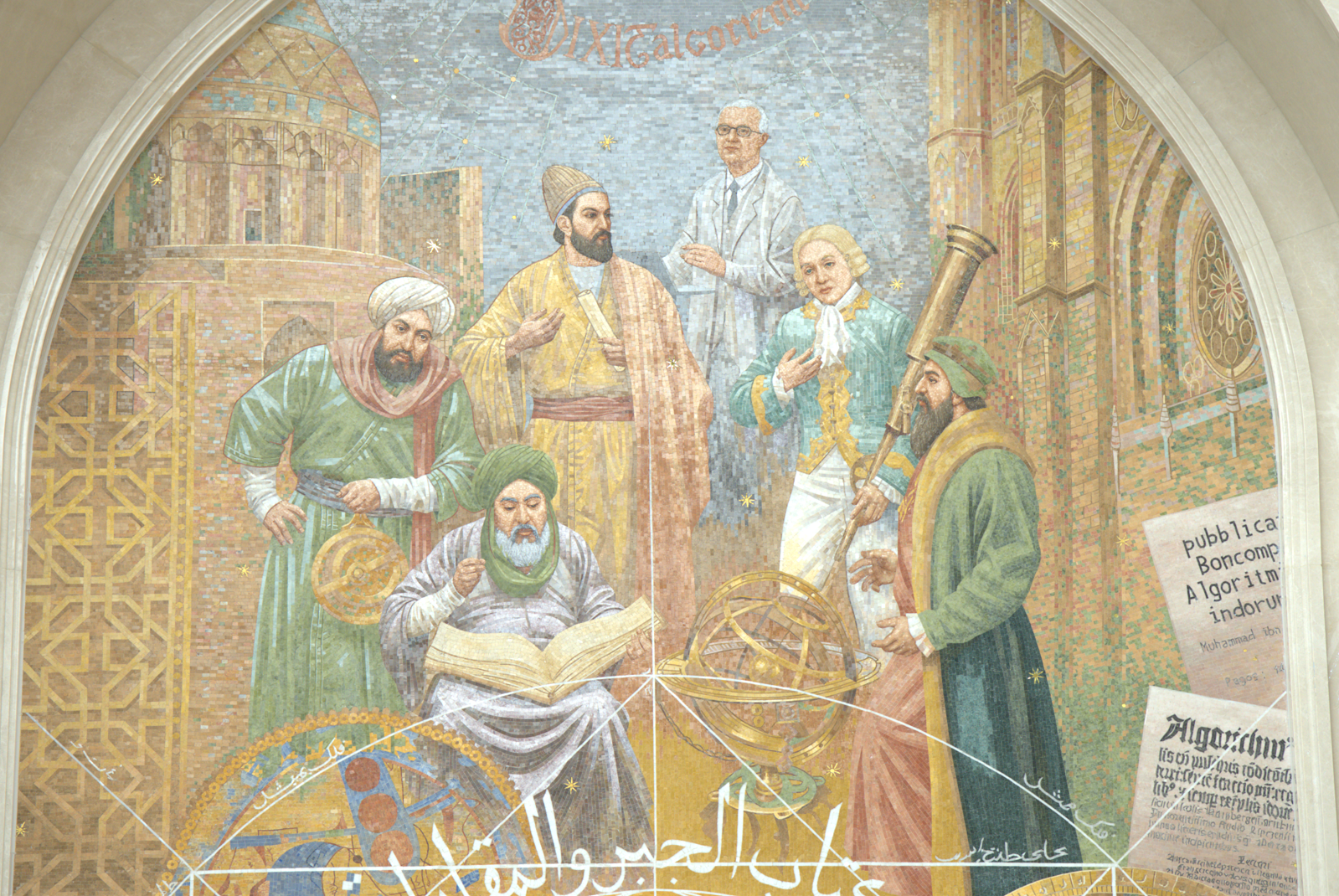
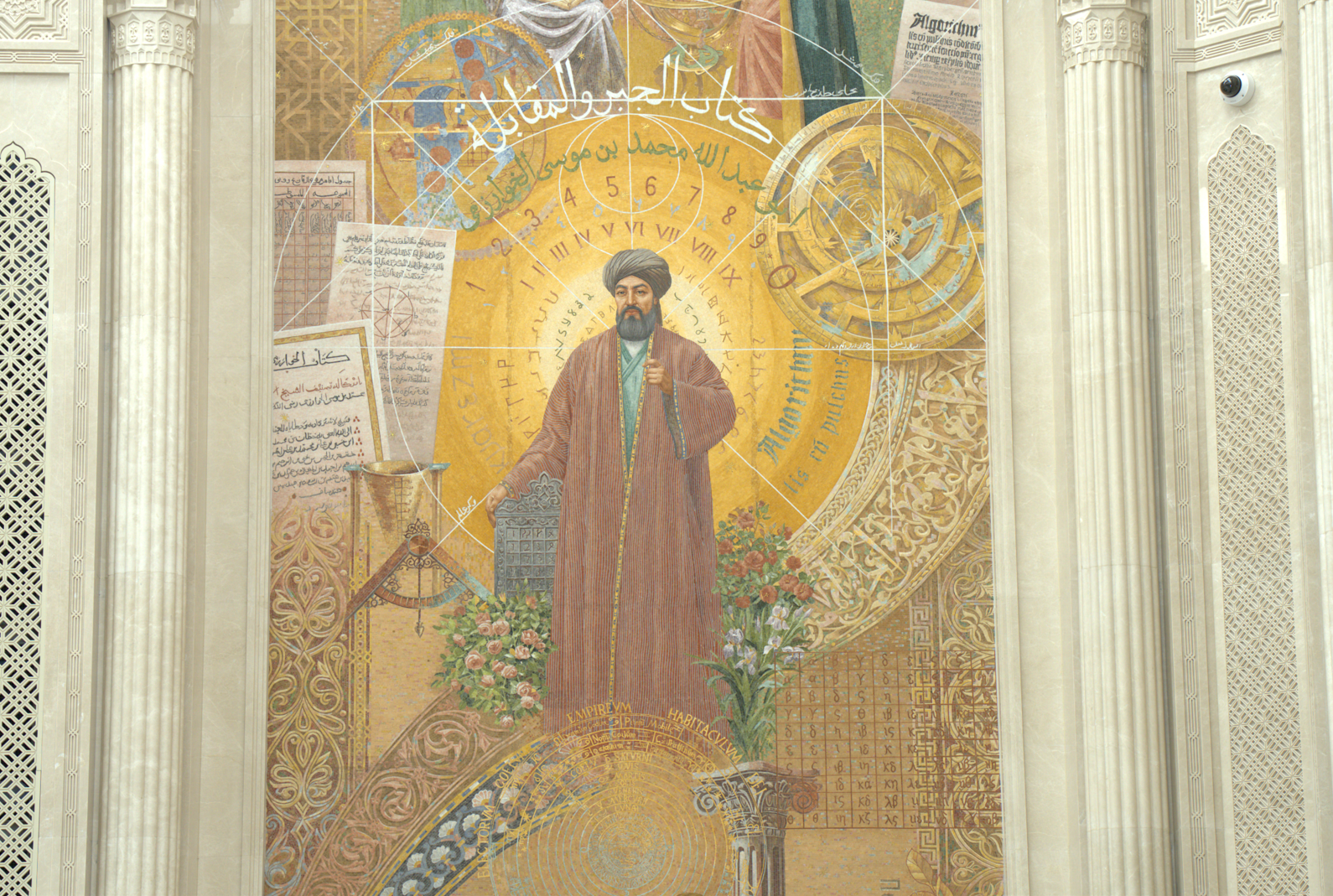 In the upper part of the artwork, scholars of Bayt al-Hikma are symbolically depicted, while the central composition features the main figure — al-Khwarizmi himself. At the center of the panel, his foundational work in algebra, “Kitab al-jabr wa al-muqabala” (“The Compendious Book on Completion and Balancing”), is illustrated.
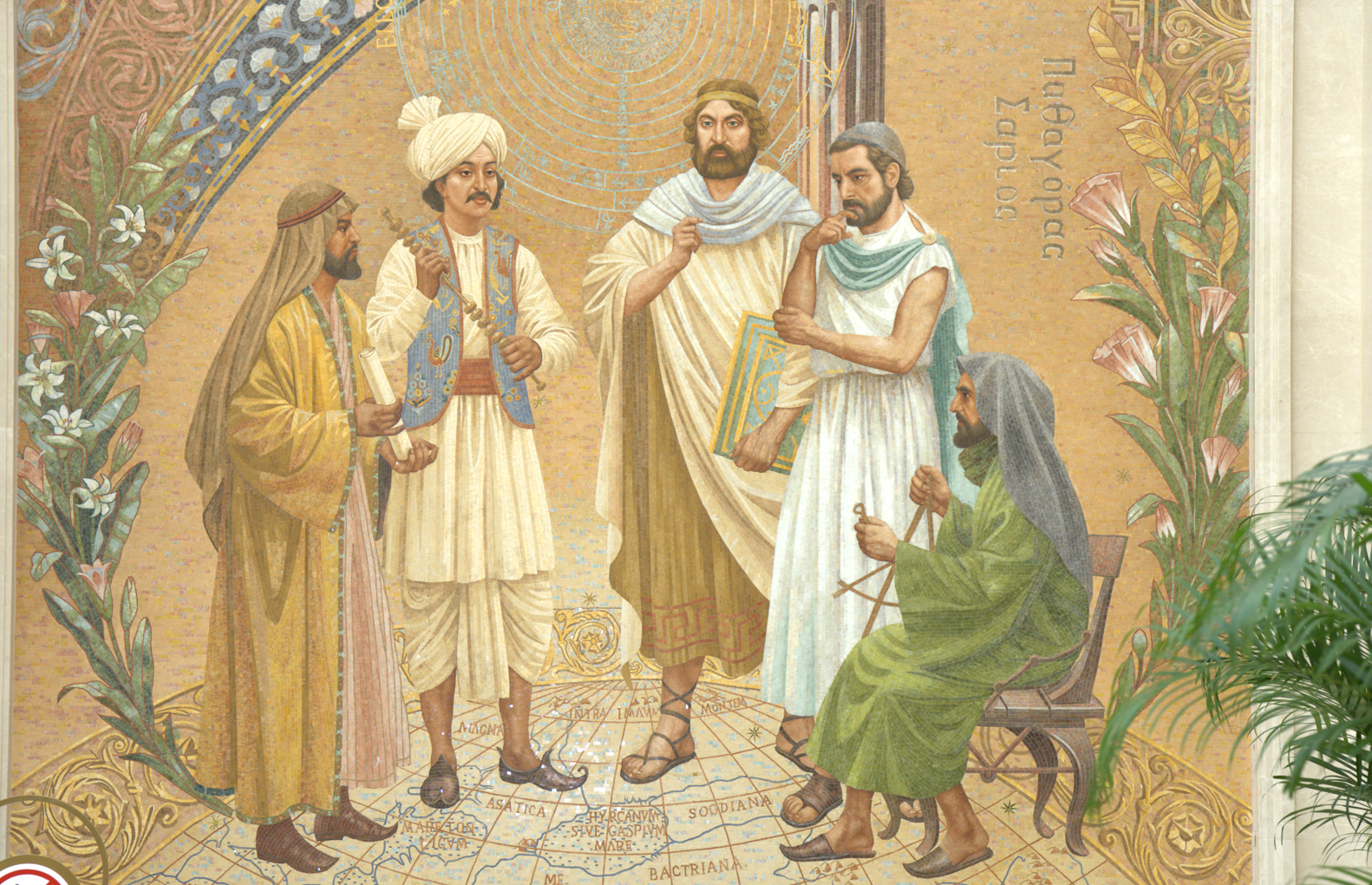 In addition, one of his greatest discoveries described in his arithmetic work “The Book on Calculation with Hindu Numerals”—the decimal positional number system — is symbolically visualized. The lower part of the composition depicts Roman numerals and various counting symbols used by different peoples in ancient times.
Following the translation of “Kitab al-jabr wa al-muqabala” into Latin in the mid-12th century, the decimal positional system spread widely throughout Europe and then across the world. The Latin translation begins with the phrase “Dixit Algorizmi” (“Thus spoke al-Khwarizmi”). It was only in the first half of the 19th century that it became known that the word “algorizmi” referred to the name of Muhammad ibn Musa al-Khwarizmi. This term later evolved into “algorithm,” denoting any systematic computational process, and today forms the foundation of modern information technologies.
Al-Khwarizmi’s other scientific achievements are also artistically interpreted within the composition. In particular, symbolic representations illustrate the motion of the Sun and Moon, the planetary system, and trigonometric functions described in his Zij. This work served as an essential methodological foundation for astronomical treatises produced over the following six centuries and was later commented upon by prominent scholars such as Ahmad al-Farghani and Abu Rayhan al-Biruni. After its translation into Latin in 1126, it also deeply influenced the European scientific environment. The trigonometric functions presented in the work came to be known in Latin as “sinus” and “cosinus,” becoming integral mathematical terms in global science.
Al-Khwarizmi’s “al-Kharita al-Ma’muniya” (“The Ma’mun Map”) is among the earliest medieval maps depicting the inhabited quarter of the Earth. This map was created in color on the wall of the palace of Caliph al-Ma’mun (813–833). Detailed information about the map is provided in his work “Kitab surat al-ard” (“The Book of the Description of the Earth”), which includes precise coordinates of more than 2,400 geographical locations — an unprecedented scientific achievement for its time. The work also contains one of the earliest descriptions of the “al-Bahr al-Muzallam” (“The Dark Sea”), referring to the Pacific Ocean. Moreover, information about the Korean Peninsula, the Japanese islands, and their river systems is also reflected in the map.
The most important scientific aspect of this map lies in its correction of a fundamental error in the cartographic model established by the 2nd-century Greek scholar Claudius Ptolemy. While Ptolemy’s theory proposed that land surrounded the world ocean, al-Khwarizmi demonstrated the opposite — that the world ocean forms a unified body surrounding the land. In doing so, he advanced the correct concept of a unified world ocean. This approach marked a turning point in the history of cartography and became a crucial methodological foundation for the development of the field in subsequent centuries. It opened the way for scientific reasoning about unknown regions of the Earth and paved the path for new geographical discoveries.
The monumental painting dedicated to Muhammad al-Khwarizmi also incorporates other significant inventions of the scholar, including the water clock.
Zohidulla Munavvarov, Chief Researcher at the Islamic Civilization Center:
The artwork prominently features the Tekesh Fortress in ancient Urgench, where the scholar was born and raised. The composition is further enriched with figures representing various civilizations that served as sources of his scientific inspiration — Arab, Indian, Greek, Assyrian, and Persian scholars.
To enhance the artistic expressiveness of the panel, elements characteristic of the scholar’s era have been skillfully incorporated, including architectural monuments, intricate patterns and ornaments, the astrolabe and other scientific instruments he used, as well as examples of calligraphy based on Arabic script.
Shahnoza Rahmonova
P/S: The article may be republished with a reference link to the Center’s official website